

What's The Difference Between The Ford Maverick's 2.5-Liter PowerBoost And 2.0-Liter EcoBoost Engines?
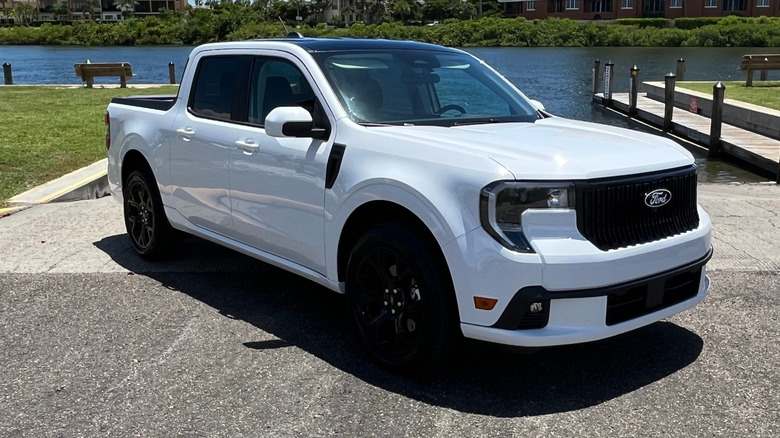
Ford's bread and butter is pickup trucks. The company offers a range of sizes to fit any job, from the massive F-750 commercial chassis cab to the massively-popular F-150, as well as the small-yet-practical Maverick. That Maverick is the newest truck in the Ford lineup, and it targets small business owners, DIY-ers, and anyone else who needs a practical and affordable utility. For those interested in the truck, there are two different power train options: A 2.0-liter EcoBoost and a 2.5-liter PowerBoost. Despite their similar names, they are "boosted" in very different ways.
EcoBoost has long been the name of Ford's turbocharged engine options. It first debuted in the form of the 3.5-liter EcoBoost V6, which was introduced in the 2011 Ford F-150. The one in the Maverick is smaller, but it's still quite potent. The turbocharged inline four-cylinder EcoBoost in the Maverick makes 250 horsepower and 277 pound-feet of torque. It's paired with an eight-speed automatic transmission in every version but the Lobo, which has a seven-speed automatic. The most fuel-efficient version of the truck with EcoBoost — the front-wheel drive XL — gets 23 miles per gallon in the city, 30 on the highway, and 26 combined.
The PowerBoost first appeared on the Ford F-150 in 2021, denoting its hybrid status. Until recently, Ford simply called the power train a hybrid and didn't give it trademarked branding. It's a 2.5-liter Atkinson-Cycle inline four-cylinder that makes 191 horsepower and 155 pound-feet of torque, and it has a continuously-variable transmission. In the base front-wheel drive version, the truck is rated for 42 miles per gallon in the city, 35 on the highway, and 38 combined.
Different engines for different tastes
The EcoBoost's operation is pretty simple. It's a traditional internal combustion engine, but the exhaust gases are fed through a turbine that spins an air pump. It's used to increase the amount of air pressure entering the engine's intake, thus increasing overall horsepower. Turbocharging is a popular way to make more power out of smaller engines, and those smaller engines help automakers meet emissions targets.
On the other hand, the PowerBoost is a naturally-aspirated four-cylinder engine that utilizes an electric motor to help assist with acceleration. In some cases, the electric motor itself can drive the truck without the gas engine running at all. This type of hybrid has no plug for the truck's built-in battery pack, and it recharges that battery in several different ways when the vehicle is in motion. The primary method is through regenerative braking, which recoups the energy lost during braking and sends it back to the battery. This type of hybrid is one of several different hybrid technologies currently available, but it's the only one you can get on the Maverick.
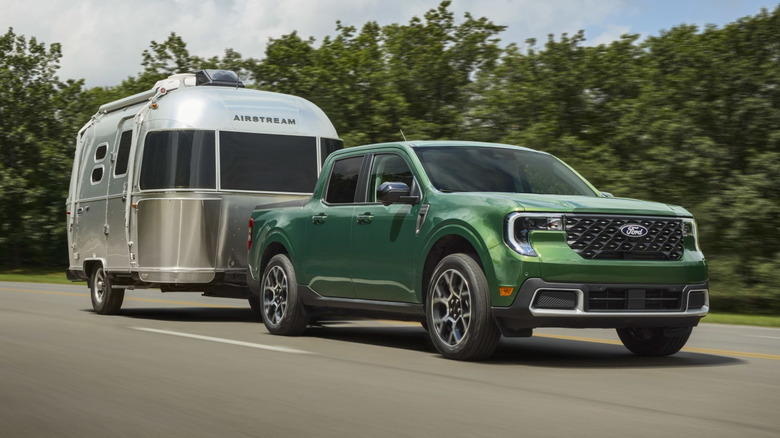
Both power trains can be ordered with the 4K Tow Package, which raises the maximum tow rating to 4,000 pounds. Both can also be equipped with all-wheel drive. Which engine you get mostly comes down to personal preference and overall performance. The fuel economy is hard to beat on the PowerBoost, but if you want the most grunt, you'll want the EcoBoost.