

What's The Biggest Difference Between Ford's Coyote And GM's LS Engines?
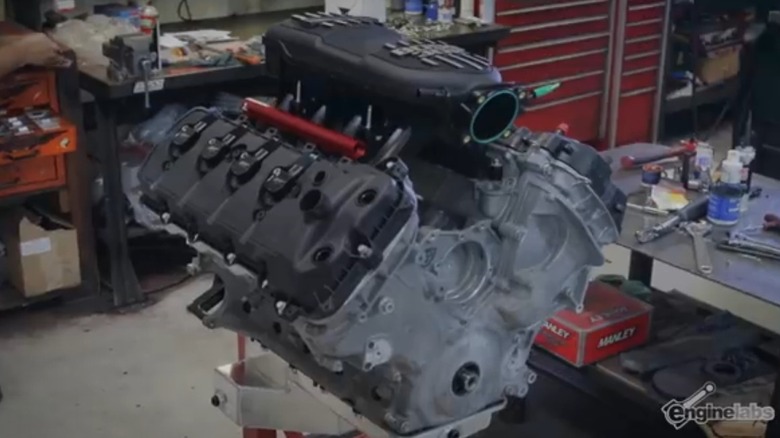
If you're looking for an alternative to the boring Chevy LS engine swap, you might be wondering about the differences between it and Ford's Coyote engine. While you can still buy these V8 engines in naturally aspirated form or opt for supercharged versions, the biggest design difference between the Ford Coyote and General Motors' LS engines, besides their respective badging, is their valve train designs.
The LS engine features the tried-and-true camshaft-in-block pushrod-activated overhead-valve design common to other small-block Chevy engines over many generations. On the other hand, the Ford Coyote engine uses a dual-overhead-camshaft arrangement to open its intake and exhaust valves. The biggest difference between the two engines from a swap perspective is their size. The Ford Coyote engine, with its expansive valve covers housing the DOHC valve train, is about six inches wider than a GM small block LS engine.
The LS engine spans much of the third- and fourth-generation GM small-block family tree. It covers generally-recognized displacements including 5.3, 5.7, 6.0, 6.2, and 7.0 liters, and they have simple names like LS1, LS2, LS3, LS4, LS6, LS7, LS9, and LSA. The Ford Coyote engine's family tree isn't much simpler despite being relatively younger. There are four Coyote generations and six distinct variations, with displacements ranging from 4.95 to 5.2 liters. Ford Coyote engine variants include names like Roadrunner, Voodoo, Aluminator, Predator, and Dark Horse.
Coyote vs. LS crate engine specs
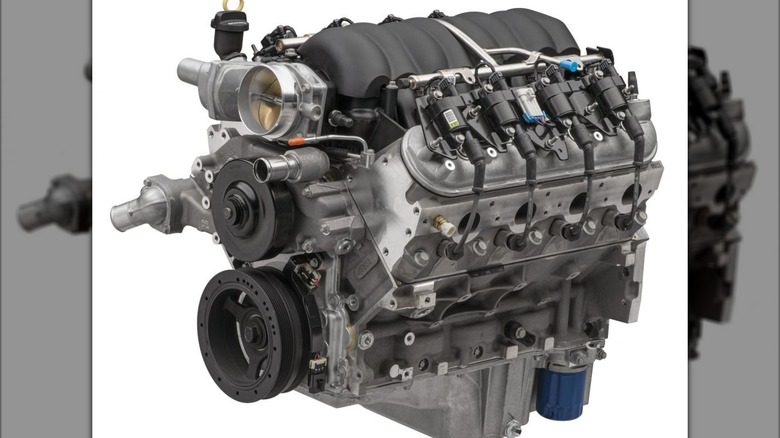
Of all the Coyote engine generations to consider for an engine swap, one option from Ford Performance Parts is a fourth-gen 5.0L Mustang Crate Engine with an included flywheel priced at $12,650.00. This particular crate engine is modeled after the engine that came in the 2024 Mustang GT. Like other Coyote engines, this model features four valves per cylinder, dual overhead camshafts with independent variable camshaft timing, and direct and port fuel injection with dual throttle bodies. The aluminum cylinder heads and 12.0:1 compression ratio contribute to the crate engine's 480 horsepower and 415 pound-feet of torque.
For comparison, Chevrolet still makes the Gen4 6.2L LS3, which it sells through GM Performance with a suggested retail price of $12,608.00. The cast aluminum block and heads house a nodular iron crankshaft, powdered metal connecting rods, and hypereutectic aluminum pistons designed to produce a 10.7:1 compression ratio. Ultimately, the 376 cubic-inch LS3 makes 430 horsepower and 425 pound-feet of torque.
The most powerful LS engine is the supercharged LS9 powering the C6 Corvette. It delivers 638 horsepower and 604 pound-feet of torque. For comparison, the top-tier Coyote engine is a supercharged version of the 5.2L fourth-gen Coyote found in the Mustang GTD. That engine is capable of producing up to 815 horsepower and 664 pound-feet of torque.