

Is It Safe To Use Two Different Tire Brands For One Car?
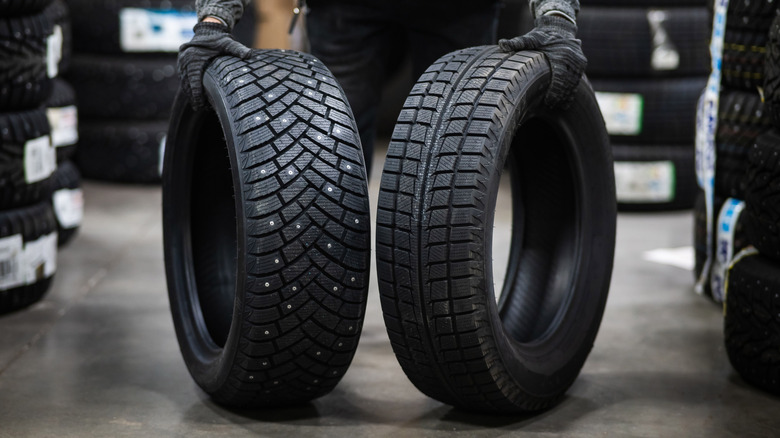
Tires are the only point of contact between a car and the road, meaning that no matter how dynamic, safe, or comfortable a car may be, every input has to be communicated to the road through the tires. Given their importance and ubiquitousness, the world of car tires is filled with countless brands, some more premium than others. To ensure every input gets translated to the road as effectively as possible, using four tires from the same brand is ideal.
Still, is it safe to use two different tire brands on one car? According to leading brands like Michelin and Continental, mixing tire brands is generally not recommended. When all four tires share the same characteristics, the car responds more evenly and remains easier to control and manage, especially in challenging conditions. However, what if mixing is the only choice? In that case, both manufacturers advocate for installing matching tires onto the rear axle.
While the same tire brand is indeed part of a safer and more cohesive driving experience, the type of tire, its size, load index, and speed rating are even more important. Also, keep in mind that replacing just a single tire is strongly discouraged since it can negatively affect traction, suspension components, transmission, and tread wear. The general idea behind this no-no is fairly similar to why your AWD vehicle needs matching tires.
How to mix tires without screwing it up

Tires on the same axle should have similar (at the very least) tread depths and tread designs. The front tires are designed to steer the car, and having two different tires on the front axle would be like having two different shoes on. When you have to change direction, especially quickly, the differences in how those tires manage traction can cause uneven grip. Having uneven tire wear on one side of your vehicle or the other can also lead to blowouts.
If you run high-performance tires like the Michelin Pilot Sport series and need to replace only two tires, the new tires should offer similar performance and tread depths. Models like the Pirelli P Zero Run Flats (8/32") and Goodyear Eagle F1 Asymmetric 6 (8/32") come to mind — though each tire may have different tread depths based on its specific size. Regardless of which specific performance tire you choose, experts recommend keeping single axle tread depth differences within 2/32" of each other.
Load index ratings also need to be similar to properly support the weight of your vehicle. And, the new tires you get will need to match the speed rating of the tires you already have. To get the most out of your tires, rotating them at the proper mileage intervals is essential. Proper rotation becomes even more important with tires that have different tread depths in the front and rear. It helps equalize uneven wear and brings those tread differences closer to each other over time.
Tire-mixing red flags you shouldn't ignore
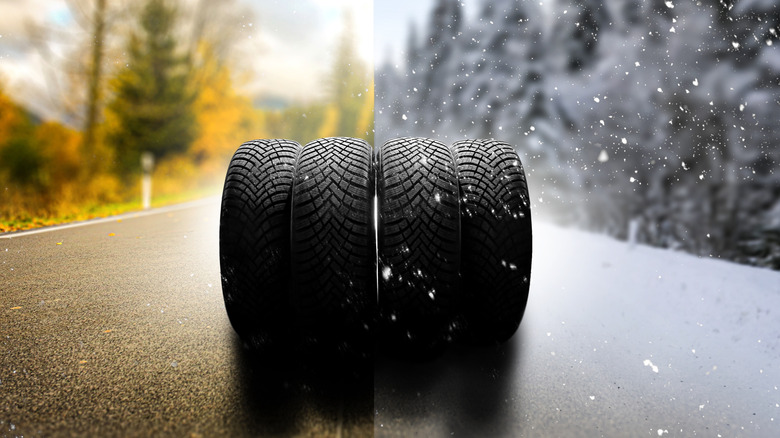
You should never mix different tire sizes on the same axle, run-flat and standard tires on the same car, radial and non-radial tires, or different season tires (e.g., winter and summer tires). If you do, there's a strong likelihood of creating mismatched rolling diameters, and if the sizes differ by a large degree, it can create serious vehicle safety and drivetrain issues.
Run-flat tires are designed with reinforced sidewalls. This means that they are stiffer than standard tires and that they can wear out more quickly, resulting in uneven wear when they're on the same vehicle as non-run-flats. The problem with mixing radial and non-radial tires has to do with different flex characteristics. Radial tires use cords that run perpendicular to the tread, while non-radial (bias-ply) tires have cords at a diagonal angle. When run together, you are relying on two completely different motion characteristics, which can result in loss of traction at one of the two axles.
While all-season tires are compromised for extreme cases like ultra-cold weather, they're useful for most drivers in many scenarios. But if you've found the need to use summer and winter tires in different seasons, it's important that you don't mix the two. It can mess with your vehicle's handling characteristics, the tires can wear differently over time (leading to different sizes), and in some places, like Colorado, driving with summer tires during active winter traction laws can result in a fine.