

Forget Diesel, Europe Was Wild About Wood-Powered Cars During WWII
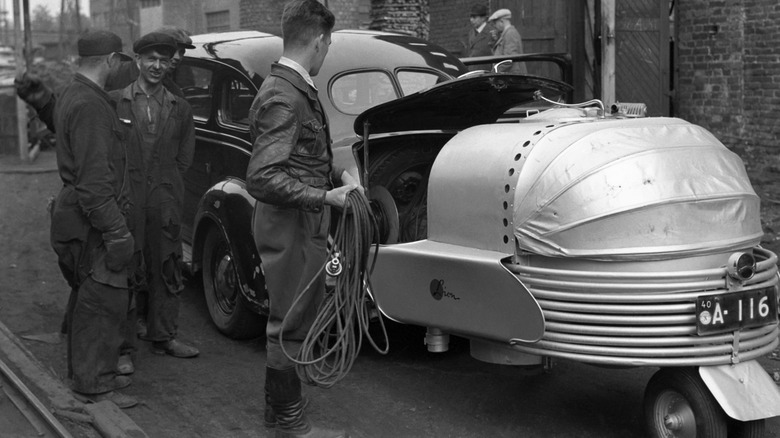
Over a century ago, people figured out how to make cars run on honest-to-goodness "wood gas," also known as also known as "producer gas," which is produced by heating up wood or coal to between 1,650 and 2,200 degrees Fahrenheit. Converting cars to run on wood gas was a real trend, especially in Europe during World War II thanks to a limited supply of gasoline. In Germany alone, there were an estimated 500,000 wood gas-powered vehicles on the road by 1945, and this unique fuel also helped drivers in occupied France to motor around. To be clear, this is not a Stanley Steamer situation where heated water drives a steam engine. The gases coming from the wood are fueling an internal combustion engine that requires shockingly few modifications to run on not-gasoline.
But powering a car with wood gas isn't as simple as chucking firewood into the gas tank and hoping for the best. The necessary generator systems, also called "gasifiers," rely on a stove, a filter, and a cooler attached to the outside of a car or the inside of a trailer, plus piping to bring the gases to the engine. Given the time period and the industrial-looking apparati, the resulting gaggle of conduit-festooned vintage vehicles looked as if they were taking part in a steampunk "Mad Max" prequel.
How and why wood gas-powered cars even exist
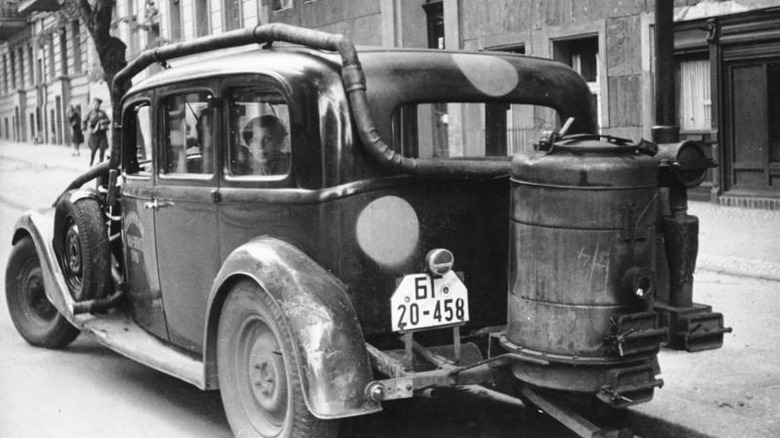
Belgian chemist Jan Baptista Van Helmont discovered in 1609 that heating wood or coal releases usable gas. By 1791, a patent issued to English inventor John Barber described a gas-driven turbine that could have possibly given us "horseless carriages" nearly 100 years before the Benz Patent-Motorwagen. In 1861, Wilhelm Siemens patented an open-hearth furnace heated by coal gas. And then, in 1878, Joseph Emerson Dowson attempted to run a three-horsepower Otto-cycle engine on producer gas.
The dream became reality in 1884 as B.H. Thwaite successfully powered a 15 horsepower engine using blast furnace gases. Following this, J.W. Parker drove a producer gas car over 1,000 miles in 1901. 1905 saw English carmaker Thornycroft try its hand at bespoke vehicles running on producer gas, and 1920 was when French engineer Georges Imbert created his "Imbert generator" that could be retrofitted to existing vehicles. It produced enough gas from wood chips to power an engine, and in 1931, it entered mass production. This was the catalyst that caused producer gas to explode — in popularity, that is.
The timing of the Imbert generator's debut was fortuitous for Europeans with World War II just around the corner. When the war reached full swing, fuel resources became nearly nonexistent. America and Canada even had to rely on cooking oil for lubrication, as from-the-earth oil was needed for the war effort. Everything received the wood gas treatment, including trucks, boats, trains, tanks, and motorcycles. Germany even established a network of fueling stations to provide firewood for gasifier cars. But after the war, when liquid fuels were back to being plentiful, wood gas power all but disappeared (except in North Korean gasifier trucks, anyway).
The legacy (and scary parts) of wood gas cars
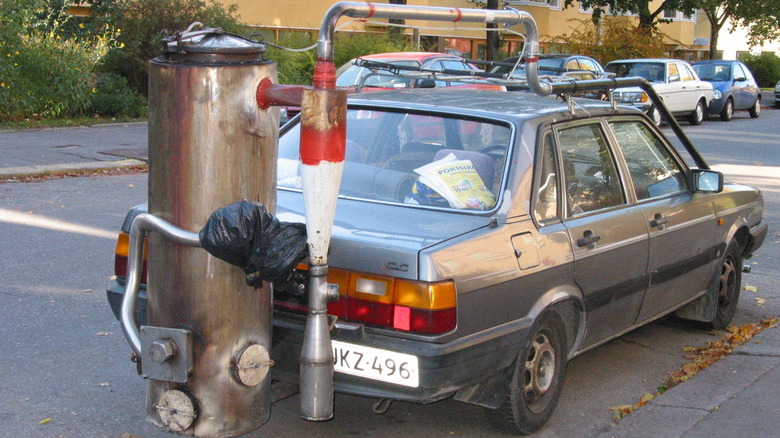
Though the Swedish government (along with Volvo) researched producer gas in 1957 as an alternative in the event of an oil shortage, producer gas cars are exclusively a hobbyist endeavor, and they aren't for the faint of heart. Here's a short rundown of how the process works from former Finnish Prime Minister Juha Sipilä, who converted a Chevrolet El Camino (turn on English subtitles):
One of the main products of the wood-heating process is carbon monoxide, which is odorless, colorless, tasteless, and exceptionally deadly. Immaculate sealing and filtration are a must, as burning wood is worse for the environment than just powering engines with gasoline (though some people have tried to do both at once). Breathing isn't your only concern, though, as there are plenty of risks regarding possible explosions from synthesizing wood gas. Also, half of the gas produced is non-combustible nitrogen; in other words, wood gas doesn't make much power. And you have to make sure the wood is dried first before using it.
Here are more downsides: The filters need constant cleaning, ashes need to be swept out after every drive, and the starting process can take 10 minutes – and it all amounts to a slow car that's only good for short distances. A wood gas-powered Volvo built by a man known as Dutch John tops out at 75 mph and converts 66 pounds of wood into 62 miles of range. Despite these limitations, as long as you can trap and filter the gases (and avoid a catastrophic "boom"), your emissions will be on par with burning natural gas. If you want to try creating a gasifier car yourself and you drive an old woodie station wagon or a wood-framed Morgan, you'll always have a source of reserve fuel.