

Some Amish Communities Are Adopting E-Bikes Instead Of Horses
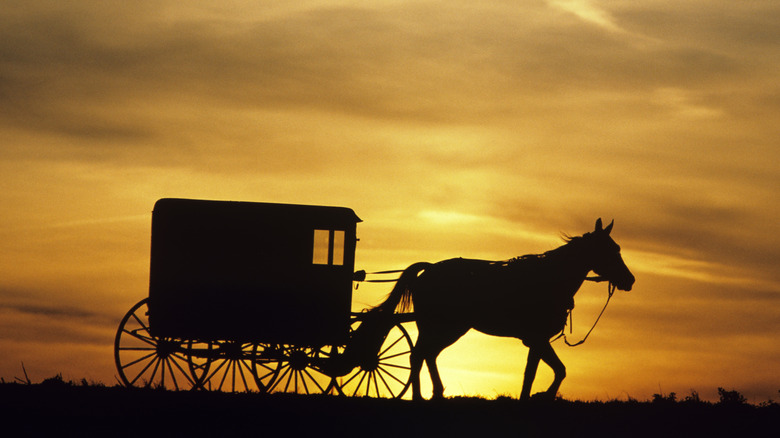
The Amish are well known for clinging to their traditional ways, which can occasionally get them in trouble if they cling too hard. However, individual communities are allowed to set their own rules, and some of the more progressive communities have recently expanded their allowance of bicycles to include e-bikes, according to Forbes. They see e-bikes not as a technological disruption to their way of life, but as a service to them.
David Kline, the bishop of an Old Order church near Mount Hope, Ohio, explains that it's not technology itself that the Amish are opposed to, but the destructive effects they believe it would have on their communities. As he told Forbes:
"We're fairly open to technology. We use modern medicine. We go to the dentist. We donate blood. The car was really the first piece of technology that the Amish said: 'Whoa. What will it do to the community?' And as we know, Henry Ford's Model T destroyed thousands of small communities."
That's why the Amish horse and buggy is still a common sight in some rural areas. But as Kline says, they don't shun technology entirely, contrary to the stereotype. Some work for modern businesses in roles that align with their beliefs. For example, Janus Motorcycles employs Amish craftsmen to build frames and gas tanks. So does Keim Lumber in Charm, Ohio, where hundreds of e-bikes plug in to recharge while their owners work inside, reports Ideastream Public Media:
Abe Troyer is Amish. He works at Keim Lumber as the executive director of sales. He said his eBike gives him more time with family because his commute is 45 minutes shorter.
"[It's] basically 10 miles a day, but I do a lot more than just work," Troyer added. "I go different places at different times. So, in the last year and a half, I put 3,400 miles on my bike."
Community and self-reliance
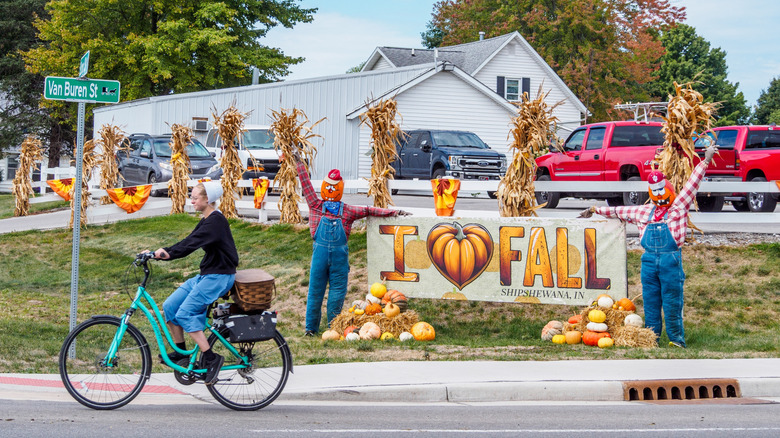
Bicycles are becoming accepted as a form of transportation among the Amish. A proper e-bike is limited to 20 or 28 mph, depending on its class, and assuming you don't accidentally buy an electric motorcycle instead. That's about the same as a pedal bike's top speed with a strong rider. E-bikes have become quite popular among the Amish in Holmes County, Ohio, not just because their community is among the more progressive, but also because the terrain is rather hilly, unlike in flatland communities like Indiana, where it's easier to pedal. Although the Amish live off the grid, some do make limited use of electricity, mainly solar. That provides the means to charge e-bikes, as well as run lighting, water pumps, and small appliances in their homes.
Roughly two-thirds of Amish churches now allow e-bikes. That still leaves one-third who remain opposed to them. It's not necessarily the technology they oppose, but what they see as the negative impact it can have on their communities, as David Kline alluded to with the Model T. Mart Miller explained his own e-bike opposition to Forbes:
"My biggest concern is they are exchanging the Amish mode of travel for higher-speed transportation that will eventually lead to the car," said Miller, a retired farmer and bishop of an Old Order Amish church near Mount Hope, Ohio. "We have a lot of people out there where the parents do not own a horse and buggy anymore, so the children will not learn how to use a horse and buggy."
If that sounds a bit extreme, consider how many car enthusiasts lament that their children won't learn how to drive a manual transmission because such cars are so rare now. I see this as the same thing, just at different levels of technological development. The Amish may not embrace cars as we do, but they have some pretty bright ideas, some of which are solar-powered.