

Why Semi Trucks Are Required To Weigh In So Often
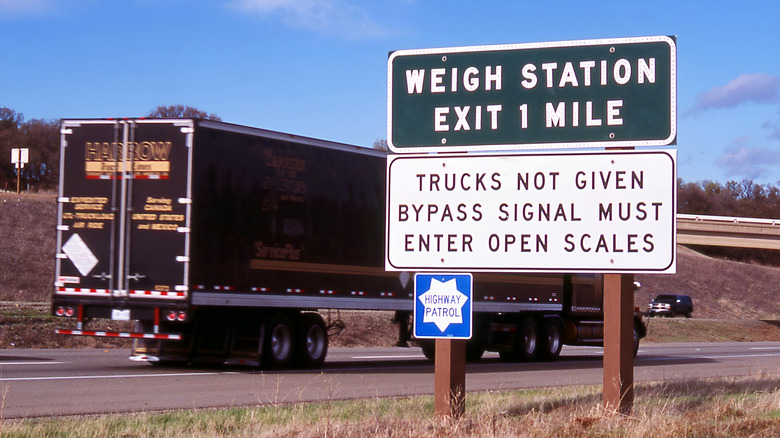
In 2024, American semis transported over 11.2 billion tons, according to the American Trucking Associations. However, federal and state regulations place limits how much carriers can load on their trucks. Weigh stations, used to verify semis aren't too heavy, are found along interstates, including some of the oldest highways in the U.S. The trucks are weighed using sensors built into decks called weighbridges.
Factors like safety are a major reason why big rigs need to step onto the scale regularly. These hulking 18-wheelers pose a significant risk to other motorists when overloaded. Even though semi trucks have a wild number of gauges, which allow drivers to monitor a wide range of systems, extra weight alters various aspects of normal operation. It places a greater strain on tires, which are already under immense pressure and can harm nearby motorists when they fail. More weight in the trailer also means that it will take much longer to bring the rig to a stop.
Overladen trucks are also hard on roadways. WCCO CBS spoke with Sgt. Livingston, a Minnesota commercial vehicle inspector, who explained that studies have found that "even 1% to 3% of vehicles that are overloaded can decrease the lifecycle of the pavement by 25%." To determine what's overweight, the Federal Highway Administration crafted the Bridge Formula, a mathematical tool to help protect its bridges from damage. This formula is based on the number of truck axles and how far apart they are from each other. Essentially, you can't weigh more than 80,000 pounds total, have more than 20,000 pounds over a single axle, or have more than 34,000 pounds on a tandem axle.
Why would a semi be overloaded, and what happens if it's over the limit at a weigh station?
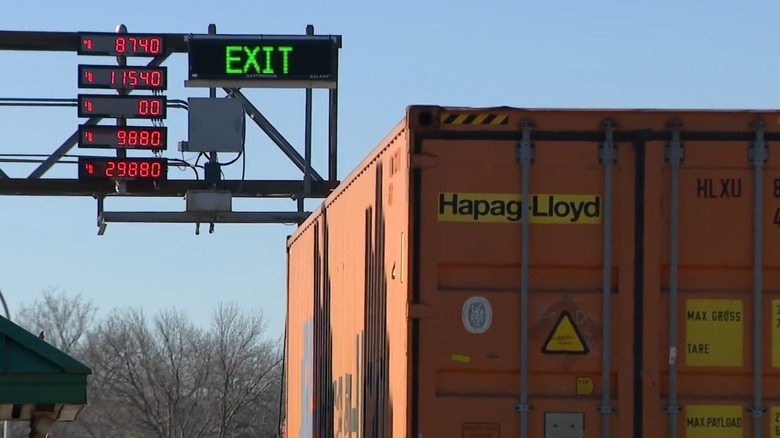
There are different approaches used to calculate pay for truck drivers, and, unfortunately, low wages may be creating a trucking industry crisis. Each approach has advantages and disadvantages, but some can encourage more risky transport decisions. For example, if a driver's pay is based on the value and volume of the load, it may be tempting to stuff a bit more into the trailer. Of course, an overweight truck can also be due to mistakes, like incorrect cargo data and unbalanced loading (too much weight over a particular axle, for example), among other reasons.
If a trucker pulls into a weigh station, rolls onto the scale, and is found to be overladen, it sets off a chain of unpleasant events. The extra pounds may need to be removed from the trailer, resulting in loss of time and money. Then there's the matter of fines, which depend on the state and the amount of weight over the limit. Each state employs its own fine structure, and fines can go up based on how far over the limit the truck is. For instance, if a truck is 1,000 pounds overweight in Kansas, it's a straight fee of $40 and then an escalating amount beyond that. However, you could get slapped with a $125 fine per 1,000 pounds overweight in Rhode Island. Repeat offenders may have their fine multiplied in some states.
Beyond fines, drivers can also lose their license (CDL), preventing them from working behind the wheel of a big rig. Even worse, depending on the circumstances, a trucker could even potentially face jail time.