

Why Water May Be Coming Out Of Your Tailpipe
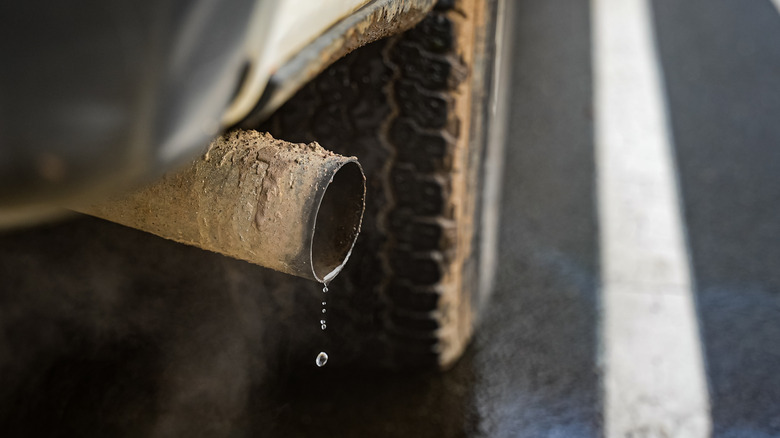
Sometimes, car problems are obvious, like leaks, unusual noises, overheating, and bluish exhaust smoke, which can indicate that your car is burning oil excessively. Other symptoms are less clear in terms of their seriousness and may be classified with the vague statement, "it depends." Concerning water droplets out of the exhaust pipe, it's a great example of the latter, and it could indicate something significant or perfectly normal.
For instance, when the vehicle's exhaust system is cold, such as first thing in the morning, the typically invisible airborne byproducts of the combustion process will rapidly cool down as they make their way toward the tailpipe, transforming into droplets via condensation. However, as the exhaust system warms up, the droplets should disappear. Additionally, it's the job of the catalytic converter to take pollutants — like hydrocarbons and carbon monoxide — and turn them into water vapor, among other harmless or less volatile substances. So, condensation can easily occur briefly under completely normal circumstances. However, tailpipe condensation can also be a sign of serious trouble, which, if not addressed, could result in catastrophic engine failure. You could be facing a damaged cylinder head, a problem with your EGR cooler (if applicable), or a failure of your engine's head gasket.
In order for an internal combustion engine to run properly, it must be able to maintain compression, which is accomplished, in part, via the sealing power of a head gasket. If this part is compromised, performance suffers, and coolant can get into places it shouldn't be, sometimes signaled by water droplets leaving the tail pipe.
How can you tell if water out of the tailpipe is a serious issue?
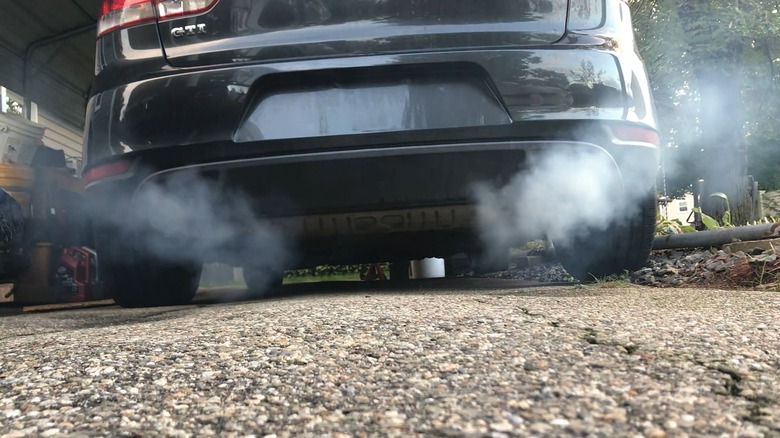
You don't need to be a seasoned mechanic to determine that you may have a severe problem on your hands with regard to water spitting out of your car's exhaust. What's important to note is when it happens, how much water comes out, and any other symptoms present. For instance, after a vehicle is warmed up, it shouldn't continue to drip water. If it does, it may be a sign that something bigger is going on.
You'll also want to take a closer look at the amount of water leaving the end of the exhaust, as normal operation should only produce a minimal and occasional dribble. Flow in larger quantities is definitely a warning signal.
Finally, while water droplets on their own may not be a cause for concern, if they are accompanied by the presence of white smoke and/or a sweet fragrance, you have trouble. This is a strong indication (although not definitive) that your head gasket is blown, which is one of the car parts you should never cheap out on. It also means that coolant has infiltrated your exhaust system. Coolant, which is made with ethylene glycol, creates out a decidedly unique odor, which one user on Reddit's r/subaru forum describes as smelling "like a weird candy."
If you notice these issues, get to a mechanic as soon as possible
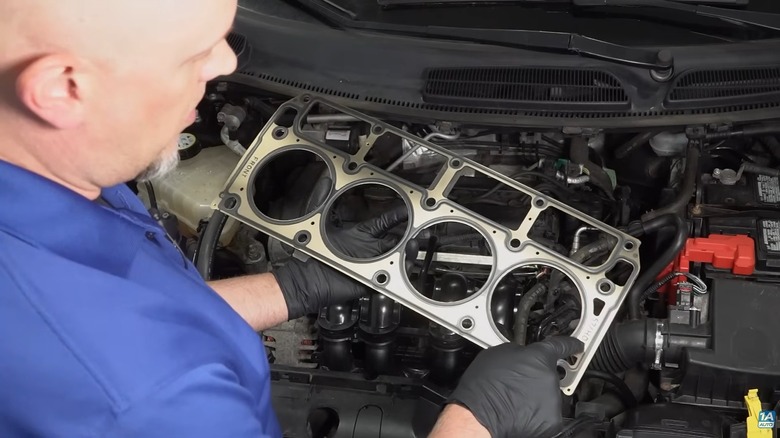
If you notice excessive amounts of water, or any of the other additional symptoms described above, you'll want to visit an automotive service shop immediately. If, for example, the issue is a blown head gasket, without intervention, your engine is on borrowed time. The main concern is that coolant can begin mixing with oil, as the gasket is no longer sealing the block and cylinder head together. This creates a two-fold problem — low levels of coolant can lead to engine overheating, while oil mixed with coolant can strip away the necessary lubrication and eventually cause the engine to seize.
Replacing a head gasket isn't a cheap repair, with Repair Pal estimating that it costs between $2,457 and $3,219 on average. However, if the problem isn't immediately addressed, you could be looking at far more damage to your wallet. While it depends on several factors, such as the vehicle's make, model, and year, Consumer Affairs estimates that you'll need to shell out a minimum of $5,000 for an engine replacement, and it could cost as much as $10,000 in some cases.