

Here's How Much A 2020 Honda Civic Has Depreciated In 5 Years
There was a while there, right after the COVID years, when at least some cars saw their values go in reverse — allowing folks to sell used cars for more money than they originally paid for them. For most of us, though, those days are long gone, and vehicle owners once again have to deal with the specter of depreciation. It essentially starts from the moment you take delivery of your new ride, with Kelley Blue Book (KBB), for one, reporting the typical car endures a 30% depreciation rate during the first 2 years and continues dropping in value by 8% to 12% annually after that.
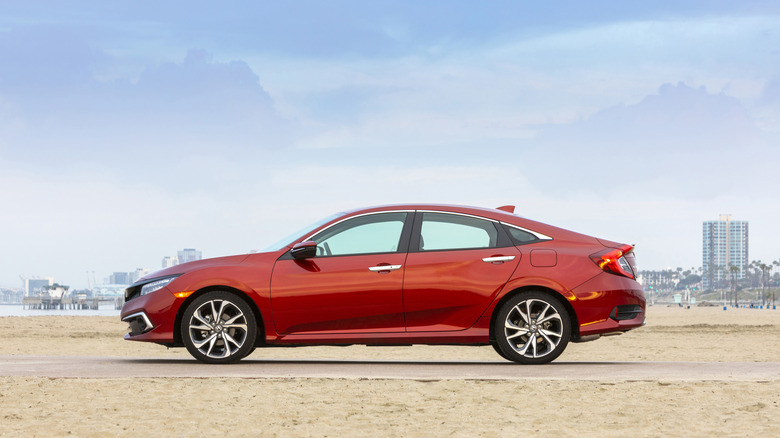
But here's the thing: The Honda Civic isn't your typical car. Again, according to our friends at KBB, the Honda Civic was the top-rated small car of 2020 and, at that stage, had been named a Small Car Best Buy for its 5th consecutive year. More specifically, KBB called out the Civic's safety, reliability, and low maintenance costs as key selling points for the 2020 Civic. As a result, the website's experts say that a 2020 Honda Civic LX sedan, the entry point to that year's Civic family, has depreciated roughly 24% over the past 5 years — going from an MSRP of $21,755 to a current KBB fair purchase price of $16,521.
For some context here, the current 2025 Honda Civic roster — starring the tuned-up and turned-on Civic hybrid — opens with an updated LX sedan that starts at $24,250 (before a $1,195 destination charge). The '25 Civic continues to have the best KBB resale values in its class, too.
Trim-by-trim depreciation rates for the 2020 Honda Civic

The 2020 Honda Civic roster also impressed KBB with its extensive range of individual choices: It was available in three body styles and seven trim levels (not counting the high-performance Civic Type R), and while not all trims were offered in all body styles, each model still managed to transform its unique benefits into better-than-average depreciation scores. Remember that the average 5-year depreciation rate is around 54% (30% from the first 2 years and 8% the next 3).
Beyond the LX sedan, for instance, the LX coupe and hatchback saw their original values of $22,005 and $22,705 fall by only 23.8% and 22.4%, respectively. The Sport trims, which welcome features like a 7-inch touchscreen and Apple CarPlay/Android Auto, originally had MSRPs as low as $23,555 for the sedan, which — to flip the script — retained more than 77% of its value versus the typical car's 46%. With the ability to add sunroofs and leather seating, the upscale EX and EX-L sedans held onto about 73% and 76% of their value over 5 years.
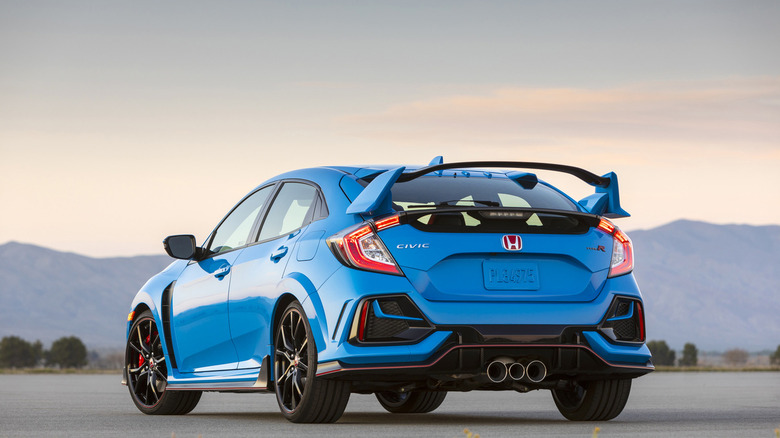
The enthusiastic Si trim raises the bar for retained value to approximately 80% – gearheads who want to go even faster will notice that a 2020 Honda Civic Type R depreciates even slower, shedding roughly 15% of its value after 5 years. The Touring and Sport Touring trims top the line with standard features like LED lighting and satellite-linked navigation, with the most expensive model for 2020, the $29,905 Sport Touring hatchback, depreciating by roughly 29% during its initial 5 years in service.
How does the 2020 Civic compare to its rivals for retained value?
All those various build combinations can mean that the Civic's competition can vary pretty widely as well: After all, the person who's looking for a basic family sedan like the Civic LX probably isn't cross-shopping extreme hot hatches like the Civic Type R. A better match for the LX sedan would be the 2020 Toyota Corolla sedan, another of the country's most popular compacts.
In this situation, shoppers will discover the Honda LX retains slightly more of its value 5 years into its life cycle than an entry-level Toyota Corolla L sedan: The Honda, as mentioned, depreciates by 24% during that time, and that compares to Toyota's small sedan at about 26.5%. The gap widens further when comparing the Civic and Corolla hatchbacks. Over the span of 5 years, the former falls in value by 22.4%, and the latter by about 27%.
On the topic of the Type R, it's hard to find another mainstream compact carrying more than 300 horsepower for a comparison, but the 2020 Hyundai Veloster N came close, with a standard 250 horses. Depreciation-wise, however, Hyundai just can't keep up, since the Type R's roughly 15% slip in value compares to the Veloster N's massive falloff of almost 35%. Of course, this isn't quite apples-to-apples, as the Civic Type R has four doors plus a hatchback, and the Veloster N has two traditional doors, a hatchback, and a rear access door on the passenger side. But the bottom line remains: Don't expect Civic Type Rs to get cheap anytime soon.