

Why Cheap Catalytic Converters Can End Up Costing You More
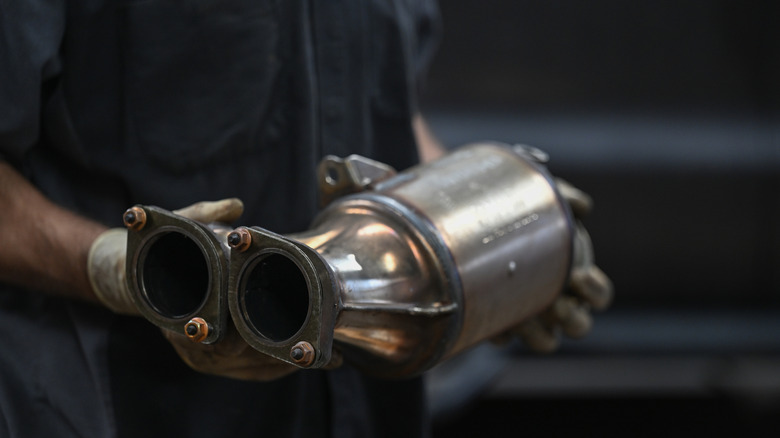
Catalytic converters were made mandatory in the U.S. in 1975 as part of the Clean Air Act, which itself was introduced in 1970. This meant that every vehicle from the '75 model year onward had to be equipped with one, and ever since, that's remained the case for gasoline-powered vehicles. Catalytic converters work by using precious metals to turn toxic exhaust gases into cleaner gases. Metals like platinum, palladium, and rhodium trigger chemical reactions, and this turns gases such as carbon monoxide and nitrogen oxides into less harmful substances, like water and nitrogen. So, it's easy to understand why catalytic converters are important, but that doesn't mean they are without their downsides.
A catalytic converter is essentially a pipe full of precious metals and materials, and, as such, they do not come cheap. They also don't last forever, and when it's time for a replacement — usually signified by a rotten egg smell, a check-engine light on the dash, or reduced engine performance — the price can be quite a shock. Even regular commuter cars can command north of $1,000 for a catalytic converter replacement, whereas cat replacements for performance and luxury cars can be significantly higher still, sometimes upward of $4,000.
Aftermarket catalytic converters are available, and they can sometimes be as cheap as $100, even direct-fit options. This may sound like a saving grace, but it's rarely a fitting long-term solution. There are a number of reasons why you may be better off shelling out for an OEM catalytic converter, rather than opting for a cheap aftermarket unit, including durability, ease of fit, and efficiency.
Cheap catalytic converters are not built to the same standards
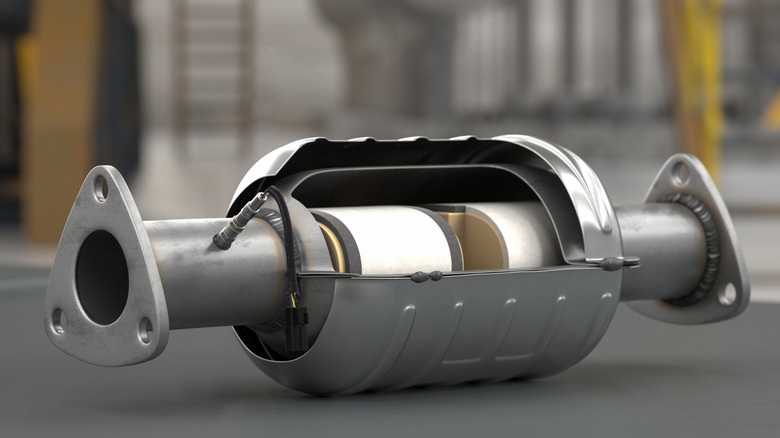
As we've covered, catalytic converters use precious metals to reduce emissions. So, naturally, cats are expensive to manufacture. In order for aftermarket producers to get costs down on their units, they simply use less of these precious metals. In fact, cheap catalytic converters can use as little as a third of the amount of precious metals as OEM units do, which means they won't perform as well and will reach the end of their lifespans quicker. In addition, while they may initially meet federal standards, cheap replacements may struggle in stricter states like California. In areas like this, even a brand-new cheap catalytic converter may not be efficient enough to pass inspections.
Moreover, while they may meet the required emissions standards at first, the use of cheaper materials can cause aftermarket cats to wear out quickly. This means that, by the time your vehicle requires another inspection, you may need to replace it again. This translates to more labor, another new part, and more downtime for your vehicle — not things you'd have to worry about with an OEM part.
Furthermore, aftermarket catalytic converters are sometimes built as universal parts, rather than direct-fit components for your exact make and model. This will inevitably lead to higher labor bills when installing, plus, the fitment is unlikely to be perfect. So, welds may crack and joints may fail, once again pushing you to fork out and buy another new unit. To top it all off, cheaper units will likely have shorter warranty periods, meaning by the time the part fails or wears out, the burden is back on you to shell out for a replacement.
Don't get caught out by big catalytic converter bills
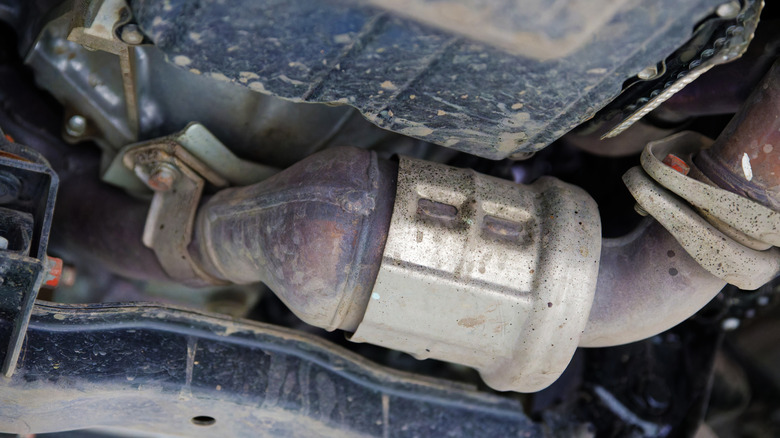
Regardless of how inefficient cheap catalytic converters are, it's understandable that, at times, buying one may be the only option. After all, not everyone has a spare $2,000 at any given time for an OEM replacement, so opting for a cheap aftermarket part is the next-best thing.
Fortunately, though, catalytic converters rarely fail drastically without any prior warning. The main things to watch out for are rich, sulfur-like smells from the exhaust, slower than usual performance from your engine, worsened fuel economy, an engine that's trickier to start, and extreme heat from underneath the car. If one or more of these signs sound familiar, then your catalytic converter could be on its way out.
That isn't to say you need to replace it immediately, but these are warning signs that something is amiss. You may start noticing these signs before a check engine light appears on the dash. Take these symptoms as a sign to start saving for a new catalytic converter. If an engine light does appear, it will likely be linked to code P0420 if your catalytic converter is failing, and this is definitely a sign that you should visit a mechanic sooner rather than later.