

The Physics Of Slip Angle: Why Sliding Actually Makes You Faster

One of the concepts within vehicle dynamics that is often misunderstood, but vital in terms of gaining a competitive edge, is slip angle. Imagine taking a corner at speed on a track. There is a moment where your wheels are pointed in a different direction than the vehicle's direction of travel. It's more dramatic at higher speeds, and it happens in all sorts of cornering scenarios (not just on the track), but the difference between the direction of your car and its tires is slip angle. In drifting, slip angle is much more dramatic. But optimal slip angle for maximum performance is right on the ragged edge.
Slip angle allows a vehicle to achieve optimal grip for enhanced handling performance, without losing speed. Essentially, as the slip angle increases (around a corner), so does lateral force on the tires, but they can only handle it to a certain point (peak grip) before you begin gradually losing traction. Ideal slip angle isn't a static measurement, and depending on whether you're running street tires or racing tires, it could be at very different points during a high-speed corner.
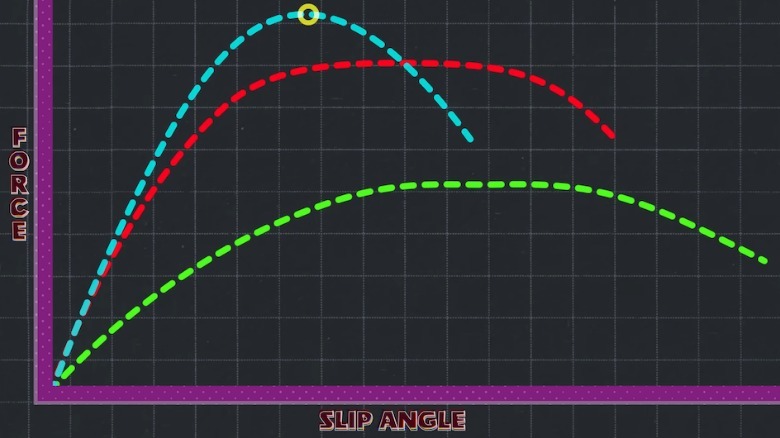
The Drive recently broke down slip angle, demonstrating the concept on track, with their driver making a lot of steering adjustments around corners. Getting the right slip angle goes beyond just finding that optimum balance, as keeping that ideal slip angle through a corner is the real challenge. And from a driver's perspective, it'll require continual adjustments to steering throughout the turn.
Ideal slip angle involves minimal sliding

Going into a full drift isn't typically the quickest way to navigate a curve, even if it is really fun to watch. Why? The complete loss of traction means that power isn't moving the vehicle forward. Slip angle isn't really a full slide, though. Instead, the tire has changed shape and twisted due to the lateral force applied to the car, but the tires are still tightly gripping the road.
Regardless of whether they're standard all-season tires or upgraded performance tires for summer driving, every tire has a portion of its surface in constant contact with the pavement. It's naturally called the contact patch. Rubber is flexible, so even though the wheel may be angled slightly to one side, the contact patch could be pointed forward. This causes tire deformation, as a greater lateral load is imparted onto the rubber in contact with the ground. When a driver is successfully utilizing optimum slip angle, it will appear that they're sliding a bit around a corner, without the awesome drifty side effect of smoke pouring from the tires.
Knowledge of slip angle is also useful outside of motorsports, as it helps explain some handling characteristics. Slip angle can be different between the front and rear of a vehicle, which significantly impacts its cornering ability. A greater slip angle on the rear of the car versus the front will cause oversteer. More slip angle in the front, and you'll have understeer. An equal slip angle in both the front and rear of the car will generally result in neutral handling. Weight distribution is a major factor in a car's slip angle — so nose-heavy cars from automakers like Audi are known for understeer.