

These Are The 8 Quickest Sportbikes On The Market Right Now
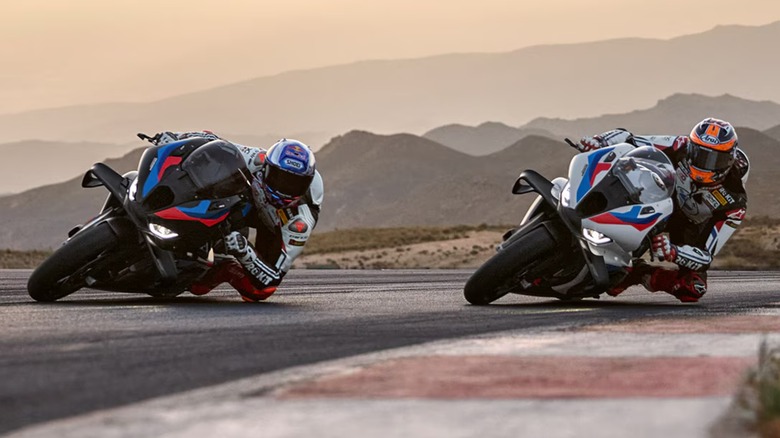
For those of us who ride motorcycles, memories of running through the gears while huddled down in the dead of winter can be a particularly melancholy experience. But do you know who else is feeling down on a short, cold winter day? Your local motorcycle dealer employees. Sure, they might still be getting the odd motocross or enduro special moving, but they've still got their top-tier sportbikes on the showroom floor, and there's no better time to see what kind of deals might be waiting for you.
We're thinking specifically about the fastest street-legal sportbikes you can buy, right now, in these United States. The lineup in the liter class is full to bursting with incredible machines we're lucky to consider. That's what led us to ask — which manufacturer produces the fastest accelerating sportbike that 2026 has to offer?
While there are plenty of powerful naked and cruiser options available, we wanted to focus on full-fairing sportbikes — class leading straight line speed that can also handle your favorite twisty road, from the Tail of the Dragon to the recently reopened Snake section of Mulholland Highway. We also decided to compare the quarter-mile times, where both the time and the trap speed reveal how the bikes make their speed. The superbike that gets the lowest time is the winner here, but we'll discuss the speeds the bikes achieve across the line as well.
How we created this list
Two main points stood out as we compiled this list. First, the quarter-mile times achieved by these superbikes are bunched very tightly together. There's barely half a second separating first place from last place, although the trap speeds vary significantly. Every one of these bikes sport sophisticated electronic traction systems in the hopes of keeping grip levels high and wheelie angles down.
Which brings us to the second point — motorcycle companies are achieving these numbers with diverse approaches to engine configuration, adding to their unique characteristics. Inline fours, V4s, different crank layouts — while it can be hard even for enthusiasts to point to tangible mechanical differences between their cars, motorcycle manufacturers make it easy to pass a blindfold test on sound and feel.
We also don't mind telling you that getting comparable test data is not as easy as it used to be. Documented acceleration times by independent journalists on stock production machines aren't widely available, since those kinds of tests just aren't as prevalent in our current content creator era. We avoided relying on online video content with modified examples, or personally owned sportbikes, even when the content was of good quality. To qualify bikes for this list, we stuck with examples that had solid aggregated acceleration data, were available on the manufacturer websites right now, and had a listed MSRP base price.
Aprilia RSV4 Factory 1100 — 10.35 seconds
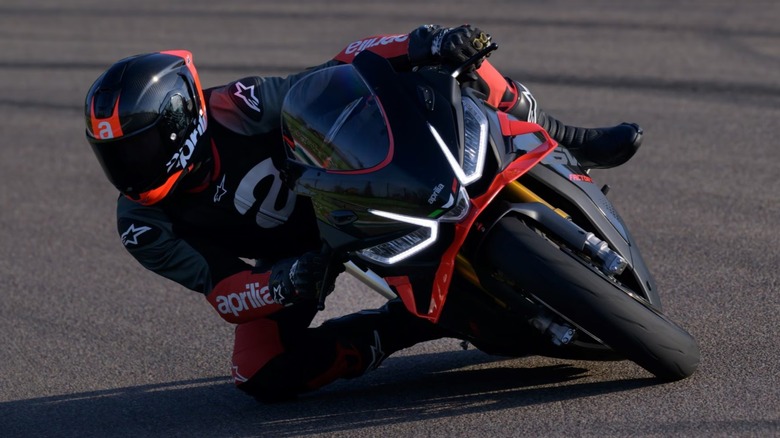
Kicking off our list is the bruiser of the bunch. Aprilia makes some serious bikes, and those bikes tend to be hooligan-approved — powerful and hairy, these are the kind of bike that you have to wrestle with to get down the road. The company is probably more widely known for their naked entry, the Tuono, but this smaller Italian company punches above its weight with engines that are torquey and brash, recalling more edgy motorcycles from earlier eras.
Priced at $26,499 excluding destination, the Factory 1100 V4 engine makes launching from rest more difficult as a result of its torque, so managing traction and keeping the front wheel near the ground requires more care than with the high revving Japanese liter-bikes. However, that's also what makes it so effective on the move — more power down low in the rev range makes a difference. Having said that, the quarter-mile sits at 10.35 seconds at 147 mph.
Design wise, the Aprilia features a new popular addition to the aero package of the latest sportbikes — winglets on the leading edge of the front fairing to help with downforce at speed.
Honda CBR1000RR-R Fireblade SP — 10.11 seconds
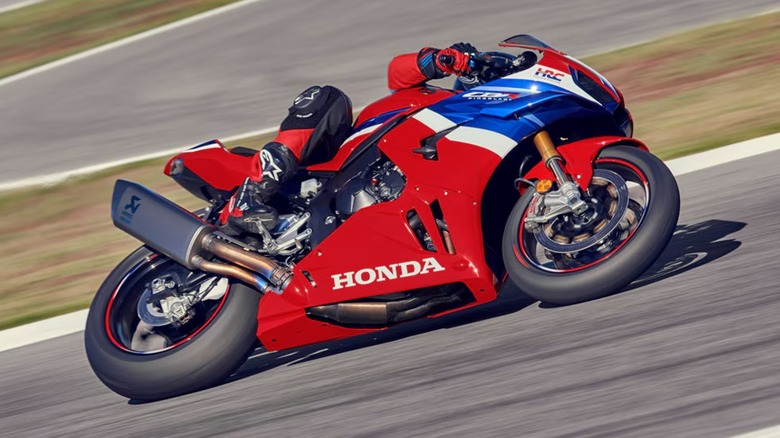
Next is a model from the company that helped set the stage for mainline acceptance of the motorcycle — Honda. The CBR1000RR-R Fireblade SP runs through a quarter-mile in 10.11 seconds, and at a $28,999 MSRP plus a $775 destination fee, this bike represents the top rung for Honda.
This entry is a great example of how different bikes run through the quarter-mile. While it's nearly the slowest by time, in this group the speed it achieves is the third fastest, at 154 mph. So this means that while it lags the tiniest bit behind initially, once it finds its grip it is accelerating more quickly — and given the narrow time delta from the back of the pack to the front, this means it might be overtaking the other entries as it goes past the quarter-mile.
Either way, this Honda is clearly right in the mix with the other bikes here, capable and quick. The other bikes might make more of the mid-range speed with their torquier power delivery, but when the speed difference is so small it comes down to rider ability, the Fireblade makes a great case for itself.
Lightning LS-218 — 10.05 seconds
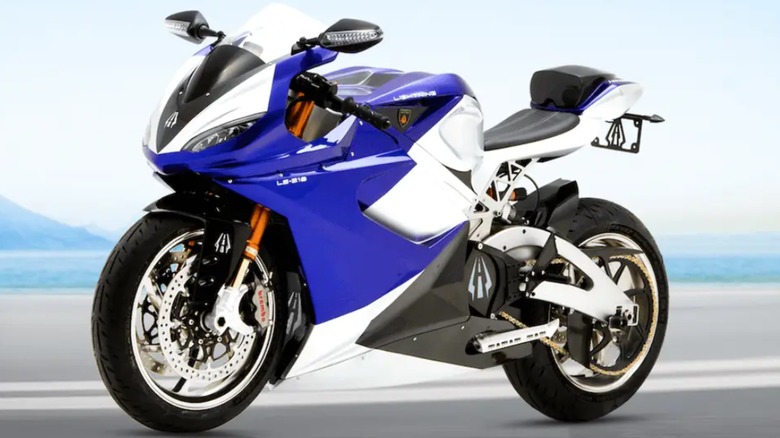
What's the opposite of Loud Pipes Save Lives? An electric superbike. Quick and silent, these seem as suitable for undercover ops behind enemy lines as being pointed down a dragstrip. Lightning Motorcycles is an electric motorcycle American company that has been selling models to the public since the mid-2010s and currently offers a 244 hp power unit in its top spec bike – the LS-218 — that can be ordered directly from the manufacturer for a mere $38,988.
However, it was difficult to find a quarter-mile time for the LS-218. Research for a documented time revealed this video from Motorcyclist of an earlier version with a fully recorded quarter-mile run of 10.05 at 144 mph. Internet estimates have this bike in the low nines, but without more complete test data, it's hard to judge if there is more speed to exploit from this electric entry.
If we start to see conventional bikes having issues with meeting emissions standards – assuming those rules don't change like they have for passenger cars — it's likely that we will get more electric entries into the sportbike category.
Ducati Panignale V4 R — 9.95 seconds
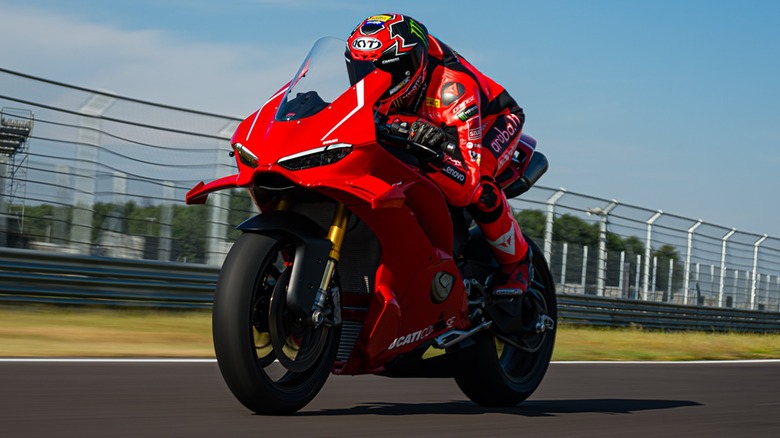
Well, if it isn't the representative from legendary Italian company Ducati – priced at the group leading $49,995 plus destination – sitting at the middle of the pack. Disappointed, you say? Give us a second to put this result in its proper perspective.
Historically, Ducati has benefitted from the very specific character of its V-twin engine configuration. Ducati's thump and growl soundtrack is uniquely recognizable to anybody familiar with them, offering a deeper, meatier, and substantially torquier sound than the scream of its inline four competitors. However, roughly 20 years ago it seemed Ducati had hit the V-twin power ceiling. Ducati solved that with its V4 powerplant, a configuration that it first introduced on its street bikes in 2007 with the very exclusive and very expensive limited run Desmosedici model.
Those engines made it to production bikes like the Ducati Panigale V4 a decade later, and the results of this doubling down — particularly in the quarter-mile — tells the tale. At 9.95 seconds, the Ducati relies on electronic aids to clear the 10-second mark. However, at 159 mph it exceeds the trap speed of the next fastest bike by a solid 3 mph. It's viciously quick once the rider can just pin the throttle and hang on.
Last but not least — the winglets on the front for aero management? Ducati was the first to do it for modern production motorcycles, and it's become the norm.
BMW M 1000 RR — 9.9 seconds
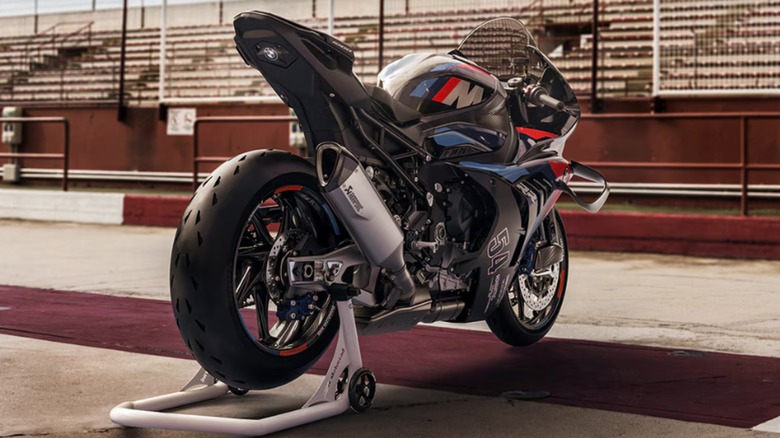
Until the first S 1000 RR came along, BMW was mostly known for its boxer twin variants, alongside the more modern but also more touring-oriented K bike line. The S 1000 RR, however, was BMW's direct competitor for Japanese liter-bikes. Even the earliest versions featured a 193 hp inline four along with an array of sophisticated rider aids such as multi-stage DTC traction control and advanced ABS.
The second generation was introduced in 2019, and BMW has the financial means to keep the bike at the leading edge of technological development. Of course, the M 1000 RR trim featured here is even more performance oriented, with the "M" Motorsport designation signaling that division's first time working their magic on a two wheeler for BMW — and it costs a perfectly reasonable $35,395 plus a $1,095 destination fee.
The M 1000 RR offers an inline-four powerplant producing 205 hp, race optimized suspension with more aggressive electronic traction settings, and carbon fiber substitutes including winglets for the nose. End result? 9.9 seconds at 151.6 mph.
Suzuki Hayabusa — 9.86 seconds
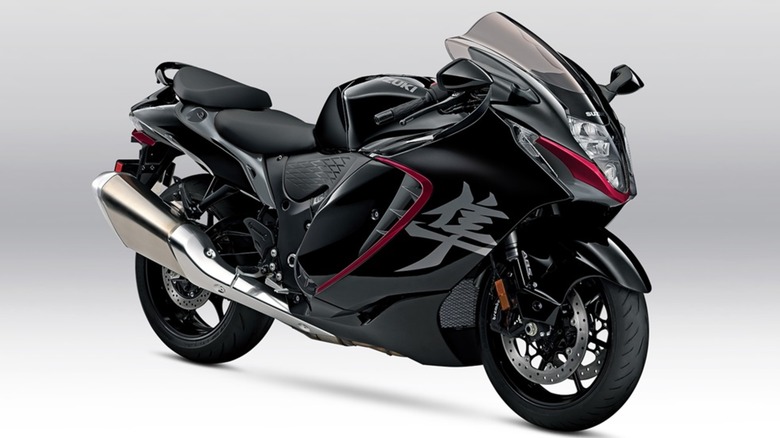
While the Hayabusa's focus is more towards the sports touring end of the spectrum, it's clearly a sportbike — just a slightly more comfortable one with cruise control. However, when it comes to verified speed, the Suzuki is a frustration. In a sign of the times, there isn't an independently tested quarter-mile time from a stock example of the current Hayabusa to be found online, beyond a time affected by being tested at elevation in Utah by Cycle World.
After careful consideration, we decided that you can't make a list of the fastest sportbikes without including the 'busa, which altered the motorcycle landscape permanently upon its arrival. Even using the earliest and least powerful first generation version, it's still right in the mix with the famous 9.86 second at 146 mph result recorded by Cycle World in 1999.
The Hayabusa tilted the balance farther towards high speed stability and acceleration, and you can see it, especially in the length — the Hayabusa is 85.8 inches long, a bit more than the BMW M 1000 RR's more typical 82.1 inches. This makes it less tossable, but does wonders for rider comfort, letting them stretch a bit compared to the tighter confines of most superbikes. Beyond that, the Hayabusa is the performance bargain here by a substantial amount, with a starting price of $19,499 plus a $700 destination fee.
Yamaha YZF-R1M — 9.8 seconds
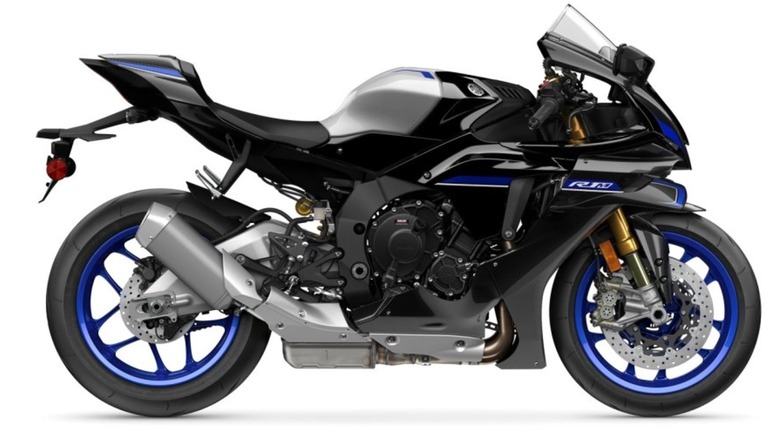
Valentino Rossi fans rejoice – the Yamaha R1 is still worthy of the good Doctor. The Yamaha sports an inline-four engine that is uniquely configured with a crossplane crankshaft. With a smoother fuel delivery, more precise throttle control, and a corresponding smoother sound, R1 enthusiasts maintain that the R1 delivers a unique experience that earns their loyalty.
This MotoGP legend includes many updates we're also seeing from the other competitors. On the M version featured here, you get front winglets, lots of carbon fiber, and more aggressive Öhlins electronic racing shocks. Of course, the Yamaha still acquits itself well on the street, with a 9.8 second, 149.9 mph pass.
The R1 is an older platform, but it has benefitted from solid upgrades that leave it priced at $27,899 with a $775 destination charge. Yamaha has relied on continual improvements since the chassis first debuted in 2015, and the success given the age of the platform is admirable. But while it has kept pace technologically with its competitors, it's worth noting that Europe's new Euro5+ emissions laws were strict enough to keep Yamaha from offering the model there, except as a track-only machine. Sad news for that continent, but a rare example of U.S. buyers getting the best trim level compared to foreign markets.
Kawasaki Ninja H2 — 9.62 seconds
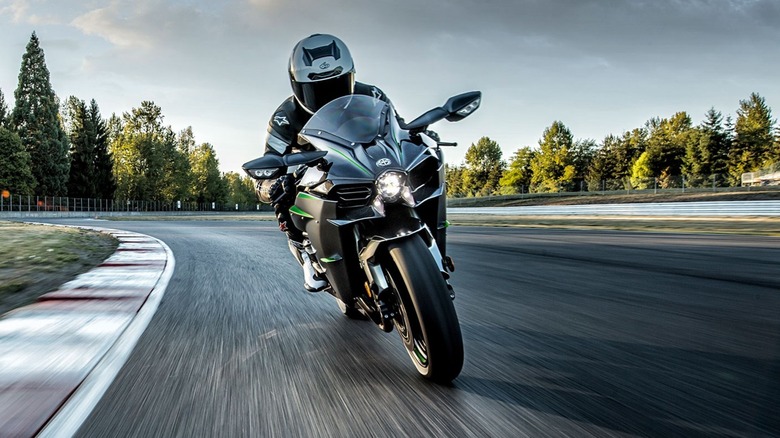
At the number one spot – and at a fair $34,400 price given its supremacy – is the Kawasaki Ninja H2. Judged on the metrics, it's still a traction game — but the Kawasaki Ninja H2 is in another league on power, and the trap speed proves it. With the only forced induction engine of the group, Kawasaki was so committed to being dominant that this 240 hp bike isn't even the fastest version of the H2 that Kawasaki sells, by a significant margin. The H2R version of this motor results in a claimed 322 hp, but only on a track version with no lights and limited safety gear.
Still, even the less powerful street-legal version of the engine results in a winner both on time and speed, at 9.6 seconds and 160.5 mph. Despite all the latest electronic traction aids, this much power limits how well you can launch a powerful sportbike without making larger sacrifices, like an extended swingarm that drag bikes require to make effective standing starts happen.
That the H2 came out over a decade ago and we still haven't seen another manufacturer attempt to offer a superbike with more power, isn't because it can't be outdone. It's because we are firmly up against the limits of traction and physics for two wheeled things — for the moment. For that, may we all be thankful this winter season.