

What Happened To Detroit Diesel?
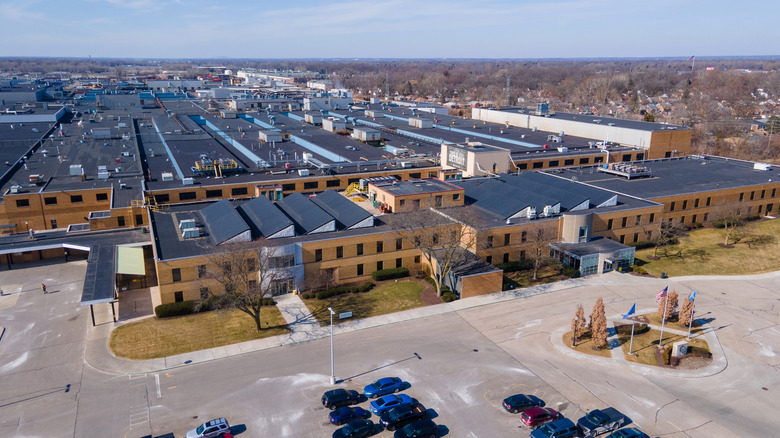
Who was known as America's greatest diesel engine maker? You'd probably say Caterpillar or Cummins, but some old timers might argue that Detroit Diesel takes the crown. While this makes for a never-ending debate, there is no question that Detroit Diesel was one of the most prolific engine builders of its time.
The company started in the late 1930s, gambling on diesel technology in an era dominated by thirsty gasoline engines. General Motors witnessed a need for both fuel economy and torque, so it created an entity called the General Motors Diesel Division – which later came to be known as Detroit Diesel. This entity grew exponentially around World War II. Afterwards, these engines became the backbone of American transportation, finding use in trucks, buses, bulldozers, cranes, boats, and even tanks.
It's a company that touched the skies like Icarus, but it came down thanks to complacency and hubris. So what exactly happened to Detroit Diesel? To know the answers, we must first know about the company's first great successes.
The era of Screaming Jimmy
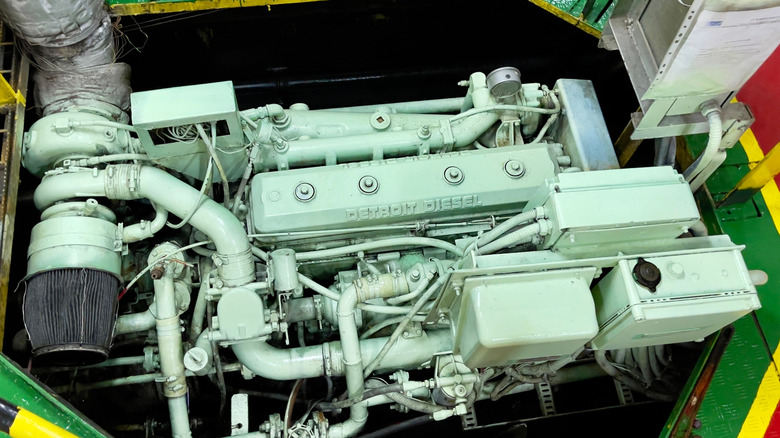
1938 was the year when "Screaming Jimmy" was born. Aside from sounding visceral, this engine defined heavy hauling for the next five decades. This two-stroke diesel engine was the first of the Detroit Diesel 71 series (named after its 71 cubic inches of displacement per cylinder). The 71 Series was an outrageous concept, and it worked exceptionally well. While the competition's slow-revving and bulky four-stroke engines featured a power stroke every two revolutions of the crankshaft, Detroit Diesel's offering delivered a power stroke at every single crankshaft rotation, creating a perpetual combustion cycle and effectively delivering around double the power density of the competition. Topping it off was a massive gear-driven Roots blower that shoved fresh air into the cylinder, effectively scavenging the burnt gases out.
Hearing the "Screaming Jimmy" for yourself will let you revel in the unmistakable sound of a blower whining in sync with a two-stroke exhaust pulse. In case you're wondering why it gained the Screaming Jimmy nickname, the "Screaming" owed to its exhaust note, and the "Jimmy" term referred to a common slang for General Motors, Detroit Diesel's parent company. Screaming Jimmy didn't just make noise a lot of noise, either. Later versions of the engine — particularly the 6V71 — could deliver an impressive 238 horsepower from a compact package.
An engine for everything
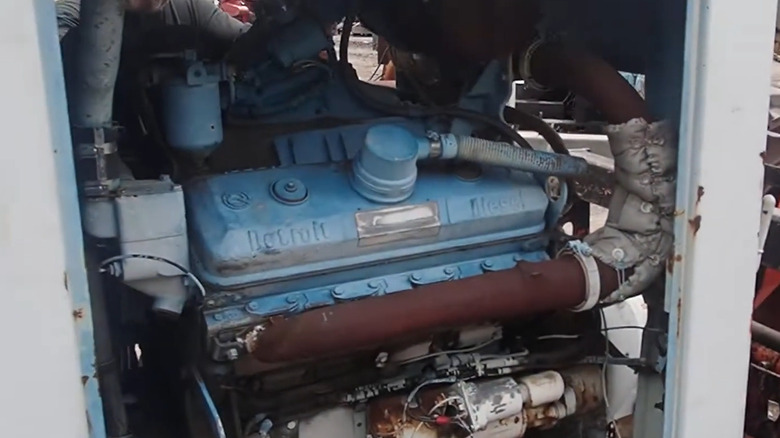
Detroit Diesel's greatest strength wasn't performance, but rather how modular its engines were. GM built a family of engines where critical components like pistons, connecting rods, and fuel injectors were interchangeable throughout the range. In other words, the smallest two-cylinder engine and the largest 16-cylinder engine in the lineup shared the same platform.
While this saved GM a lot of production and tooling costs, the biggest benefactor was the Allied war effort. By 1940, the series 71 became the diesel engine of choice for the U.S. military. At its peak, Detroit Diesel was producing around 6,000 engines per month for the war effort. These engines were widely used in vehicles ranging from trucks and tanks to navy patrol boats to amphibious landing crafts. While the two-stroke engines were designed for durability to survive the rigors of war, they were also designed for extreme field serviceability.
After the war, the Series 71 engines were an integral part of American lifestyles. Transit buses and fishing boats extensively used 6V71s while massive tugboats used larger 12V71 engines. Many of these engines were a favorite in the construction industry as well, though Detroit Diesel also branched out from the Series 71. For smaller applications, it introduced the Series 53, while mining and marine operations got the mammoth Series 149. In 1974, Detroit Diesel came up with the Series 92, also known as the "fuel squeezer" — a nickname that was actually a clever marketing ploy to demonstrate its fuel-sipping characteristics. However, Detroit Diesel's greatest strength ultimately led to its downfall.
The Achilles' heel
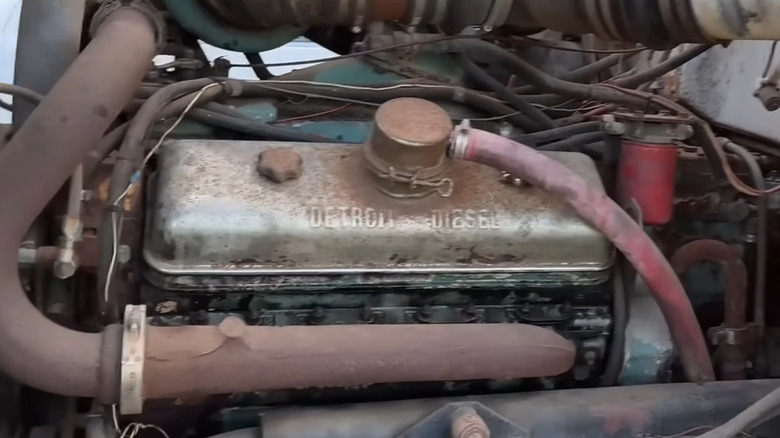
The 1973 oil crisis was a pivotal moment not just for the automotive industry, but for Detroit Diesel as well. Overnight fuel prices climbed from 38 cents to 84 cents per gallon, moving efficiency to the front of vehicle buyers' priority lists. This was a major blow for the two-stroke diesel engine, as fuel economy was one of its fundamental weaknesses. While it delivered twice the power stroke, it also needed more fuel to accomplish that feat. This problem was compounded by the mechanically driven supercharger, that, unlike a turbocharger, consumed power even at idling speeds.
The fuel crisis was just the beginning. By 1974, the rigorous Environmental Protection Agency emission standards kicked in. The two-stroke diesel's scavenging process gave the engine a performance advantage, but in the process, it released unburnt fuel into the atmosphere. This meant its hydrocarbon emissions were higher than those of four-stroke rivals. Then, there was the iconic scream of the Screaming Jimmy, which was exceptionally loud. That loudness made it harder for the engine to deal with regulations at the time, such as the 1972 Noise Control Act.
The downfall

Despite the inherent benefits of four-stroke diesels and the mass exodus of customers, the manufacturer stuck to what it knew best. There were a lot of reasons for Detroit Diesel to phase out its two stroke engine, but the company doubled down and launched the Series 92 in 1974 — a larger two-stroke diesel that, obviously, consumed more fuel. By 1987, the company finally moved into four-stroke territory with the Series 60. It was an in-line six-cylinder diesel engine with a sophisticated electronic control system, allowing its 12.7-liter variant to deliver 500 horsepower and 1,650 pound-feet of torque. More importantly, the new engine was far more fuel efficient than the competition.
However, the Series 60 came too late. General Motors, facing financial hardships, decided to pull the plug on Detroit Diesel. Even Chevrolet switched from Detroit Diesel to Duramax engines. Controlling interest of the engine builder was sold to Penske Corporation for a mere $300 million, effectively turning what was once GM's crown jewel into a fire sale liability. The Series 60 helped Penske claw back market share to 33% by 1993, but Detroit Diesel was ultimately acquired by Daimler Chrysler in 2000, marking its end as an independent American engine builder.
The Series 60 was discontinued in 2011. As for Detroit (the "Diesel" part of its name was dropped), it still builds heavy-duty diesel engines. In fact, in 2024, Daimler Truck announced a $285 million infusion in Detroit's Michigan manufacturing facility to supplement diesel engine productions, signalling a positive outlook on the manufacturer's future.