

Here's How Much A 2020 Mazda CX-3 Has Depreciated In 5 Years
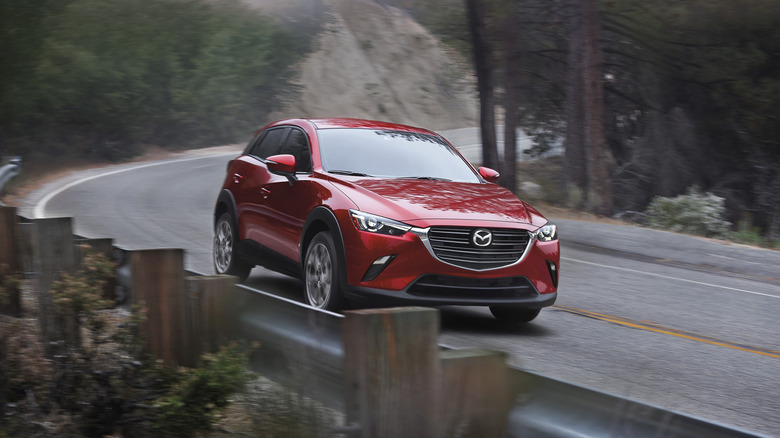
The Mazda CX-3 lived a short life in the automaker's U.S. lineup. During its 2016-to-2021 model year run, the subcompact crossover competed against rivals like the Subaru Crosstrek and Chevrolet Trax. Then, internal competition arose with the 2020 launch of the CX-30, which Jalopnik called a lower-budget Porsche Macan. This newer model became the automaker's sole entry-level SUV when the CX-3 was axed for 2022.
Despite the CX-3 joining the annals of discontinued nameplates, you'll still find examples for sale on the used car market. This is when depreciation becomes a buyer's friend. In the case of a 2020 Mazda CX-3, shoppers can expect a 38% to 40% loss in value from the original MSRP. That's a midrange number compared to category rivals that include the Subaru Crosstrek and Hyundai Kona.
Looking at 5-year-old cars can be a smart buy for used car shoppers. Examples from 2020 usually have experienced enough depreciation to make them less than new, while still having elements of modernity (infotainment and safety systems). We looked at data from iSeeCars and Kelley Blue Book (KBB) to see how the 2020 Mazda CX-3 stacks up. Of course, the 2020 model year was filled with many competitors in this category. So, we dove into the numbers for same-year challengers, including the Ford EcoSport, as well as the HR-V, Trax, Crosstrek, and Kona. Where are the Toyota C-HR, Nissan Kicks, and Kia Soul? They're not on the list because these models weren't available with all-wheel drive, which was available on the CX-3 and the others.
5-year depreciation for the 2020 Mazda CX-3
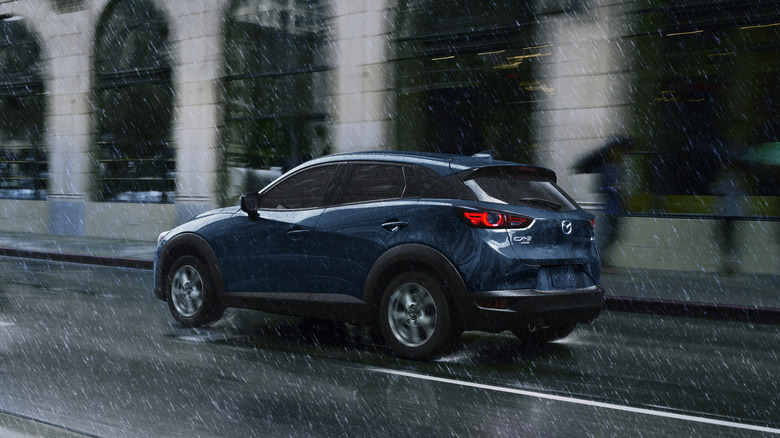
Data from iSeeCars shows that the 2020 CX-3 gets hit with a 38.1% depreciation rate over 5 years. From a cold, hard cash perspective, that means the original MSRP of $21,685 translates into a car worth $13,423 today. A real-world check on KBB shows dealer asking prices starting around $16,000 for accident-free examples with under 80,000 miles. iSeeCars reports an average selling price of $18,450.
KBB's estimates for the 2020 CX-3's 5-year depreciation are even worse at 40.5%, or a residual value of $12,903 ($520 lower than iSeeCars). However, KBB goes a few steps further by forecasting that the 2020 CX-3 will be worth $10,716 a year from now. In 2027, its value drops to $10,095, though these numbers can vary, depending on your location.
Regardless of the yardstick you use, the CX-3 doesn't appear to lose value much worse than its big brother, the CX-5. Depreciation for a 2020 Mazda CX-5 in the U.S. averages around 40% for the 2020 model year over half a decade.
How Mazda CX-3 depreciation compares against other subcompact crossovers
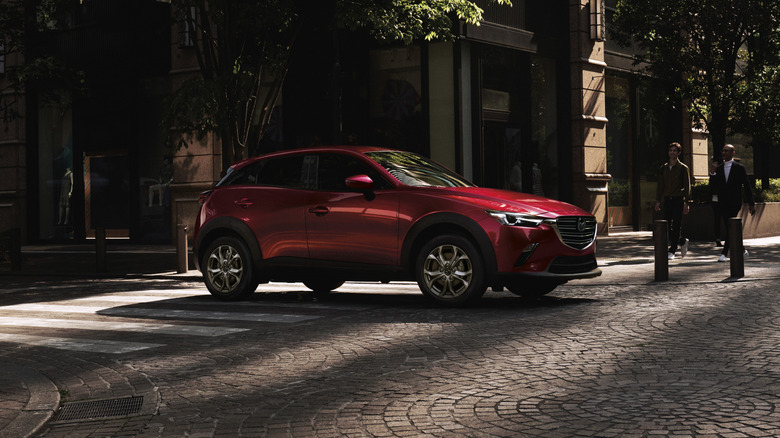
Looking at the iSeeCars figures, the CX-3's 5-year depreciation rate of 38.1% puts it in the middle of the group. The Ford EcoSport has the greatest loss of value, dropping by almost half (48.8%) over 5 years, leading to an average selling price of $15,419. Yet, there are far worse vehicles with faster depreciation – the Cadillac Escalade plunges by 62.9%.
Not too far behind the EcoSport is the Chevrolet Trax with a depreciation decline of 47.3% and a typical market price of $15,072. The Hyundai Kona and its $17,089 average selling price hover closer to the CX-3, but it still loses more over time: 42.2%.
The Honda HR-V and Subaru Crosstrek are the value-retention champs with near-identical depreciation rates of 33.9% (HR-V) and 33.6% (Crosstrek). Unsurprisingly, higher residual values mean higher market prices for these models as used cars. iSeeCars says the average 2020 HR-V goes for $19,787. It's $21,665 for a 2020 Crosstrek.