

Do Tire Shops Reuse Or Recycle Old Tires?
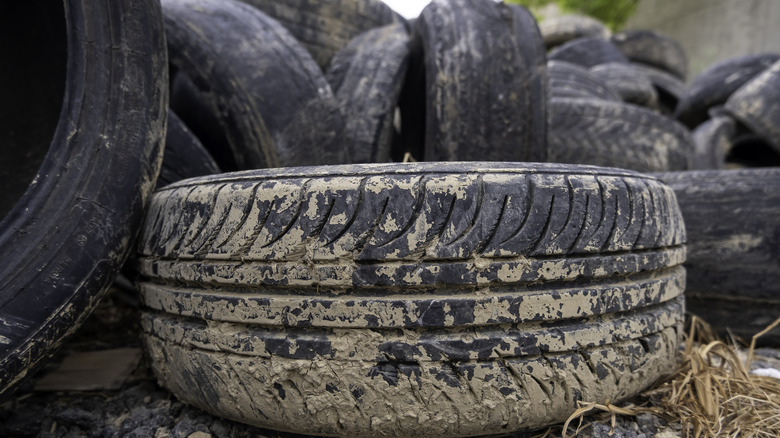
Tires don't last forever. Once the tread wears down sufficiently, it can become a safety issue, with motorists unable to get adequate traction on the road's surface. The problem is that the rubber compound comprising tires, along with the steel wires added for extra rigidity, don't degrade efficiently in a landfill. According to the EPA, by the end of 2003, there were an estimated 290 million old scrap tires in the U.S., which is why it's critical to find a more environmentally friendly method of disposal. It isn't just everyday drivers contributing to a stockpile of rubber either — do you ever wonder where all those used NASCAR tires go after a race?
Fortunately, nearly all U.S. states have enacted regulation surrounding tire scrap, with the exception of Alaska. Furthermore, the majority of states have laws against dumping old tires at landfill sites. So, instead, many tire shops will send your old tires to a recycling facility. It isn't free for the tire shop to recycle each tire, so sometimes a tire disposal fee will be passed on to you, the customer. Although, if the used tires are still in decent condition, in some cases, they can be retreaded and used again.
In addition, in many places across the country, when you register a vehicle or purchase new tires, the state collects a small fee. This fee is then used to support clean up efforts of old tires dumped irresponsibly and illegally. Unfortunately, not every tire shop recycles, as a situation in Nacogdoches County, Texas demonstrated in late 2025, when authorities discovered a dumping ground of several hundred used tires, potentially linked to a few unscrupulous retailers.
How does the recycling of old tires work? And then, where are they used?

While the tread can exhibit wear, tires are generally very durable, and the recycling process requires robust approaches. There are a few different methods that a facility can employ to put these tires in a more usable state. However, the first step is using magnets to remove the wire inside the tires, leaving just the rubber compound moving forward. The goal is to break down each tire into many smaller pieces. Machines can grind down the tire into various sizes, or the rubber can be subjected to a liquid nitrogen treatment, which causes it to become brittle and vulnerable to impact, allowing it to turn into a crumb-like consistency.
Following further refinement, these old recycled tires can end up in a variety of everyday materials, helping to keep them out of landfill waste. For instance, if you ever spent time on your high school's track, that rubbery surface was likely made using recycled tires. Those looking to spruce up their home's curb appeal may have used recycled rubber mulch around bushes or trees in their yards. You can even have recycled rubber shingles installed on your roof, which work great as a thermal barrier.
Burning old tires is toxic to the environment, but it goes beyond that

Burning tires releases things like volatile organic compounds, sulfur dioxide, and heavy metals into the air, but it can also negatively affect local water. However, while the toxic impact is widely discussed, there are also some additional concerns surrounding discarded piles of old rubber. It's not necessarily that people are always the ones directly setting fire to these old tires, but discarded tires can also can collect enough heat to light up on their own. And once the blaze gets going, it requires a significant number of resources to snuff out. How bad can it get? In one example, a fire raged for the better part of a year, spanned almost 50 miles, and cost millions to battle, back in Virginia in a 1983 incident.
Even when these old tires aren't burning, they still pose some threats in the form of infectious disease. Imagine a whole stack of used tires, as well as all the voids and open spaces that are created due to their shape. Not only does this eat up far too much space (in terms of an efficient landfill), but it becomes an ideal habitat for rodents, mosquitoes, and other pests. Illnesses such as hantavirus, plague, and leptospirosis, among others, can spread to people from large uncontrolled rat populations. Unfortunately, it isn't just rubber scrap piles they like, as your vehicle (if stationary for a long time) could be a prime nesting spot. Fortunately, there are proven ways to prevent rodent damage to your car, with solutions as simple as regular lawn maintenance and the use of dryer sheets, among other options.