

Breaking A Car Window From The Inside May Be A Lot Harder Than You Think

We may receive a commission on purchases made from links.
It's a nightmare scenario: You're trapped inside a car, sinking into treacherous waters. The water pressure is holding the doors shut, the electric windows have failed, and you're desperately beating at the windows with your fists as the water rises. Of course, since it's a nightmare, you can escape by waking up — but in real life, how hard is it to break a car window? Well, it may be harder than you think, even though a Nantucket seagull broke a car window by dropping a clam on it.
Two types of impact-resistant glass are used in car windows: tempered and laminated. Neither breaks as easily as the plate glass around your home, with both designed to prevent the large glass shards that turn you into a statistic. Your passenger window is often tempered glass, which will shatter into small, less hazardous pebbles, while your windshield is invariably laminated, with a sheet of vinyl sandwiched between layers of glass to hold things together in an accident.
It's far more difficult to smash a human-sized hole in laminated glass, which sticks together, than in tempered glass, which crumbles into pieces. And while your side window may be tempered glass, there's an increasing chance it's laminated, either for extra security, or to prevent the occupants being thrown from the vehicle in a rollover. When trying to bust out of your car in an emergency, you will fare a lot better if you know beforehand what kind of glass it has.
Do you know what you're up against?
The type of glass in your car window may be noted on a small manufacturing label in the corner. Any code starting with "T" means tempered glass, while "L" means laminated. If you can see layers when looking down at the edge of the glass, it is laminated. If you can't find a code, or can't determine the glass type visually, check this list compiled by the American Automobile Association (AAA), or contact the manufacturer.
Even if you have tempered glass in your side window, breaking it can be extremely difficult when you're inside the vehicle. From outside, you can swing a bat, throw a rock, even drop a clam from a great height. Inside, you have very little room, and precious few tools — if any — at hand. The chances of breaking a side window with your car keys, phone, fists, or even a glass bottle are next to none, especially when your movements are constrained by crash damage, a stuck seat belt, or injury.
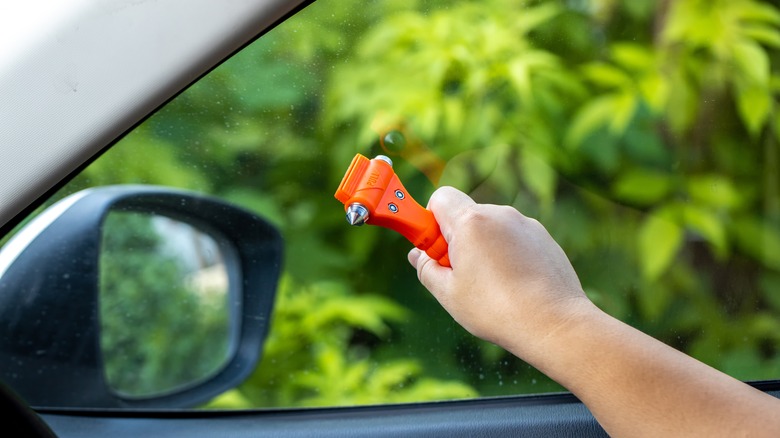
Fortunately, tempered glass has an Achilles' heel: it shatters when struck firmly with a pointed metal object. This is the Houdini trick that will get you out: the vehicle escape tool, which comes in a range of shapes and sizes, from an inexpensive hammer to a spring-loaded punch. (The New York Times' Wirecutter recommends the Lifehammer Evolution.) And if such a tool ends up joining the long list of features in your car you never use, then you can, at least, count yourself lucky for that.
Can I use the headrest?
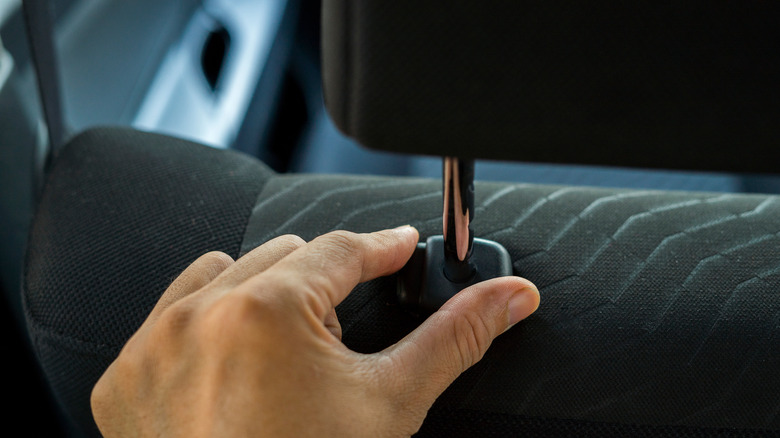
Would you rely on something you read on social media to save your life? One post making the rounds suggests using the metal supports of a headrest to break a car window in an emergency. But this is a bad idea. First, headrests are not designed for this purpose. Secondly, it can be perplexing just to detach them, as federal regulations require a deliberate action, separate from adjustment, for their removal. Good luck finding that secret panel in an emergency!
Even with the proper tool, car windows are stubbornly hard to break. In 2019, AAA tested a half-dozen escape tools on tempered glass windows and shockingly, two of the six failed to do the job, while none could break through laminated glass. If you're willing to fork out a sizable swag of cash, the sawtooth blade of a rescue tool like the Lifeline Evac-Pro could help you cut through the vinyl sandwich of a laminated side window, although it will take a lot of effort.
Admittedly, the chances of finding yourself in a scenario like this are quite low, with cars submerged in water making up only half of 1% of all crashes. On the other hand, the risks posed by driving into flood waters are very high. So rather than fumbling about with a headrest, use your head instead. Check what glass you have, and if it's tempered, buy a proper car escape tool and keep it somewhere handy.