

When Did Cars Start Using Catalytic Converters?
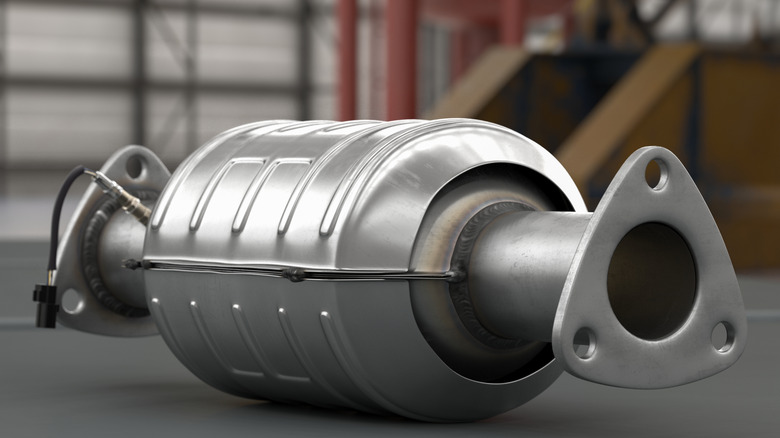
The gas-powered car has been with us for about 140 years now, transitioning from being a rich folks' toy to an essential of modern life. And as it grew in popularity, it had to adapt. By the early 1970s, muscle cars dominated American roads with huge-capacity V8 engines, heaps of horsepower, and miles per gallon nothing but an afterthought. Then the Arab emargo made oil suddenly far more expensive, and about the same time insurance premiums rose dramatically. These soaring costs gave Americans food for thought, and Japanese imports with economical four-cylinder engines became popular in the U.S., posing a serious threat to the American auto industry.
Furthermore, the dangers of using leaded gas had become too much for government, consumers, and producers to ignore. The '50s and '60s had been fun for the American auto industry, but the fun had to stop. At President Richard Nixon's request, in 1970 Congress created the Environmental Protection Agency, the EPA, which rolled out significant changes. Starting in 1973, unleaded gas had to be made freely available, and from the 1975 model year onward, all new cars had to be sold with an emissions-squashing device known as a catalytic converter. These devices had their downsides, but they also worked well in reducing tailpipe emissions. And so, starting in 1975, the expensive catalytic converter was mandatory on all new gas-powered cars sold in America.
How catalytic converters changed the auto industry

That's not to say that all American cars suddenly sported catalytic converters — only new models were mandated to have one. Older cars were still free to drive around discharging all sorts of emissions, but as these cars aged, most met their makers and were junked.
As the years progressed, emissions regulations only got tighter, and automakers got even smarter about cleaning up their acts. During the 1980s, most cars transitioned from carbureted engines to electronic fuel injection, and while the earliest versions of these systems had been a little dubious, now they quickly entered the mainstream. Furthermore, the development of engine control units and oxygen sensors helped to better monitor and control exhaust content and fuel-air ratios, further aiding the fight for cleaner air.
Catalytic converters got smarter over time, too, with the implementation of nano-sized catalyst particles and better washcoat technologies, which helped to improve the devices' efficiency. The longevity of catalytic converters improved, too, which is great, as they aren't exactly cheap to replace.
It's now been 50 years since the catalytic converter started to be used on automobiles, and in that half-century, we've managed to drastically clean up tailpipe emissions. We've even managed to come up with numerous zero-emissions technologies, such as EVs and hydrogen fuel-cell powered cars, but for those who still prefer good old-fashioned gas, the catalytic converter and other associated technologies still work well in reducing harmful emissions.