

This Solar Tonneau Cover Is A Neat Idea, But How Useful Is It?
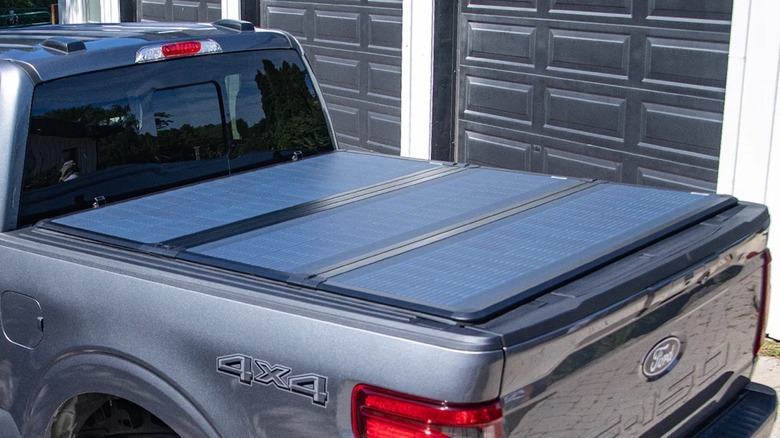
We all like getting something for nothing. If you're going to put a tonneau cover on your truck, it might as well have some built-in solar panels to generate free electricity. That's exactly what the Worksport Solis accomplishes, turning that flat space on top of your pickup bed into a solar array that can keep a power station charged up and ready to go. Worksport offers these for a wide variety of trucks from the little Ford Maverick to the big Chevy Silverado, with the recent addition of the Rivian R1T.
But don't go thinking that you can slap one on the back and never plug in your Rivian again. It's a great idea, but it does have some limitations. One is the price, ranging from $1,999 to $2,499, depending on the bed size. That's a lot of coin for a cover, but it's also not the most expensive one out there. I found some tonneau covers from Leer that cost as much or more than Worksport's, and they don't have solar panels built into them. You're paying more not only for the solar panels themselves, but for the custom engineering to integrate them into a tonneau cover. That's worth something, especially if you don't have to buy additional roof racks and mounting hardware for solar panels.
Size matters
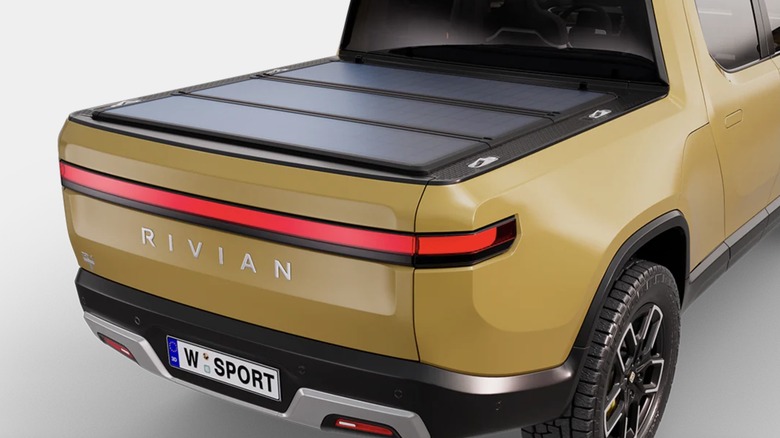
Worksport says the Solis tonneau cover can generate up to 600 watts of power. However, the key phrase here is "up to," for two important reasons. The first is that the wattage manufacturers provide is for optimal conditions, with full, unobstructed sunlight shining directly onto the panel. Conditions vary in the real world. It may be a cloudy day, or the panel may be partially in the shade. It almost never gets sunshine from straight overhead, so you're never going to get its full rated output. There's a huge seasonal difference, too, between the shorter winter days and the sun being lower in the sky, which means the panels don't generate as much power during what little time there's any sun at all. This goes for any solar panel from any manufacturer, not Worksport's in particular. Despite cloudless days, winters in the Arizona desert gave my camper van its least efficient charging of the year, requiring an extra solar panel on the ground just to keep up with my regular power use. In contrast, my batteries were fully charged by noon using only my rooftop panels during the summers in the northwest.
The second reason solar panel output varies is that the amount of power it can generate depends on the size of the solar array. That 600-watt figure likely applies only to the longest beds Worksport makes these for. The smaller the bed, the less surface area is available for solar cells. While Worksport does not provide outputs for specific makes, models, and bed lengths on its website, a recent press release announcing the Rivian R1T solar tonneau cover says it generates up to 250 watts for this relatively small bed. For comparison, Rivian says the smallest battery available on the R1T is the R1 Dual Standard, which stores 95.6 kilowatt-hours. Divide 95,600 watt-hours by 250 watts of charging per hour, and you get 382.4 hours to recharge it from empty at a rough estimate. The battery never drops to zero watt-hours in real life, but the point here is that it would still take hundreds of hours to recharge the truck solely from solar power. This is why we still need charging stations, except for EVs specially built to run exclusively off solar power.
Storing free energy
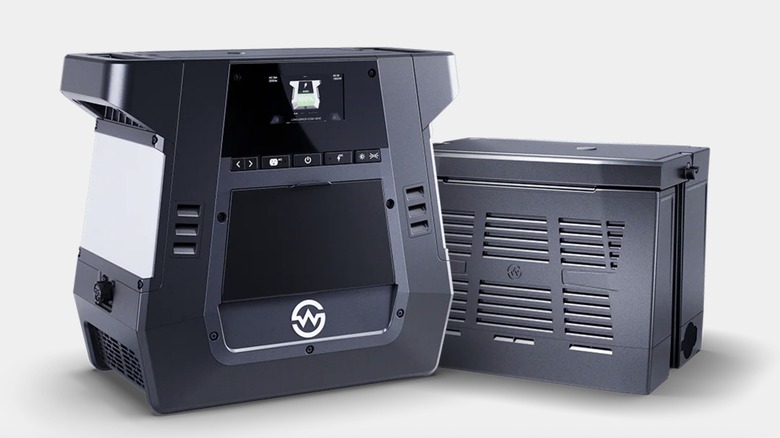
Solar panels aren't the entire story, however. The electricity they generate needs somewhere to go until it's needed, which is where a power station comes in. Worksport will hook you up with the COR portable power system for $949, including one battery and one "inverter," which not only provides up to 2,000 watts of AC power, but also contains all the other electronics needed to run your devices, including USB and 12-volt power ports. Worksport also sells a kit that lets you mount the power station securely in your bed. Each battery stores one kilowatt-hour of power. You can buy more than one battery, swapping the inverter between them as needed, if that's not enough power for you.
Because it might not be. For comparison, the Bluetti Elite 100 V2 is a power station with comparable input, output, and storage capabilities as the COR, except for the swappable batteries. It's one of Bluetti's smaller offerings, and sells for $599, far less than the COR. The Elite 200 V2 provides double the storage capacity for $1,099, only $150 more than the COR. There are also countless no-name power stations available for even less money, though perhaps of more questionable quality. Fortunately, the Worksport Solis comes with universal MC4 power connectors, just like any other solar panel. That means you can plug into any power station you want with the correct adapter, which often comes with the power station.
Or, you can buy Bluetti's 350-watt portable solar panel for $649, lay it on top of an ordinary tonneau cover, and have a complete system for less than the cost of the Worksport Solis itself. There's a lot to be said for the slick integration Worksport has done here, but if you're okay with a little less convenience and having to set it up every time, you can save a lot of money and get better electrical capabilities for less money. Many of my van life friends do exactly that every day.