

Full Vs. Mild Vs. Plug-In Hybrids: What's The Difference?
Not too long ago, if you wanted to get a new car, your only choice was a straight-up internal-combustion vehicle with a choice of gasoline or diesel. While you can still do that today, there are many more options for those looking for their power train to be electrified. Most of these options are a hybrid of some type or another.
There are three different types of hybrids out there. Traditional hybrid systems make up the average, while mild systems are basic and plug-in hybrids are advanced. They're all electrified, but they all work in different ways. The electrified options don't end there, either, because you can also choose to get an extended-range EV or a fully-electric vehicle.
It's no surprise that some people might be confused by all of the options. As companies make more hybrids and fewer non-electrified vehicles, it's helpful to know what the differences are and why you might want one power train over another.
What's a mild hybrid?
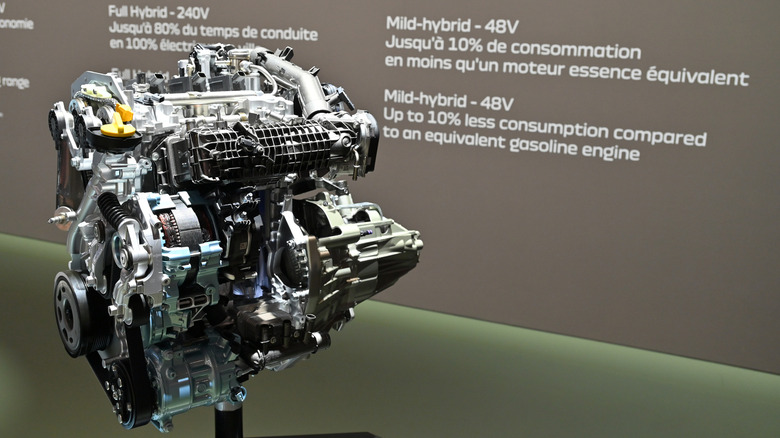
A mild hybrid system, sometimes called a 48-volt mild hybrid, has the least amount of focus on electric power. A mild hybrid cannot drive the vehicle on pure electric power alone, unlike every other hybrid. With the advancement of 48-volt electrical systems, automakers add a small electric motor to provide additional power to the engine when accelerating. Since the electric motor assists the engine at low speeds, there is a slight benefit to fuel economy.
The integrated starter generator of modern vehicles tend to restart the car in stop-start situations, performing the task much more smoothly than non-assisted systems. One major complaint about these automatic stop-start systems is the jarring nature of engine restarts, which can put stress on the car's starter. The integrated starter generator in mild hybrids is significantly smoother and designed to handle these many restarts. During braking or coasting, energy is recuperated, allowing it to be reused when the vehicle accelerates.
This is often the least-expensive hybrid option and is even used in big pickup trucks, like the Ram 1500 Hemi with eTorque and 'Symbol of Protest' badging. But compared to other hybrid systems, the benefits of a mild hybrid are also the smallest.
What about the traditional hybrid?
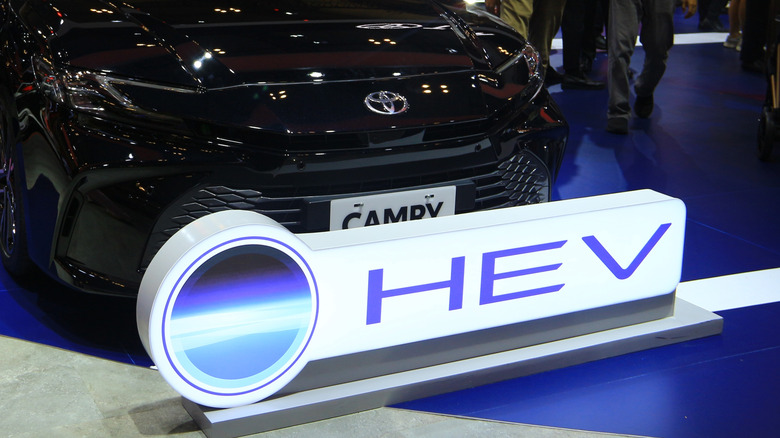
A traditional hybrid system, which Toyota calls a self-charging hybrid, is what dominates the marketplace in the United States. Toyota even believes so strongly in them that the new RAV4 is all-hybrid in its latest iteration.
In hybrids, the gasoline engine is assisted by an electric motor during most vehicle operations, with the two components working together to improve performance and fuel economy. A hybrid can drive some distance on electricity alone, and that electricity is recuperated through regenerative braking or by running the gasoline engine. There's no need to plug it in -– in fact, there is no way to plug them in –- and the computer ensures the battery is charged to give you maximum performance when you need it.
Batteries are typically small on these types of hybrids. The Corvette E-Ray uses a 1.9 kWh battery, for example, which doesn't add much weight overall to the vehicle. Plus, stop-start events are even smoother in a hybrid, as the engine usually turns off while slowing and won't turn on again until the vehicle is moving. At low speeds around town, the engine isn't likely to run. This helps provide fuel savings while also producing fewer tailpipe emissions.
A hybrid with a plug?
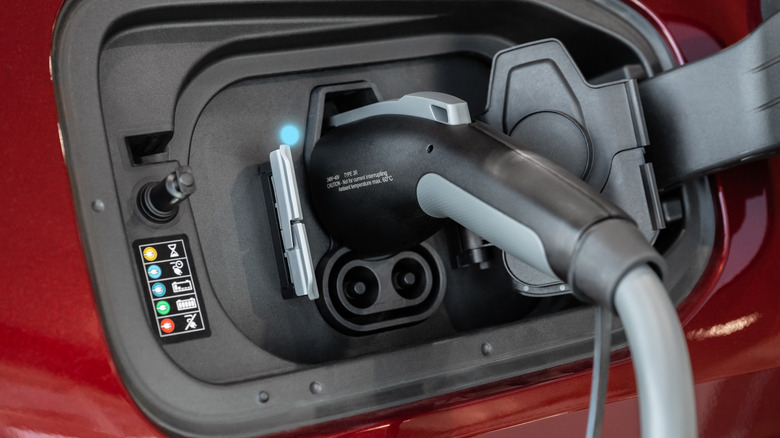
The plug-in hybrid is a traditional hybrid with the addition of a plug, letting it recharge from a wall outlet. Plug-in hybrids typically have bigger batteries on board so they can travel longer distances on electricity alone. Some have over 500 miles of all-electric range, meaning that many owners never even use the gas engine during their daily commutes.
Plug-in batteries assist the gasoline engine like traditional hybrids and similarly recoup energy. They are typically heavier than conventional hybrids, but the fuel economy benefits often offset that. The plug-in hybrid technically doesn't actually need to be plugged in, though you get significant benefits for doing so. Adding driving range from the power grid is cheaper than adding driving range from the gas pump; the more miles you drive on electricity, the more money you save over full gas power.
You might not drive enough to need the onboard gas engine, but it's there for longer road trips or situations where you need the extra range. Even if you never use it, it might sometimes fire up to run through a fuel-refreshing mode, helping to prevent the gas in the tank from going bad. The plug-in hybrid is often viewed as a stepping stone to a full EV, but it's more complicated due to having the EV functionality alongside the gas engine. Still, for the right person, a plug-in hybrid can make the perfect one-car solution.
About about EREVs and dedicated BEVs?
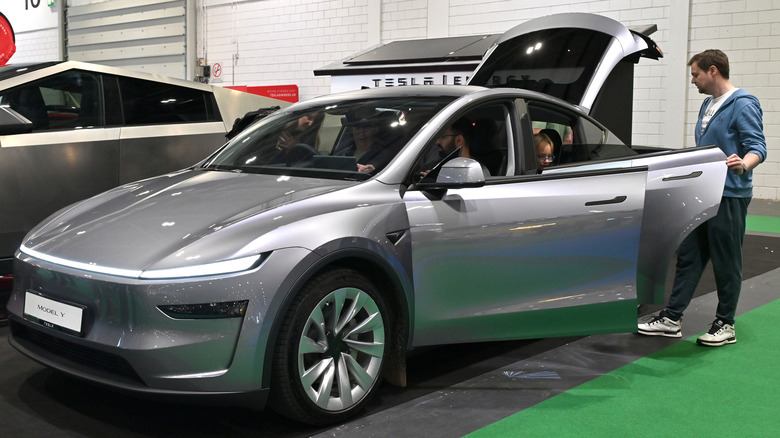
It's worth mentioning that the automotive industry has two other electrified technologies. The full electric vehicle, sometimes referred to as a battery electric vehicle (BEV), runs completely on electricity. It has a plug and can be recharged in several different ways, including the regeneration of energy under breaking. They also have the biggest batteries, so they require the most rare earth resources to make the packs. Toyota says it can make 90 Prius hybrids with the same resources needed to make one BEV.
There's also the extended-range electric vehicle, sometimes called an EREV. It works functionally like a fully electric vehicle, but it also has a gasoline generator on board to make sure the battery never runs out. Practically speaking, it's not too far from a plug-in hybrid, but the engine on an EREV doesn't drive the wheels at all. It's only there to recharge the battery. The new F-150 Lightning will be an EREV, and Ram's REV will use a similar system.
What's next?
You wouldn't be blamed for expecting the mild hybrid to be phased out for more traditional hybrid vehicles. While a mild hybrid offers some improvements for the driving experience, there aren't enough fuel economy or emissions reduction benefits to justify the technology's continuation. Meanwhile, the non-mild hybrids are likely here to stay. They remain as an affordable way to electrify a vehicle for the sake of improving fuel economy and reducing carbon emissions. Brands like Toyota will likely have its entire fleet composed of either hybrid or plug-in hybrid vehicles (plus some dedicated EVs).
Plug-in hybrids will also continue to expand, but they perform best when they can be plugged in. For those who have a place to charge at home or at work, these hybrids can provide the benefits of dedicated electric vehicles while still having the security and peace of mind offered by gasoline engines. Each solution makes driving greener and helps with fuel economy, as well as the cost of that fuel paid by the consumer. When considering all of this, it's not a surprise that the industry continues to move in the direction of hybrids.