

What Are The Differences Between Ceramic And Semi-Metallic Brake Pads?
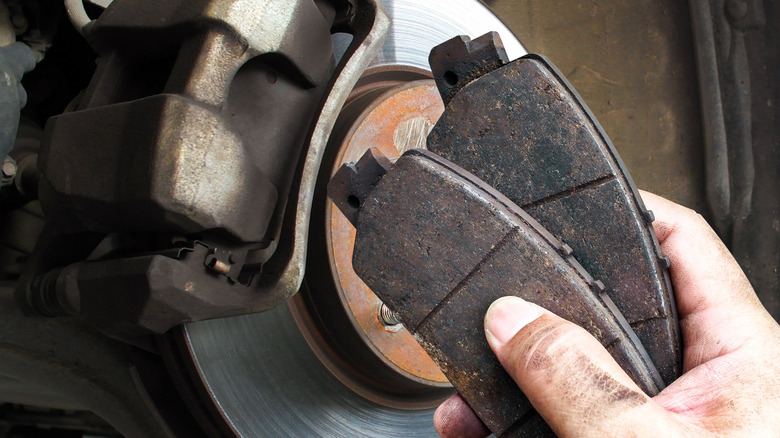
Most modern vehicles use one of three different types of brake pads: organic, ceramic, and semi-metallic. In motorsports, some vehicles feature carbon-ceramic pads because they offer superior stopping performance — but they come at a much higher cost. For everyday drivers, the main choice often comes down to ceramic vs. semi-metallic. So, what are the differences between these types of brake pads?
In general, metallic pads tend to be cheaper than ceramics while also being more well-suited for high-stress applications. This means that they perform better for heavy braking and towing, largely thanks to their better heat dissipation. On the other hand, ceramics are usually quieter, and they're typically able to last longer while producing less brake dust. The choice between these two often depends on your driving habits and what you use your car for.
While there are different ways you can stop brake dust from clinging to your rims, if you want cleaner-looking wheels with the least amount of hassle, ceramic pads are a better bet. Moreover, if you spend most of your driving time commuting and want a smoother ride with less brake noise, you'll want to stick with ceramic. On the other hand, if you live in extreme weather regions, use your car for towing and aggressive driving, or want to save a bit of money, you'll want to consider semi-metallic brake pads instead.
Which pad fits your lifestyle and driving conditions

Besides the variables mentioned above, there are additional considerations to keep in mind. For starters, semi-metallic and ceramic brake pads often come with their own feel for the brake pedal. Ceramic pads combine ceramic fibers with other materials, allowing them to compress less under pedal pressure – thus giving a more consistent and linear feeling while engaged.
Semi-metallic brake pads are composed of heavier metal particles. Other than the fact that they conduct heat better, these materials can make the pedal feel comparably firm. If you own a truck, an SUV, or some other heavy vehicle that often carries significant loads, semi-metallic brake pads will allow you to maintain better braking performance over time. They are also less likely to experience brake fade if you push them really hard.
The climate of your home region also plays a pivotal role. In particularly cold weather, semi-metallic brake pads are likely to perform better. Unlike ceramic alternatives, they remain effective without requiring extra warmth. Meanwhile, ceramics will have an easier time in more neutral climate conditions. This is especially the case on highways.
Brake pad longevity and maintenance
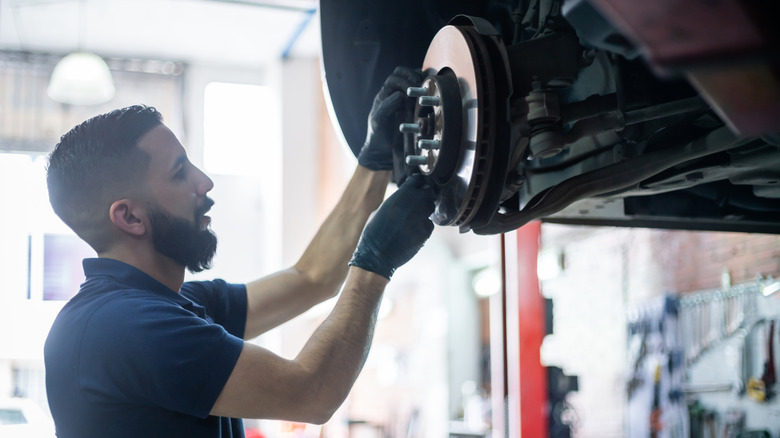
In our ceramic vs. organic brake pads comparison, we mentioned how ceramic pads can crack your rotors, but you can avoid this by bedding them according to manufacturer's recommendations. As for semi-metallics, their abrasiveness can also wear out your rotors more quickly. Plus, since they usually generate more brake dust, it's also important to clean them periodically.
According to a 2021 study published in Problems of Tribology, ceramic brake pads showed about 47% lower wear loss than semi-metallic pads at a sliding speed of 0.75 m/s. However, in environments concerning heavy-duty and high-speed braking, semi-metallic pads can perform better. The study notes that sliding speeds of 1.76 m/s and higher caused ceramic pads to exhibit about 11% more wear loss than semi-metallic pads. Regardless of the types of brake pads, though, it's also very important to keep from overloading your vehicle. The more weight you put on it, the more wear you will cause.
Also pay attention to how thick your pads are. Replacing them is generally recommended when their thickness falls below three millimeters. Nevertheless, always be on the lookout for squealing and grinding noises, longer stopping distances, and pulses in the pedal, as these are some of the most common symptoms of pads needing a replacement. The reality is that brake pad recommendations can often be a mess since there are no one-size-fits-all solutions. It all depends on your applications and what you deem most important.