

Don't Listen To Google AI, The $7,500 EV Tax Credit Doesn't Exist Anymore

Buying a new car is already a daunting and confusing process, and it's only being made harder by misleading and — in some cases — blatantly incorrect information being posted online by artificial intelligence for the world to see, which is what we have here today. President Donald Trump famously killed the $7,500 electric vehicle tax credit back at the end of September, but apparently nobody told Google's AI Overview response system.
Somehow, this bot can correctly identify the criteria a car and the buyer must check off in order to qualify for the tax credit. It knows the car has to be assembled in the U.S. It knows the MSRP of a car has to be under $80,000, and it knows the income level the buyer or lessee needs to be under in order to take advantage of the incentive. However, it seems pretty much unaware of the fact that the credit has now been dead and gone for well over a month, and this is super concerning for the general public.
Not an isolated incident
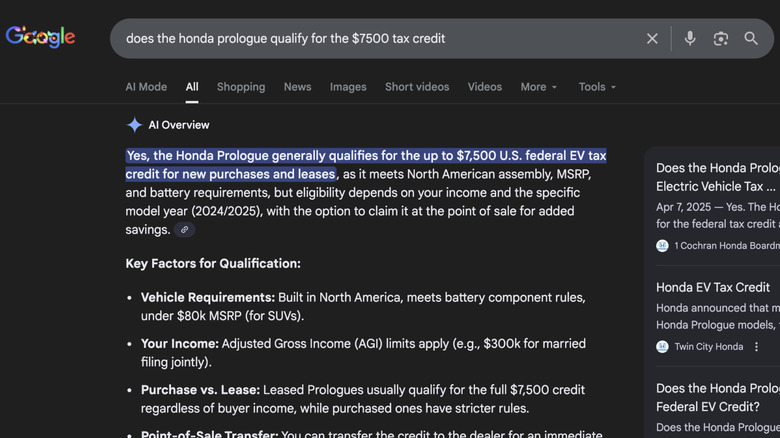
This isn't just a weird one-off situation where I caught Google's AI with its pants down, either. I used the same simple search for 20 cars that were eligible for the $7,500 EV tax credit when it went away at the end of September: "Does [CAR] qualify for the $7500 tax credit?" It got it wrong nearly every single time.
Here's a list with links to my results so you can follow along on this journey:
- Acura ZDX
- Cadillac Lyriq
- Cadillac Optiq
- Cadillac Vistiq
- Chevy Blazer EV
- Chevy Equinox EV
- Chevy Silverado EV
- Ford F-150 Lightning
- Genesis Electrified GV70
- GMC Sierra EV
- Honda Prologue
- Hyundai Ioniq 5
- Hyundai Ioniq 9
- Kia EV6
- Kia EV9
- Tesla Cybertruck
- Tesla Model 3
- Tesla Model X
- Tesla Model Y
Every single answer was virtually identical:
"Yes, the [Electric Vehicle] generally qualifies for the up to $7,500 U.S. federal EV tax credit for new purchases and leases, as it meets North American assembly, MSRP, and battery requirements, but eligibility depends on your income and the specific model year (2024/2025), with the option to claim it at the point of sale for added savings."
There were some variations from page to page, but that was the overall gist.
Some strange quirks
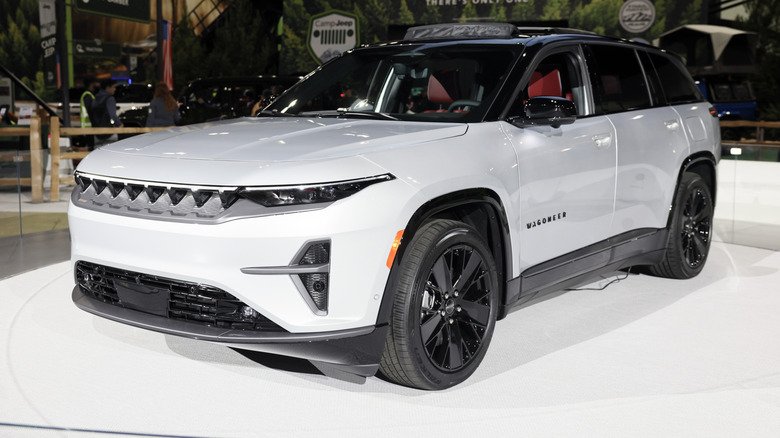
You probably noticed that there are 19 cars on the list above, and that means that Google was correct about exactly one car on that list of 20: the Jeep Wagoneer S, and judging by Stellantis' sales report, not enough people are buying those to notice an issue with Google in the first place.
In any case, Google correctly identified that the Wagoneer S "did qualify for the full $7,500 federal EV tax credit," through the end of September. It went on to say that "new legislation significantly changed the rules starting October 1, 2025, impacting future eligibility, so buyers now need to check current dealer offers." I really wish I could tell you why Google only knows the Wagoneer S no longer qualifies, but your guess is as good as mine.
Taking the strangeness up a notch, Google clearly knows what cars didn't qualify for the credit when it was killed off, so if you look up whether or not the Mustang Mach-E qualifies, it'll correctly identify that it doesn't. However, it says it doesn't because of a battery sourcing issue (which was true back in September). The search engine makes no mention of the credits being discontinued.
This isn't the first time Jalopnik has waded into the muck that is Google's AI, Earlier this year, we debunked a widespread myth (that Google's AI picked up as fact), saying Ford used Spanish Moss in early Model Ts without cleaning or decontaminating it. Because of that, legend says customers were getting bitten in the ass by all sorts of nasty bugs. Now, when you look up "Ford Spanish Moss," our story is one of the first to pop up.
Of course, folks like you and me — people who know far too much about cars — know to look past this sort of AI junk, but most people aren't like us. Unfortunately, they'll take Google's word for it, and by the time they get to the dealership and sign the paperwork, it might just be too late. It's emblematic of a much larger problem, not just in the automotive industry, but in the world as a whole. The entire internet has been ensloppened by AI garbage, and there isn't much we can do to stop it other than spreading the good word that it is terrible.