

Can You Jump Start A V8 With A 4-Cylinder Car? It's All About The Amps
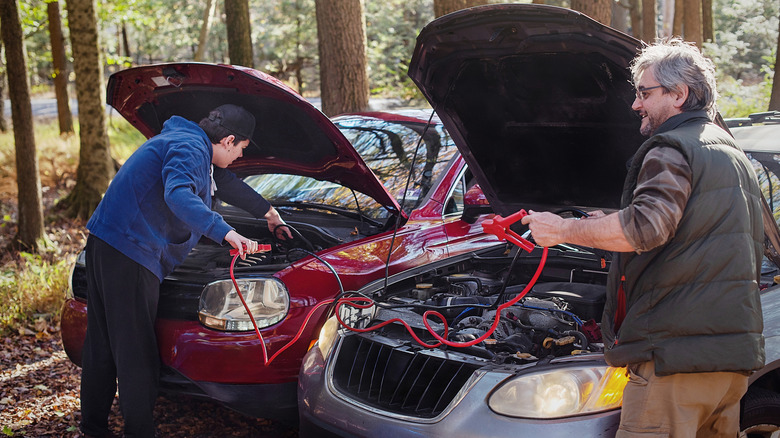
Okay, we'll admit from the start that this is sort of a trick question. Technically, you can indeed jump-start a V8 with a four-cylinder, but the ability to do so really has nothing to do with cylinder counts. Remember, you don't need a running car — or its engine — to complete a jump-start. You can jump-start a car without cables, too. What you do need are enough amps — and, perhaps, a quick refresher on what actually happens when you start a car this way.
Normally, you turn the key in your ignition (or press the ignition button), allowing your car's starter to draw electricity from the battery to get the engine components moving. When you jump a car, whether you rely on jumper cables or portable jump starters, it's that outside source that provides the electricity instead. Once the second car's engine starts and runs for a few minutes, it's enough to recharge its own battery, and you can disconnect it from the jumper source. So the key here is that you need enough electrical power — measured in amps — to turn the engine of the car you're jumping.
That does mean bigger engines with more cylinders are likely to need more electrical power to start than smaller motors. But that's because of their weight, not necessarily their cylinder count. And it still means you have to know how many amps your jumper puts out compared to how many the target engine requires.
How many amps are enough to jump-start a car?

Amperes, usually shortened to amps, are named for André-Marie Ampère, a French mathematician/physicist working in the early 19th century — although the current definition of an amp wasn't formalized until 2019. We're not going to wade too deep into those waters, but you can think of an amp as measuring how fast the current of electricity is flowing. In the auto world, however, this is usually fine-tuned into cranking amps (CA) and cold cranking amps (CCA). Both measure how many traditional amps the battery can provide over a 30-second period without letting its voltage fall below 7.2 volts; CA does the measuring at 32 degrees Fahrenheit and CCA does it at 0 degrees Fahrenheit.
It takes about 400-600 CCA to jump-start a typical gas-powered car. As mentioned, though, the bigger the engine — in terms of the weight of its rotating components — the more amps you will need. A truck with a heavy diesel engine, for instance, can require 1,000 CCA. Cold weather and older batteries can bump up CCA requirements, too. The best way to know how many amps you need for a specific vehicle's battery, of course, is to check its owner's manual. (Here's a bonus tip if you're shopping: The best car batteries, according to Consumer Reports, aren't always the most expensive.)
What happens if I use the wrong number amps to jump-start a car?
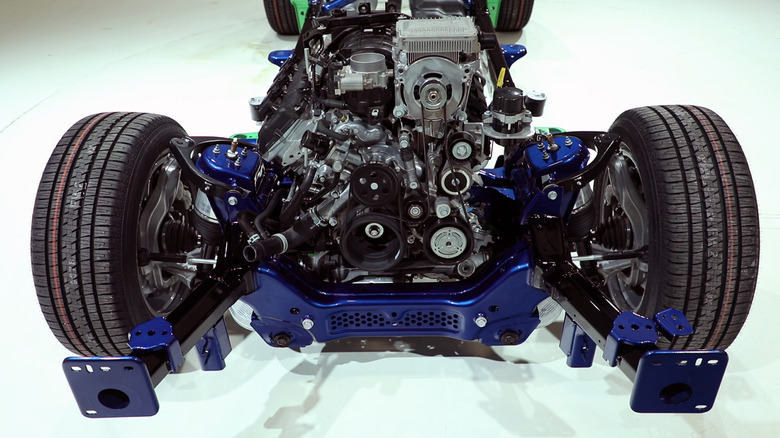
Although an electrical source with the right number of amps is vital to jump-starting a car, you can rest easy knowing that — generally speaking — using the wrong number of amps won't damage your vehicle. Naturally, though, using too few amps won't start your vehicle, either.
Thanks to the operation of Ohm's law, an electrical device — like a car with a dead battery — is limited to how many amps it draws directly based on voltage and resistance. We'll have to inflict a little bit of math on readers here, but the relevant formula is essentially current (amps) = voltage/resistance (ohms). In other words, as long as the good battery and the bad one have the same voltage and resistance, the current flows at the same rate. (Ohms, by the way, are named for one of Ampère's contemporaries, the German scientist Georg Ohm.)
With all this talk about traditional 12-volt car batteries, you may be wondering about the growing number of non-traditional cars with 48-volt architectures — sometimes called mild hybrids. The good news is that these vehicles continue to leverage 12-volt batteries for starting, so jumping one should be as simple as jumping any other gas-engine car. The bad news? If the 48-volt setup happens to go dead, a new mild hybrid battery can cost an average of $1,500.