

One Of The Worst V8s Ever Made Almost Went Into A Saab (Half Of It Still Did)
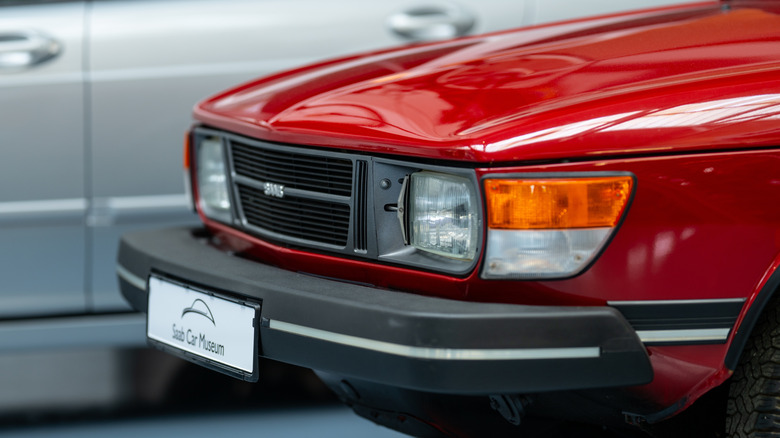
Oh, Triumph Stag V8, were there any correct decisions made at any point during your design? And how did four of your eight cylinders end up powering the Saab 99? You get around, you little scamp. Well, half of you, anyway. There is a frankly scandalous amount of DNA shared between the British maker of leaky sports cars and the Swedish manufacturer of quirky sedans prone to torque-steer – and the conceptions of the Stag and the 99 can be traced back to 1965.
As Triumph was hammering out a new engine design to replace the ones it had used since the '40s, Saab was paying British consultancy firm Ricardo to develop an engine for its upcoming 99. As Ricardo worried about development costs, the company decided to arrange a date between Saab and Triumph. The pair hit it off, and Saab fronted the bill to finish the engine, which would become Triumph's single overhead-cam slant-four. This new four-banger would also power the Triumph Dolomite, which debuted in 1971, four years before Rudy Ray Moore would forever associate the name "Dolemite" with the coolest movie you can watch when "Shaft" isn't on streaming.
Now, it's not entirely fair to say that the 1967-1984 Saab 99 is powered by half of a Triumph Stag V8. It's more accurate to say that the 1970-1977 Triumph Stag is powered by two Saab 99 four-cylinders. Yes, in a reversal of the Pontiac Trophy 4 or Porsche M44 3-liter four-cylinder, Triumph decided that it could create an engine for its sports car by Frankensteining two slant-fours to create a 2.5-liter (later 3-liter) V8. If the idea of conjoined engines from the masters of spontaneous oil leaks doesn't scare you, then what will?
The Triumph Stag V8's many sins
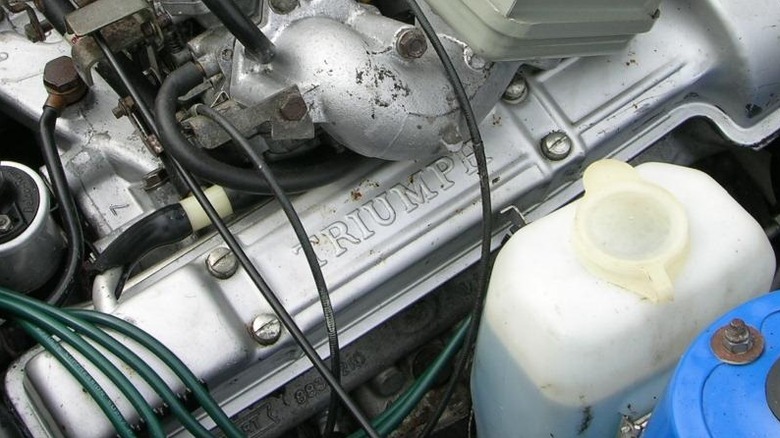
The Bosch mechanical fuel injection system Triumph initially used was too unreliable, even by the automaker's standards. Carburetion fixed that, but the horsepower dropped. The displacement was upped to compensate. Unfortunately, Triumph increased the bore rather than the stroke, so as it jumped from 2.5 to three liters, the engine became ridiculously oversquare and lost its torque potential.
Boring out the block also caused the cylinder walls to invade the space for the coolant passages, so Triumph made the coolant passages smaller. Not a bad idea, except that the Stag water pump was prone to failure, exacerbating the insufficient cooling capacity. That water pump sat on top of the engine, higher than the radiator fill cap. This meant the entire car had to be tilted back to ensure coolant actually reached the pump. When coolant leaked — not "if," but "when" – the pump would starve, break, and overheat the engine. Oh, and the pump's gears would sometimes shear all their teeth for no apparent reason.
We're not done yet. Half of the head studs were perpendicular and the other half skewed 20 degrees, causing the aluminum heads to warp as studs heated at different rates. Plus, electrolysis between the heads and the steel studs often made them difficult to remove. It gets worse from there, as electrolysis could destroy the cooling system, too, unless owners used corrosion-inhibiting coolant (which rarely happened during the engine's time). Meanwhile, timing chains needed replacing every 25,000 miles. And since Stag V8s are interference engines – meaning the valves moved so far into the chamber that they'd slam into the pistons if the timing was off — a snapped timing chain is catastrophic.
Saab considers Stag V8 power for the 99
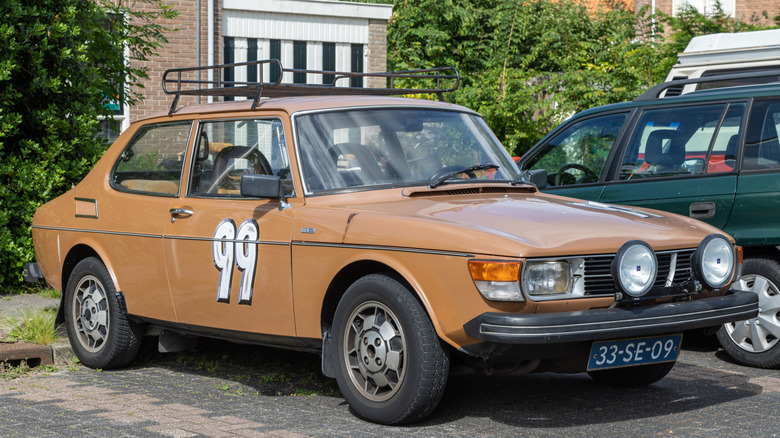
Saab considered saddling the 99 with the Stag's V8. Thankfully, though, it relented. The company had already redesigned and reworked the Triumph slant-four, modifying the head and block and upping the stroke, among other tweaks. In 1972, it was making 120 horsepower, but that still wasn't quite enough.
Stag V8s were installed in 48 Saab 99 models, which was surely the worst engine swap in history. Thankfully, Saab engineer Per Gillbrand had a better idea: turbocharging. Since Saab wanted to make a more powerful 99 for the American market, Gillbrand said, according to Hagerty, "All engines have an oil pump, a fuel pump, and a water pump. So why not an air pump, which is all a turbo really is?" When the Saab 99 Turbo debuted in 1977, it made 145 horsepower. This is the same figure as the Triumph Stag V8, so performance wasn't compromised.
Perhaps soured by the awfulness of the Stag's engine, Saab's aversion to V8s would continue. Its factory in Uusikaupunki, Finland crafted a V8 out of two Saab fours and stuffed it in a 9000 for testing. It never went into production. The V8's fuel thirst clashed with Saab's propensity for small, efficient turbocharged engines. A few have withstood the tests of time, though:
The Saab 9000's platform-mate, the Lancia Thema 8.32, received a Ducati-built cross-plane crank version of Ferrari's 308 V8, which is as close as the world ever came to a factory V8-equipped Saab. And no, the Saab 9-7X shouldn't count, it was basically a badge-engineered Chevy Trailblazer. Though, the 9-7X Aero at least got the 6.0-liter 390 hp LS2 V8, so maybe it's slightly less egregious than the rightfully forgotten Saab 9-4X, also known as a thinly-veneered Cadillac SRX.