

How Chevy's Double Hump Heads Shaped Small Block V8 Power
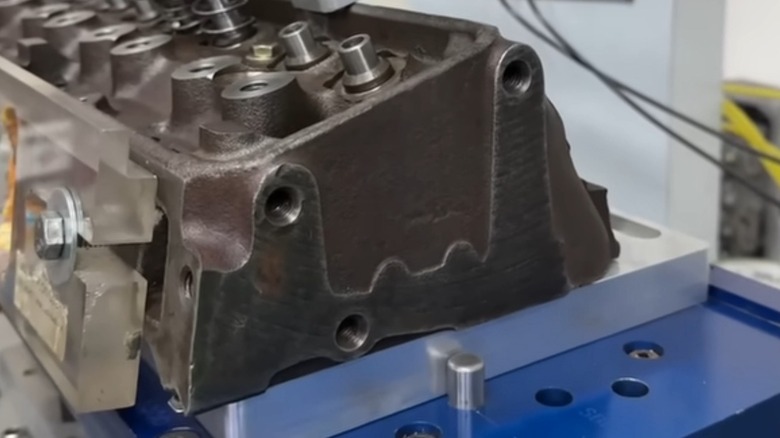
The 1960s were a time that saw muscle cars with the best names and automakers racing for horsepower supremacy. While drag racers often turned to large displacement big-block engines for power, others preferred a little more finesse and looked for ways to increase the power of the small-block V8.
The small-block Chevy (SBC) V8, the engine that's powered more cars than any other, was a leader in the small-block horsepower race. Chevrolet — and General Motorsm — produced several iterations of the SBC V8 with varying displacements and successive generations. But it all started with the 265 cubic-inch "Turbo Fire" V8 powering 1955 Corvette and Bel Air models.
If we consider the SBC to be one of the founding members of the small-block power movement, the double hump cylinder heads were its declaration of power. These heads (named for the shape of the raised casting mark identifying them) were first seen on the 1962 Chevrolet Corvette's 327 cubic-inch small-block. Hot Rod magazine calls Chevy's double hump heads "the gold standard" and says they are "among the best stock heads ever allowed in racing."
Chevy's double hump heads are sometimes referred to as "Fuelie" heads since their first appearance was in the fuel-injected 327. That engine was a shot across the bow of the other American automakers with its 360 horsepower. Other small-block V8s of the same period, or released the following year, include Ford's HiPo K-Code 289 with 271 horsepower and the 260 hp 318 Power Pack from Mopar.
What's special about Chevy's double hump heads?
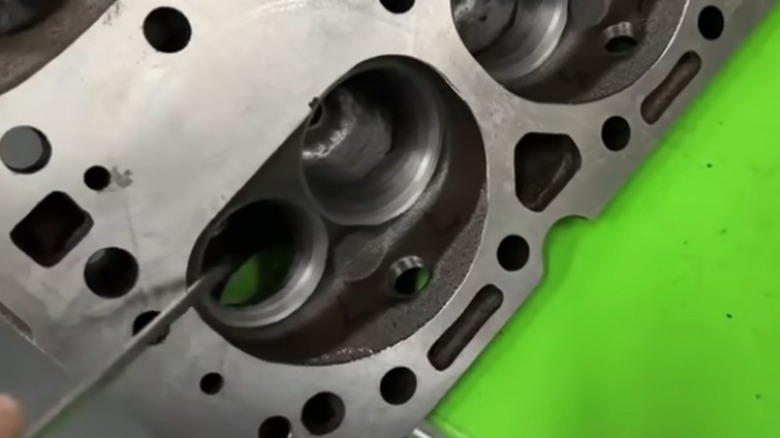
Over approximately 30 years of double hump cylinder head production, there were millions of copies made using a number of unique castings. The different castings are identified by the last three digits of their casting numbers, with examples like the 291, 461-X, and 462. The best double hump Chevy heads feature large valves measuring 2.02 inches for the intake and 1.60 inches on the exhaust side, as opposed to the smaller 1.94- and 1.50-inch valves found on more basic double humps.
Another advantage found on Chevy's double hump heads is their small combustion chamber, often measuring in a range from 62cc to 64cc. While other Chevy heads can be machined to achieve 62cc chambers, the double hump heads feature a closed-chamber design which offers more optimized fuel combustion.
While there are pros and cons to porting your cylinder heads, the double hump heads seldom need more than a touch up. In a tale of a 1962 Corvette rebuild shared by MotorTrend, master engine builder Joe Sherman found the ports of the stock 461-X double hump heads impressive. The 461-X has more intake flow potential than standard 461 double humps due to the "higher floors and roofs" present in the intake ports. During flow testing, Sherman found that the 461-X head's flow volume was about as good as a late-model Vortec head.