

The Biggest Differences Between The 5.3 And 6.2 GM Engines
What's the biggest difference between General Motors' 5.3-liter and 6.2-liter V8s? 0.9 liters. Goodnight!
Alright, 5.3s and 6.2s contrast more than that, and quite a bit, too. There's plenty to discuss, even when omitting the 4.8-liter V8 or the 4.3-liter V6 based on the same architecture, which is a completely different engine from the 4.3-liter V6 from before the 2000s. GM loves reusing engine codes, brand names, and displacements.
The company's truck engines used to be called "Vortec," not to be confused with Vortech, manufacturer of superchargers. (And yes, people have put Vortechs on Vortecs.) The name Vortec is a portmanteau of "vortex" and "technology." It was first used to describe the efficient "vortex swirling" that happens in the combustion chambers of the GM/Chevrolet 4.3-liter V6 (from the '80s), which wasn't actually part of the Vortec lineup. Then, in 2014, GM rebranded the Vortec lineup to "EcoTec3." These engines have nothing to do with GM's Ecotec four-cylinder engines — without the capitalized T. And now, the new 4.3-liter V6 actually is part of the EcoTec3 lineup that replaced the Vortec lineup.
This brings us to the Gen-III, Gen-IV, and Gen-V "small-block" 5.3 and 6.2 V8s. Colloquially, people often refer to these engines as "LS" and "LT," but technically, "Vortec" and "EcoTec3" would be more accurate, as the truck engines have different tuning and parts here and there.
5.3 vs. 6.2 part one: Housekeeping and block material
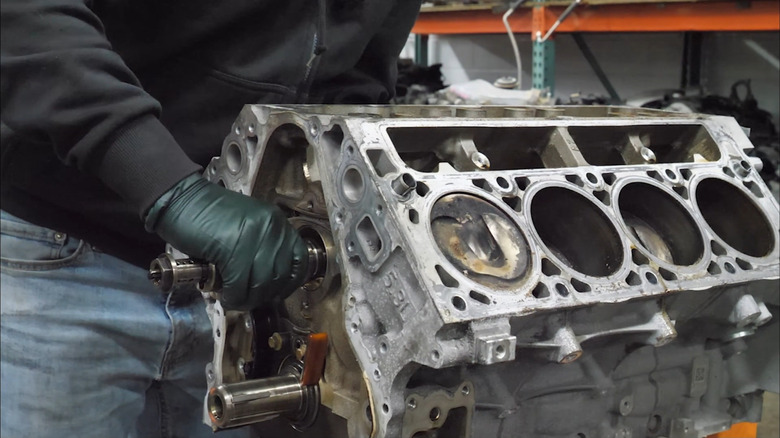
When comparing 5.3s to 6.2s, most people are talking about the Vortec/EcoTec3 engines. LS and LT 6.2 engines found in models like the Corvette, Camaro, GTO, and CTS-V are really outside the scope of this discussion. For completeness' sake, we'll mention that those LS/LT 6.2s include the naturally-aspirated LS3, the L99 (for Camaros and SS sedans with automatics, blech), and the reasonably different LT1 and LT2, as well as the supercharged LS9, LSA, LT4, and LT5.
As for truck engines, the LM7 5.3 debuted in 1999 as the Vortec 5300. GM's 6.2 Vortec 6200 didn't arrive until 2007, when it became the engine of choice in the Cadillac Escalade, replacing the old 6-liter Vortec 6000 V8. Both the Gen-III 5300 and 6200 were available as flex fuel engines, as were the later EcoTec3-branded versions, meaning they could also run on E85 (a mixture of 85% ethanol and 15% gas).
It would be convenient to say that since these are all truck engines, they all have iron blocks. But only five 5.3s have iron blocks, namely the LM7, L59, LY5, LMG, and LMF engines, while rest are aluminum. Meanwhile, all 6.2s have aluminum blocks with the exception of the aftermarket LSX376, which is iron (and not an EcoTec3 engine).
5.3 vs. 6.2 part two: Cams and Compression
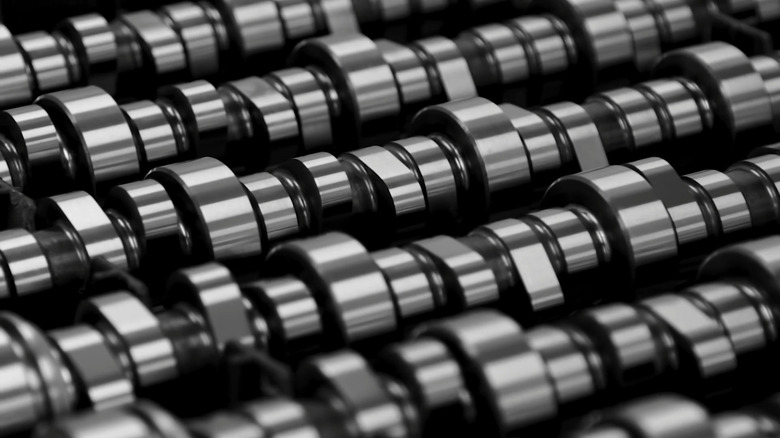
Now, 5.3s aren't weak, and that V8 turned compact Chevy Colorados and GMC Canyons into serious tire burners. But 6.2s are so much more powerful thanks not only to increased displacement, of course, but also more aggressive cams, higher compression, and better flowing heads. 5.3 tuning accentuates low end torque to make up for the fewer cubic inches, and this is best demonstrated with cam swapping.
Motor Trend grabbed an LM7 5.3 for just this purpose. Dyno tests showed a max of 384 pound-feet of torque at 4,300 rpm with the stock cam's lift of 0.466/0.457 and duration of 190/191. Switching over to an LS1 cam (like those found in C5 Corvettes) with its 0.496/0.496 lift and 202/210 duration increased peak torque to 389, but made 22 pound-feet less than stock at 2,500 rpm. Meanwhile, in an EcoTec3 6.2, you'll find a cam with a lift of 0.551/0.524 and a duration of 200/207. That block manages to hit 460 pound-feet at 4,100 rpm.
As for compression, 5.3s range from 9.5:1 for the Vortec-era versions to 11:1 for the current EcoTec3 engines. 6.2s were either 10.4:1 or 10.5:1 in the Vortec times, and they now run at 11.5:1 – Mariana Trench levels of compression. Look inside the owner's manual for a 2024 Chevrolet Silverado, and you'll find two different octane recommendations. 5.3s can go nuts with 87 octane regular all day. With 6.2s, 91 octane is recommended, though you can run 87 if you don't mind the engine reducing power and possibly knocking.
5.3 vs. 6.2 part three: Head flow and compression
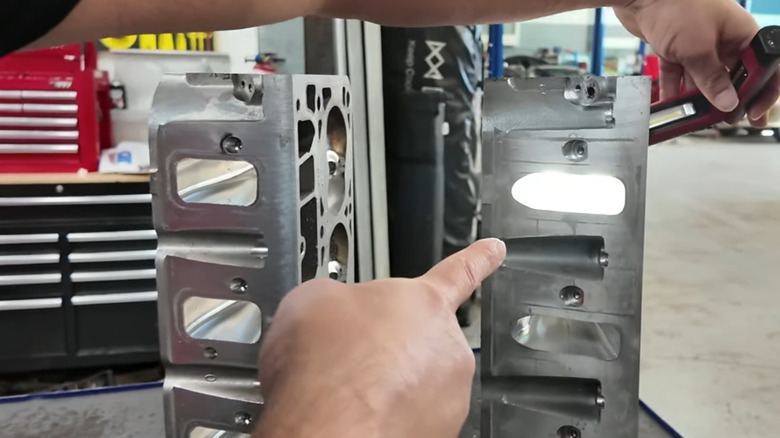
Peer inside a 5.3 head, and you'll see "cathedral ports," named because they look like rounded cathedral windows. 6.2s have higher-flowing rectangular ports, which generally flow more air. Hot Rod compared cathedral port heads with 70 cc chambers to rectangular port LS3 heads with 68 cc chambers, and they found that the LS3 heads flowed 34 cfm more on intake and 24 cfm more on exhaust.
So what's the deal with chamber volume? Well, in general, the smaller the chamber, the higher the compression. In L86/L87 EcoTec3 heads, chamber volume is just 59.02 cc, nearly 10 cc less than the LS3. And golly gee, the LS3's compression is 10.7:1, and the EcoTec3 6.2's is 11.5:1.
And no, you can't swap 6.2 heads onto a 5.3 – at least, according to all the engine forums. Apparently, the issue is that the 5.3's bore isn't large enough for the valves. But if you're a 5.3 owner and you want more power, you can use the 64 cc-chambered LS6 heads as featured on the (now quite cheap) C5 Corvette Z06 and first-gen Cadillac CTS-V. They're also referred to as "243 heads," which is the number stamped near the outside corner above the exhaust flange. You might get reduced compression compared to stock 706 heads and their 61 cc chambers, but you can always get new pistons to raise it again.
5.3 vs. 6.2 part four: Cranks, rods, and pistons
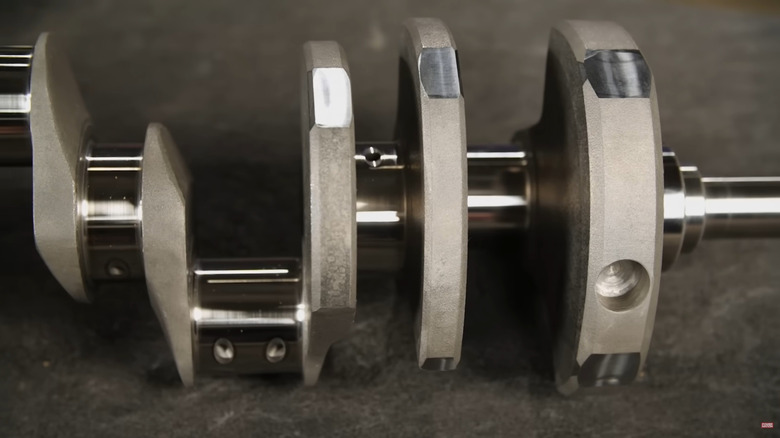
The rotating assembly in 5.3s can best be described as "fine." The cast iron cranks, powder metal connecting rods, and hypereutectic aluminum pistons can handle plenty of abuse. Case in point, Hot Rod magazine pulled a 5.3 from a 2004 Chevy pickup out of a junkyard, taking it from 315 horsepower on the dyno to 415 hp without swapping out anything in the bottom end.
With the 6.2, all the Gen-IV Vortec versions have those same materials for the spinny bits. But, once you get up to the modern EcoTec3 era with the L86 and L87, you'll discover that the crankshaft has been taking its vitamins. Gone is the cast iron crank of yore, and in its place is a stronger forged steel crank. We'll ignore, for the moment, that L87s often got improperly-finished cranks with incorrect dimensions, which can utterly destroy the entire engine as the rod bearings build up sediment. This is purely a discussion of materials. No need to mention the 28,000 L87 failures and GM recall of 600,000 trucks with the L87 6.2. Nope, no need at all. Put it out of your mind.
5.3 vs. 6.2 part five: Engine variants
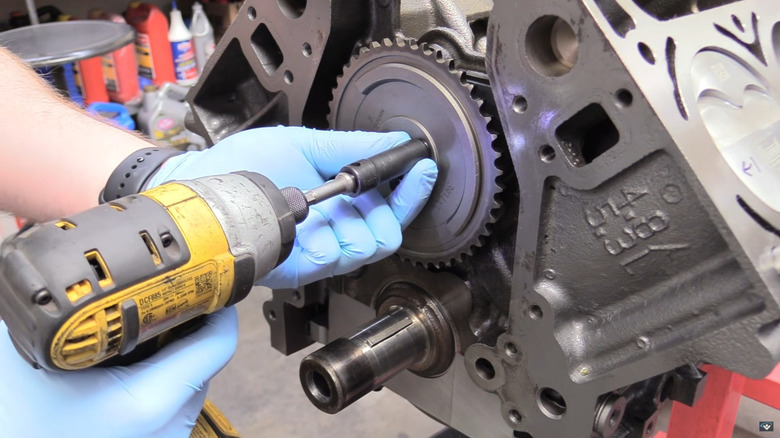
The Vortec 5300 5.3 RPO codes are LM7, L59, LM4, L33, LH6, LY5, LC9, LMG, LH8, LMF, and LH9. Power ranges from 270 hp and 315 pound-feet to 326 hp and 348 pound-feet. 2002 L59s introduced flex fuel capability, and 2005 LH6s wrought the often-problematic active fuel management (AFM). Variable valve timing (VVT) debuted in 2010 LH9s.
EcoTec3 5.3s include the L82, L83, L8B, and L84 . Like the LT engines, these all have direct injection. Flex-fuel L83s can make 380 hp and 416 pound-feet of torque on E85, though L82s and L84s only get up to 355 hp and 383 pound-feet. The L8B is essentially a mild-hybrid version of the L83, and 2019-current L82s are largely L84s with AFM. Yes, the L84 went to the possibly-even-more-hated dynamic fuel management (DFM).
Vortec 6200 series RPO codes are L92, L9H, and L94. All have VVT and 10.5:1 compression (well, L94s have 10.4:1), and they each make 403 hp and 417 pound-feet of torque. 2009 L9H engines gave 6.2s flex fuel capability, and AFM appared in the 2010 L94. EcoTec3 6.2s increased to 11.5:1 compression for 420 hp and 460 pound-feet of torque. The 2019-current L87 ditched the L86's AFM in favor of DFM.
Oh, and the L92 6.2 in '07-'08 Yukon Denalis only made 380 hp, and in '08-'09 Hummer H2s, it made 393 hp. The only explanation we can find for this comes from the implication that it was done to protect the 403 hp Cadillac Escalade as GM's most powerful SUV. Insert eye roll here.