

2026 Nissan Rogue Plug-In Hybrid Is A Slow-Charging But Solid Placeholder For Next Year's Rogue E-Power Hybrid
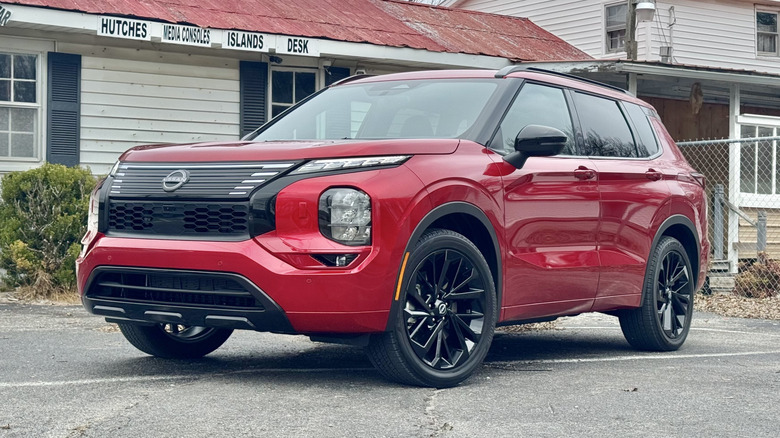
When Nissan announced that it was introducing an "all new" 2026 Rogue Plug-In Hybrid, but showed photos of a Mitsubishi Outlander with a slightly different grille, we said the Japanese automaker was bringing back the old school rebadge. The rest of the internet was similarly underwhelmed by the so-called new Rogue PHEV, but it's clear that Nissan believes it will convince more buyers to sign on the dotted line below the word 'Rogue' when it reaches dealer lots early next year.
Still unconvinced by the thinly veiled reskin, I headed to Tennessee to get behind the Mitsubishi-designed wheel of the 2026 Rogue PHEV as well as a few other new Nissans, and I actually quite enjoyed it. I also got to drive a European-market Nissan Qashqai e-Power to get a taste of what to expect from the next-generation 2027 Nissan Rogue e-Power, which will actually be a new vehicle to the U.S. when it comes out next year. This gives buyers looking for a compact hybrid Nissan crossover a tough decision to make: buy one of these 2026 Rogue PHEVs that are just a rebadged Mitsubishi, or wait for the 2027 Rogue e-Power, a more well-thought-out hybrid that doesn't need to be plugged in? The choice is yours, but here are my thoughts.
 Nissan
Full disclosure: Nissan flew me out to Nashville, Tennessee to drive some of its new cars, including the recently announced Rogue PHEV. The folks at Nissan put me up in a beautiful resort for a night and fed me delicious food and drinks, none of which influenced this review.
Hey, these numbers look familiar
Yes, the new Nissan Rogue PHEV is virtually the same as the pleasant Mitsubishi Outlander PHEV that's been out since 2022. I only got to drive the Rogue for about half an hour, so my driving impressions are very limited, but since it's just an Outlander, you can also read my colleague Andy's very comprehensive review of the Mitsubishi PHEV that should answer any questions that my limited experience doesn't allow me to.
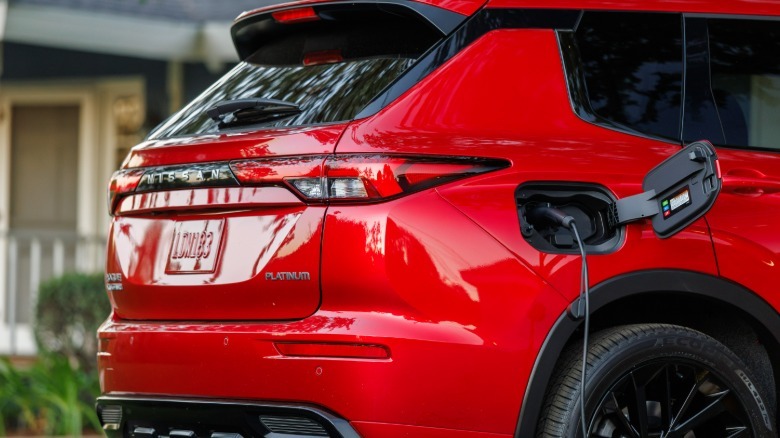
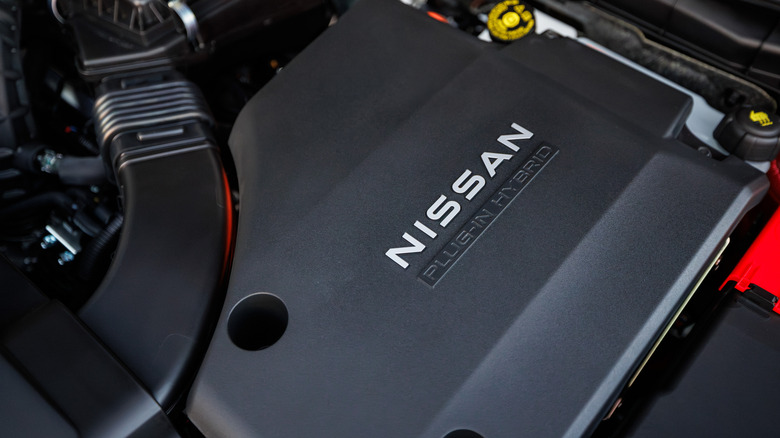
Under the hood of the Rogue is the same 2.4-liter inline-4 engine that combines with an electric motor and a 20-kWh battery pack to deliver 248 horsepower and 332 lb-ft of torque to all four wheels through a CVT. The electric-only driving range is a respectable EPA-estimated 38 miles, and when combined, it's rated for 64 MPGe. But the Nissan forgoes the DC fast charge capability of its Outlander PHEV sibling, so it's only capable of Level 2 charge speeds. That means it will take a glacial 7.5 hours for a full charge, or 16 hours on a 120V household outlet. In contrast, the Outlander PHEV's admittedly outdated CHAdeMO port enables it to fast charge at speeds of 50 kW, which takes its battery from 0-to-80% charge in about 38 minutes. That is the biggest demerit against the Rogue PHEV — its achingly slow charge time, not that it's a simple rebadge.
Buttons, sweet buttons
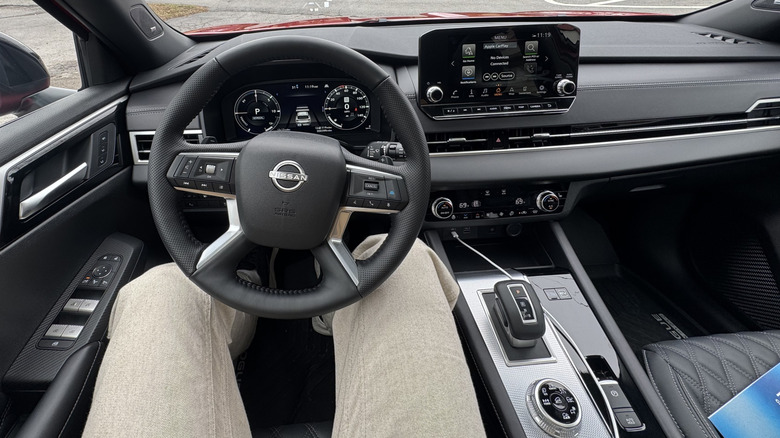
One of my favorite things about the Rogue PHEV is the button-focused control layout. If you've heard it once you've heard it a thousand times: we want more buttons! Thankfully Nissan retained Mitsubishi's interior without making any changes other than the badges and an infotainment reskin, so there's completely physical climate controls and even physical buttons for some functions on the touchscreen, book-ended by big volume and tuning knob. Hallelujah.
The standard 9-inch touchscreen infotainment system is not at the precipice of modernity, and honestly that endeared me to it. (My god am I old now?) I'm not a fan of the graphics per se, but I am a fan of the system's easy-to-navigate menus, and the choice of standard wired and wireless Android Auto and Apple CarPlay integration. My test car was a top-of-the-line Platinum trim – Nissan is only offering the Rogue PHEV in SL and Platinum trims – and came with a crisp and uncomplicated head-up display, a respectable nine-speaker Bose stereo, a power panoramic sunroof, heated rear seats, leather seats, rear sun shades, and a heated steering wheel, It felt quite luxurious for what it is, which is one of the Outlander's most common compliments.
 Logan K. Carter/ Jalopnik
Though Nissan hasn't released prices for the Rogue PHEV, representatives said to expect it to start at the top of the gas-powered Rogue's price range, so likely above the $40,000 mark — the Outlander PHEV starts at $42,190 and tops out over $50k. That sounds like a lot, but the Rogue PHEV joins the Outlander PHEV as a rare three-row plug-in-hybrid compact SUV with lots of desirable features, so it's not a bad value proposition.
It's actually pretty good to drive
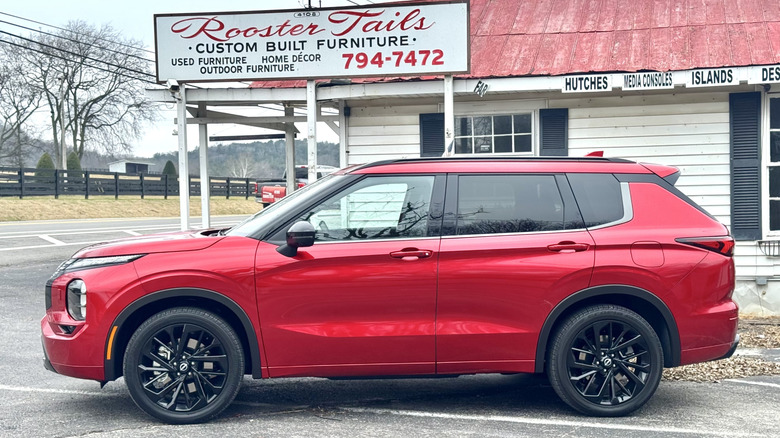
As a plug-in hybrid with a sizable 20-kWh battery pack, the Rogue PHEV drives much like an EV when it's fully charged, so you get spunky acceleration from a stop and minimal drivetrain noise intrusion. There is a weirdly audible and annoying high-pitched whine from the electric motor that's especially noticeable at low speeds, and which I haven't noticed in other electrified vehicles. The perforated four-spoke leather steering wheel feels great in your hands, and the steering is quick and responsive. In my very brief time behind the wheel, I found the Rogue PHEV to be quite enjoyable to drive.
More important than sportiness, the Rogue PHEV is very comfortable on the road, with a taut suspension that does a good job of absorbing bumps and cracks in the road without feeling floaty or sloppy when taking corners quickly. It feels solid, safe, capable, competent, comfortable, and well-built.
The Rogue PHEV is a placeholder until the 2027 Rogue e-Power hybrid arrives
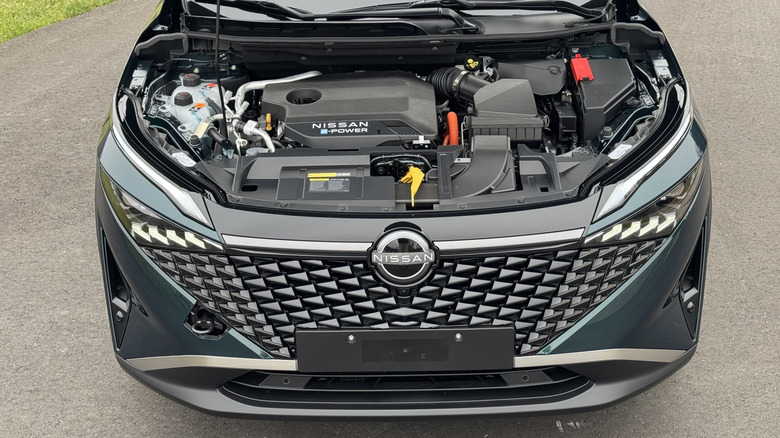
If, for some strange reason, you're itching to buy a plug-in hybrid with a Nissan badge on the front, you might want to act fast. Nissan has big plans for the Rogue for 2027, including adding a new-to-the-U.S. hybrid powertrain it calls e-Power, a setup that's been offered in Europe and Asia for years. The company says that it doesn't want to alienate customers who want a hybrid in the interim, so the 2026 Rogue PHEV is likely to be a one model-year car.
Nissan let me sample the e-Power hybrid powertrain in a European-market car, the Qashqai subcompact crossover that's hugely popular in the UK despite only being offered with front-wheel drive. The automaker says the Qashqai's powertrain is very similar to the one that's coming in the next-gen 2027 Rogue, but that the Rogue will have all-wheel drive, so I effectively got a taste of what to expect from the Rogue e-Power hybrid — and it's a good one.
 Logan K. Carter/ Jalopnik
Nissan's e-Power system is unlike most other hybrids on sale right now because its wheels are exclusively driven by electric power, never the 1.5-liter turbocharged three-cylinder gasoline engine. The gas engine acts only as a generator to keep the small 2.1-kWh battery juiced up, regardless of vehicle speed. In the Qashqai, the gas generator engine makes 154 horsepower, and the electric motor that moves the vehicle produces 188 horsepower and 243 lb-ft of torque without ever needing to be plugged in. In my 30 minutes driving the Qashqai e-Power, I found it to be a very refined powertrain that definitely drives more like an EV than a gas-powered car, and since the gas motor never drives the wheels, there's no need for a dreaded CVT to bring down the vibe.
The 2027 Rogue e-Power should drive well but if you want a plug-in hybrid Nissan, you can go Rogue sooner
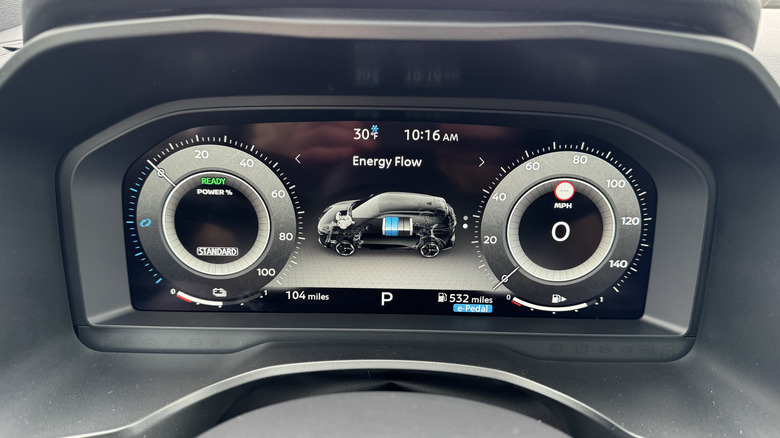
The e-Power drivetrain's power delivery is immediate, but generally the deeper you dig into the throttle, the higher the gas engine revs despite not powering the wheels, which is a bit strange. The gas engine sounds somewhat grumbly while it's working, but at least its operation causes virtually no vibrations. Other than the peppy drivetrain, the Qashqai's steering is egregiously numb and light, and the brake pedal is very squishy yet sensitive to inputs, so the driving experience wasn't especially enjoyable. Thankfully the 2027 Rogue e-Power will be "adapted for the U.S. market" according to Nissan, so hopefully those undesirable traits get addressed in the Rogue. Nissan said to expect the 2027 Rogue e-Power AWD to return "between 39 and 41 mpg," but no official numbers are available yet.
Nissan representatives said that the company decided to sell the Rogue PHEV to satiate customers who simply want a hybrid option, and that it's unclear yet whether the Mitsubishi-based Rogue PHEV will be sold alongside the next-gen 2027 Rogue e-Power. If you're looking for a hybrid crossover with a Nissan badge on the front, this 2026 Rogue Plug-In Hybrid is your only option for now, but the 2027 Rogue e-Power is coming hot on its heels, so that's something to consider. If you want a hybrid that you don't need to plug in to charge, you'll have to wait, but if you are okay with charging (and doing so very slowly), the 2026 Rogue PHEV is a good option. If you want to charge fast, though, you'll have to go for the Outlander.