

Does The Smart Money Go With Winter Tires Or All Wheel Drive For Winter Driving?

In an ideal world, we'd all own a vehicle with four-wheel drive (4WD) and snow tires for harsh winters with snow, slush, and icy roads. However, if you're choosing between winter tires and all-wheel drive (AWD), winter tires get our vote. Vehicles with 4WD have clear advantages in challenging conditions, especially when plowing through deep snow and rugged terrain. AWD can get you home in places with mild snow or mild winter seasons, though it may not be enough on its own in some situations.
There's a reason why Kelley Blue Book says a vehicle with FWD and snow tires can grip better on snowy roads than an all-wheel drive car running on all-season tires — it all comes down to the science and technology behind the design and construction of winter tires. If a FWD car with snow tires can handle snow better than an AWD car on all-season tires, then an AWD car with snow tires will perform even better. That's why winter tires are the smarter choice, and why a good set can spell the difference between maintaining control and filing an insurance claim.
What makes winter tires different from all-season rubber?
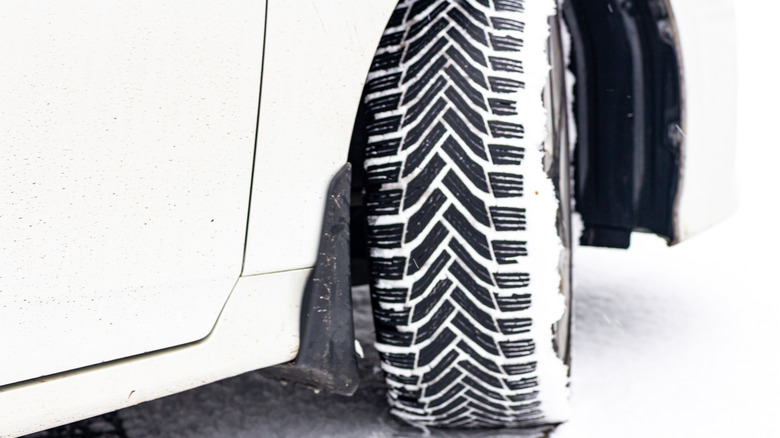
Apart from having treads with wider spacing, deeper grooves, and numerous sipes, most of what you pay for in winter tires goes toward their rubber compound. Tire technology has advanced by leaps and bounds, to the point that all-terrain tires – previously known for their unrefined ride characteristics – are now smoother on tarmac while still retaining their rugged, go-anywhere DNA.
With winter tires, it starts with the rubber itself. Snow tires use rubber with a high silica content to help it remain pliable, even when the mercury drops to -40°F. Staying soft and flexible in extremely cold temperatures is what primarily sets winter tires apart from summer or all-season tires. It's also why snow tires can help any vehicle handle better in the snow, whether it has a FWD or all-wheel drivetrain.
The folks over at Road & Track agree with us that rubber compound plays a significant role in how the tires can make any vehicle stop, go, and corner better in the snow. What is even more surprising is that unstudded winter tires with more advanced cold-weather rubber compounds can outperform lesser tires with studs, which might change your perspective on how switching to a better compound can make more of a difference than using studs.
Some things to consider before upgrading to winter tires

Your average all-season tire can deliver excellent traction and grip until the average temperatures drop below 44.6°F. If temperatures drop past that point and you do a lot of driving, it's high time to switch to winter tires.
But perhaps the biggest drawback is the cost, as a set of winter tires can run anywhere from $250 to $600 for a compact sedan and about $600 to $1,500 for pickup trucks or SUVs. Mind you, the prices do not include labor and materials for mounting, balancing, and installation, and we agree that winter tires are a costly upgrade. However, the expense is worth it — and there are a few things you can do to ease the sting.
Besides comparing prices online and looking for seasonal discounts or special promotions, consider getting a separate set of wheels for winter — preferably those that have a smaller diameter than the stock wheels of your ride. Why? Because smaller wheels and tires are better for winter, and smaller-diameter 17-inch winter tires cost less than, say, 19- or 20-inch rubber.
Yeah, we know, buying a specific set of wheels is an added cost in and of itself, but you can offset that over multiple winters. And besides, the ride, handling, and fuel economy improvements (yes, tires can affect gas mileage) are worth every penny.