

8 Promotional Vehicles That Took Advertising To The Extreme

Over the decades, many companies have rolled out vehicles as part of their marketing campaigns. It began as a quirky tactic used mostly by small businesses, but gradually morphed into a full-blown promotional frenzy by the final two decades of the 20th century.
The more brands searched for bigger and bolder ways to stand out, the more unconventional these creations grew. And among the many promotional vehicles that have debuted, some pushed the concept wheels a bit too far. They weren't necessarily the most successful of campaigns; some were either engineering oddities or ergonomic nightmares, but they certainly did grab attention.
The 1936 Wienermobile is perhaps the most iconic of the bunch, but other promotional vehicles have also competed for the title of "most outside the box" (or the brand). Many of these now reside in museums, while others still hit the road occasionally. But as technology continues to transform the face of marketing, these machines remain as precious reminders of a special era of advertising.
Outspan Orange
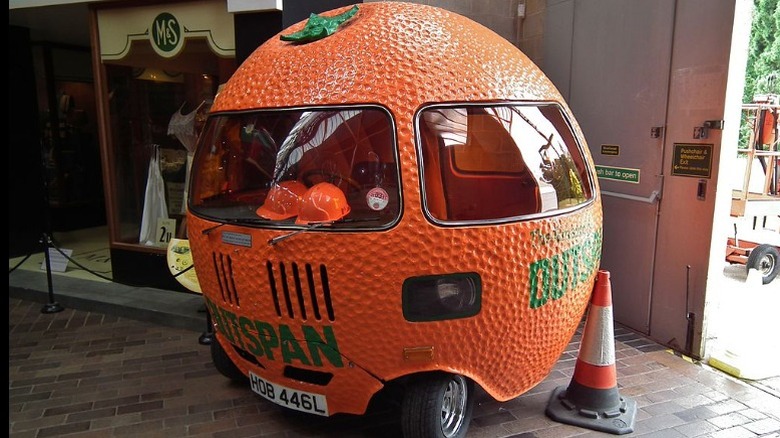
In the early 1970s, South African citrus brand Outspan unveiled what became one of the most distinctive and weirdest custom-built vehicles in history: the Outspan Orange. A round chassis crafted from two Mini subframes, bright orange livery, a bumpy orange-peel-like exterior, and a green leaf added on top for effect, the car was designed to look every bit like the fruit it promoted, on wheels.
Power came via a 998cc A-series engine, which could comfortably go up to 60 miles in a Mini. In an Outspan, that'd be asking for trouble. With its 48-inch wheelbase and 16-foot turning circle, the car had a precarious center of gravity — a few wrong calculations, and it could literally topple over. Engineers ensured that ugly reality never happened by fitting 200 pounds of ballast at the back.
Like many promotional vehicles, the Outspan Orange wasn't the most practical of rides. It had no bonnet, meaning engine access was only possible from within the cramped cabin. Heat was also a constant companion, partly due to the engine compartment's close proximity to the driver's seat. Still, the Outspan Orange fulfilled its purpose as a marketing answer to the harsh political climate that plagued the company at the time. Between 1972 and 1974, six units were built, each with a slightly different touch.
Big Idaho Potato Truck
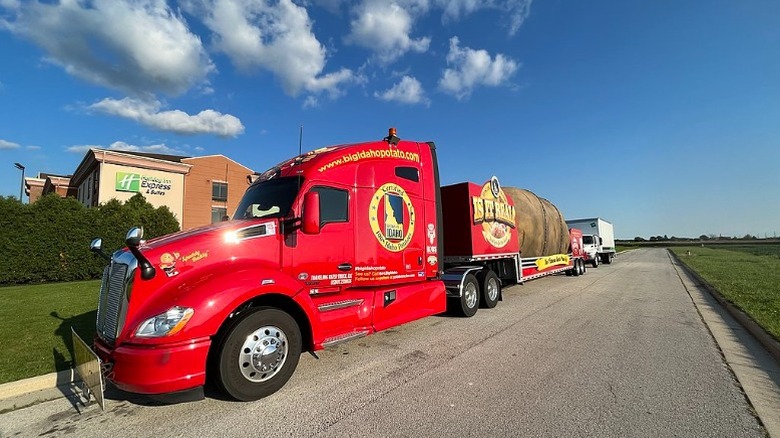
The Big Idaho Potato truck is like any regular 10-wheel flatbed, but what it hauls is a bit weird. The truck carries on its flatbed what is billed as the "world's biggest potato." It's not actually edible; this 4-ton behemoth is made of fiberglass and steel put together by Chris and Sharolyn Schofield. For reference, the biggest potato ever harvested weighed 11 pounds (802 times less).
If the Big Idaho Potato were real, science suggests it would take about 7,000 years to grow and weigh as much as 21,562 regular potatoes. In kitchen terms, that's equivalent to 20,217 servings of mashed potatoes or a million French fries, which is enough to feed a small city. From bumper to bumper, the entire truck-and-tater combo stretches 72 feet, or about five cars long.
The Big Idaho Potato Truck first hit the road in 2012 to commemorate the 75th anniversary of the Idaho Potato Commission. Since then, it has gone on at least 13 tours stateside.
2004 Wienermobile
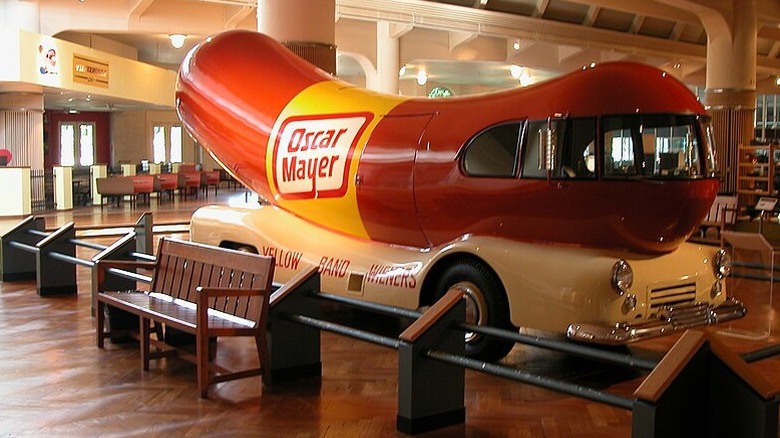
The 2004 version of the Oscar Mayer Wienermobile remains as whimsical as its 1936 ancestor. This generation preserves the classic concept: a large bright orange "hot dog" perched atop a yellow bun-shaped chassis. The former is 27 feet of fiberglass — an equivalent length to 55 hot dogs by Oscar Mayer's own scale — and features a panoramic glass bubble canopy serving as the driver's cabin. Inside, it's a continuation of the playful theme: a dashboard sculpted like a hot dog, ketchup- and mustard-colored upholstery, and a horn that proudly toots the iconic "Oscar Mayer Wiener Jingle."
Built on a Chevrolet W4 truck chassis by Santa Barbara-based Specialty Vehicles, only seven were produced, all powered by 5.7-liter Vortech V8 engines. Only officially trained Oscar Mayer "Hotdoggers" are allowed behind the wheel. These brand ambassadors travel the country at up to 65 mph, adopting pun-filled food nicknames and staying fully in character.
Voxmobile
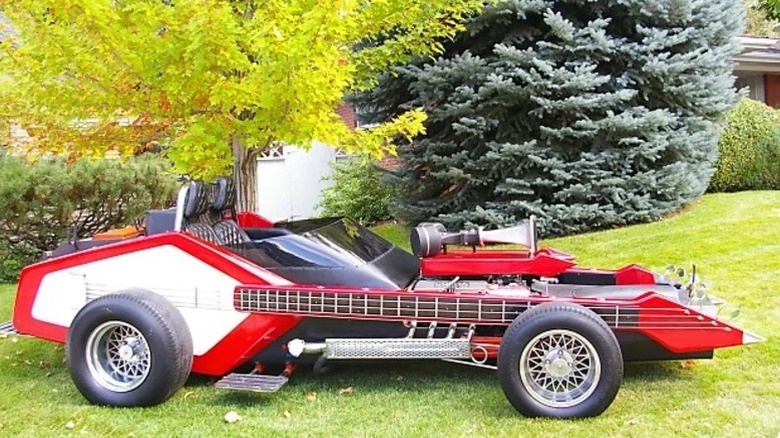
The Voxmobile looks like a pair of Vox Phantom guitars ordered a ride. The brainchild of custom car legend George Barris — the same mind behind classics like the 1966 Batmobile — the Voxmobile was born in 1967, when Vox commissioned Barris to create a showpiece unlike anything on the road. At the time, Vox was riding high as the go-to provider of guitars, organs, and amplifiers for bands like The Beatles and The Rolling Stones and wanted a promotional vehicle to capture its electric spirit. The requirements were simple: make it half car, half Vox amplifier.
Unlike many other promotional vehicles that were simply reworked production models, the Voxmobile was built from the ground up. Literally every inch of the vehicle screams "Vox." Aside from the pretty obvious pair of Phantom guitars that adorn either side of the hand-built metal, fiberglass, and wood chassis, the dashboard on the passenger side features the control panel from a Vox Super Beatle amplifier. More Super Beatles are tucked under and around the seats. The most brazen act happens out back, where there's a playable two-tier Vox Super Continental organ.
The Voxmobile is no slouch either. A Ford Cobra 289 engine pushes its Radar wheels past 65 mph on a good day. Costing about $30,000 in 1967 (or almost $300,000 in 2025), the Voxmobile was present in everything from concerts and TV shows such as "Dialing For Dollars" and "Groovy" to movies like "Psych-Out."
Zippo Car
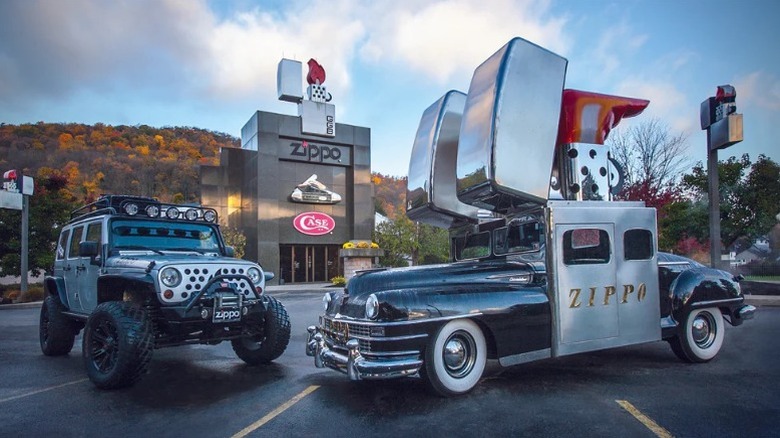
Nothing screamed "badass promotion" quite like a lighter on wheels back in post–World War II America, an era where cigarette smoking was still considered a healthy pastime. That was precisely the vision of George Blaisdell, inventor of the iconic Zippo metal reusable lighter, when he commissioned the making of a brand vehicle in 1947 as part of a broader $25,000 marketing stunt.
Designed and built by Pittsburgh-based company, Gardner Display, the Zippo car is a modified Chrysler Saratoga crowned with two giant Zippo lighters with fully functional flip-top mechanisms that opened and closed like the real thing. However, the metal lighters were heavy and took their toll on the tires and overall maintenance of the vehicle
Sadly, the original Zippo Car is no more; in its place is a 1996 replica that sits proudly in Zippo/Case Museum in Bradford, Pennsylvania. Zippo Manufacturing Company spent $250,000 on this new model. So, it's no surprise it's laden with some modern features. These include five-foot fiberglass flames, power windows, and a reinforced suspension, all geared by a 350-cubic-inch Chevrolet small-block V8 engine pushing 250 hp.
NUTmobile
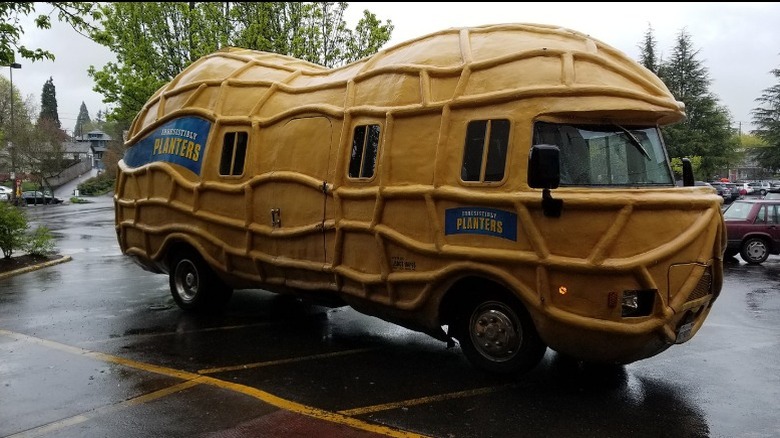
Planters Peanuts' aptly named NUTmobile (also affectionately nicknamed "the Iconic Legume") is shaped like an enormous peanut shell, as a tribute to the brand's signature snack. Over its 90 years on the road since debuting in 1935, the iconic vehicle has appeared in several slightly different iterations. The very first NUTmobile was a modestly built promotional car designed to resemble a peanut as closely as possible. Later versions were more refined: a fiberglass exterior sculpted with curved, noodle-like ridges to mimic the peanut's natural contours.
A now-retired eco-conscious model was rolled out in 2011, which ran on biodiesel and incorporated solar and wind energy to power its auxiliary systems. Today's fleet of three NUTmobles, crafted by Hudson-based specialty fabricator Turtle Transit, runs on 6.0-liter V-8 engines housed by a 2014 Isuzu W4 chassis. The General Motors' V-8 normally churns around 322 and 360 hp, enough to give the NUTmobile a comfortable cruise speed of around 80 mph.
Using a peanut as a unit of measure, the NUTmobile weighs as much as 3 million peanuts, which shouldn't be too surprising considering its 26-foot length, 11.5-foot height, and 8.5-foot width. Inside, it features a fully customized cabin outfitted with GPS navigation and other modern amenities. Behind the wheel are the brand's enthusiastic ambassadors known as "Peanutters," three handpicked drivers who beat out the roughly 1,000 folks who apply annually.
L.L. Bean Bootmobile
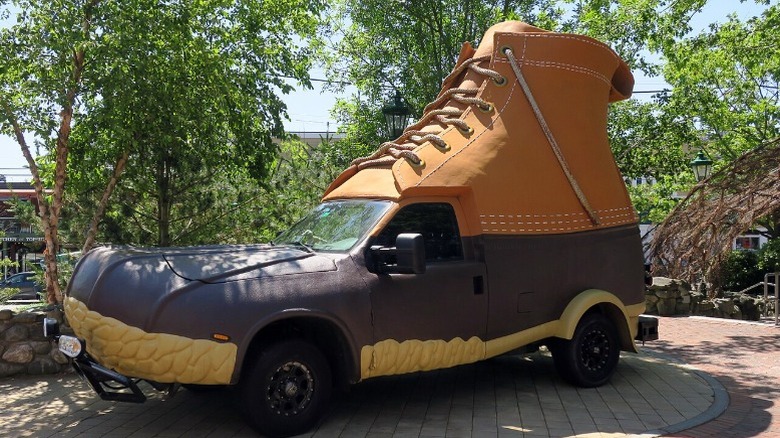
Outdoor clothing and equipment company L.L.Bean's Bootmobile features a colossal boot swallowing up a GMC Sierra truck in its sole. Its creators insist it's a truck in a boot, not the other way around. Bringing the Bootmobile to life required extensive planning. Early concepts actually placed the boot facing backward before the design evolved into the now-iconic forward-facing version. A lot of 3D modelling was involved too. Real L.L. Bean boots and miniature pickup truck models were scanned and digitally merged. Then the boots were cut apart and fitted with truck models inside them. An outer sculpture first shaped in foam, the car's build is a structural network of fiberglass, aluminum, and steel.
The dimensions of the Bootmobile are mind blowing: 13 feet high and 20 feet long. Only someone with a shoe size of 708 could comfortably fit into the boot; the wearer would likely be taller than the Statue of Liberty. Even the laces are oversized. They're made from 12-strand, two-inch braided mooring rope of the type used on tugboats, strong enough to tow 106,000 pounds.
Only debuting 13 years ago (counting the original 2012 model), the three active Bootmobiles have collectively logged more than 350,000 miles and traveled to over half of the U.S. states.
Kissmobile
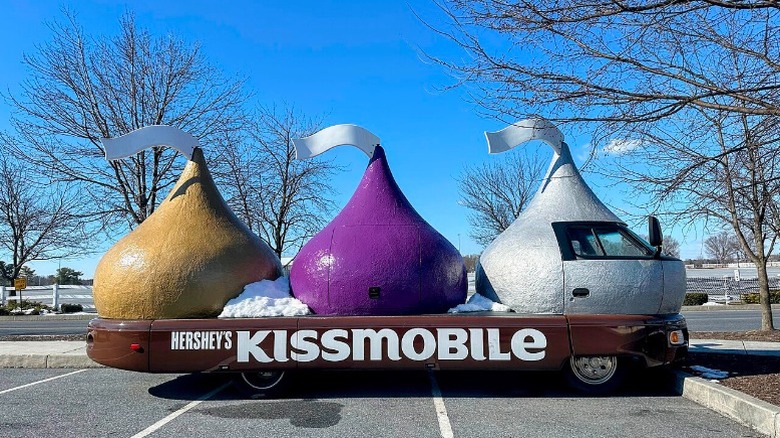
The Kissmobile has been a legend on the streets since its inception in 1997. Along with the redesigned Oscar Mayer Wienermobile (also a handiwork of Bruce Brackman) Chocolate brand Hershey's oddly shaped creation is perhaps America's most iconic promotional vehicle.
The Kissmobile's most defining features are its three 8-foot-tall fiberglass Kisses, which sit atop a GMC 4-W W-Series chassis. Inside, it's a child's delight: over 230,000 milk chocolate samples ready for distribution. There's an actual entertainment center in the mid-section, equipped with a TV, DVD player, and other necessities for on-the-go events. Thanks to the humorously dubbed "Kissmobile stinker," an exhaust attachment that emitted a light chocolate aroma, this vehicle rolls by as essentially a sweet-tooth wake-up call to anyone in sniffing distance.
A GM Vortex 5700 V8 gas engine paired with a 4180E transmission powers the Kissmobile. With this combo, the vehicle has covered over 250,000 miles in its 18-year lifespan. Although now retired — no thanks to the difficulty of sourcing replacement parts — fans can still admire the original model proudly displayed at the entrance of the AACA Museum.