

11 Factory Cars With Quarter-Mile Times Of 10 Seconds Or Less
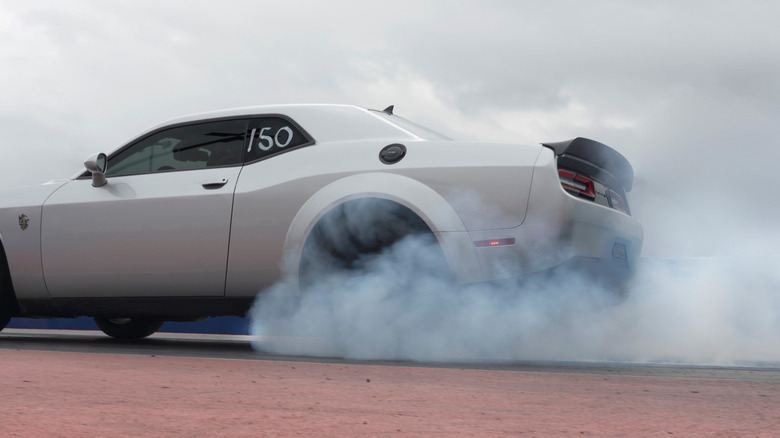
Just two decades ago, 10-second cars required some serious upgrades to existing sports cars. Larger turbochargers. Stronger internals. Nitrous. And, of course, a prayer that the engine won't explode. Anyone who watched "Fast and Furious" would know what we are talking about. The cult movie released the 10-second car into the mainstream, and 20 years later, people are still wondering which cars can cover the quarter mile in fewer than 10 seconds.
The truth is, pulling this off is anything but simple. Sure, adding power mostly solves the problem, but you also need grippy tires and quick-shifting transmissions. And at the turn of the century, the tech wasn't ready. The 650-hp Ferrari Enzo, as tested by Motor Trend, covered the quarter mile in 11.0 seconds with a 133.9-mph trap speed. Back then, this was the de facto hypercar.
Today, however, a dozen vehicles can cover the quarter mile in the 9-second range, including hypercars, supercars, and even sedans — factory warranties included. Yes, electrons have made the feat much easier, but don't overlook other technological advancements, like the spine-crushing launch control in performance vehicles.
The fascinating thing is that most of these factory cars with sub-10-second quarter-mile times can pull this off day in, day out. Ready to be amazed? Then, engage launch control. Press brake pedal. Press gas pedal. Release brake pedal — off we go!
2025 Rimac Nevera R (7.9 seconds)
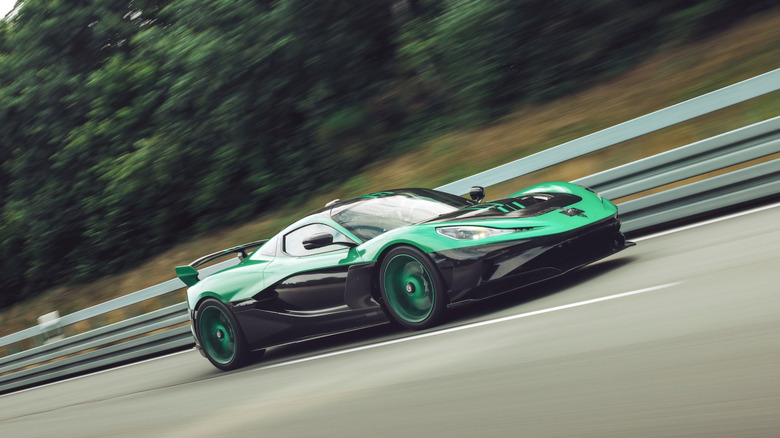
Rimac has forever changed the performance game with its first electric hypercar, the Concept One. An electric motor for each wheel. 1,073 hp. 1,180 lb-ft of torque. 0-62 mph (0-100 km/h): 2.6 seconds. Quarter mile: fewer than 9.8 seconds. Still, Rimac has made great strides with the Nevera, a 1,914-hp, four-motor rocket with a 1.81-second, 0-62-mph time and an 8.25-second quarter-mile time.
However, the Croatian boundary-pushing automaker wasn't content with these numbers. Enter the record-crushing Nevera R. Rimac's newest hypercar teleports to 60 mph in 1.66 seconds (62 mph in 1.72 seconds). It accelerates to 249 mph (400 km/h) in 17.35 seconds. 0-62-0 mph: 4.12 seconds. Quarter mile: 7.9 seconds. Top speed: 268 mph (431.45 km/h). Frankly, ridiculous.
Most astonishingly, Rimac achieved all this with a higher downforce package. The fixed rear wing and larger diffuser generate 15% more downforce, but careful engineering also increased aerodynamic efficiency by 10%. But of course, the biggest push came from the more potent, 2,107-hp four-motor drivetrain. Then, to transfer all that power to the surface more successfully, Rimac opted for special Michelin Cup 2 tires.
The All-Wheel Torque Vectoring system also played a big part in the traction story. The system can calculate and adjust torque delivery to each wheel 100 times every second, maximizing traction during acceleration and cornering. Ah, yes, the Nevera R can handle, too, as it also broke the Nürburgring Nordschleife record for a production EV with a blistering time of 7:05.298. Oh, and if you think the 'gotcha' moment is Nevera R's range, it can muster 300 miles.
2023 Dodge Challenger SRT Demon 170 (8.91 seconds / Prepped Surface)
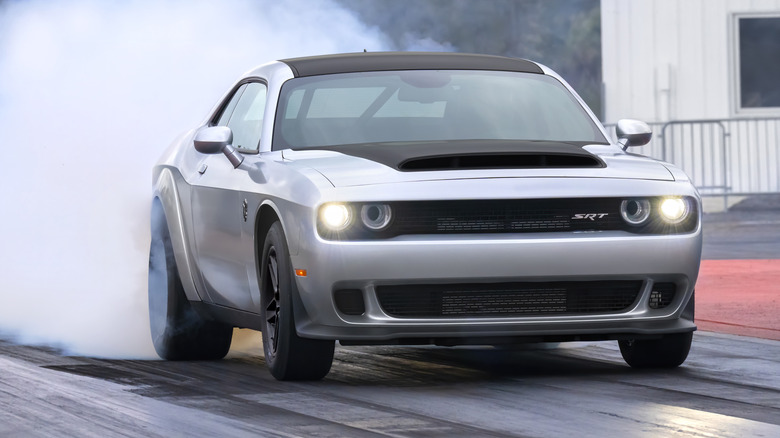
Internal combustion for the win? Well, sort of. Indeed, the Challenger SRT Demon 170 can cover the quarter mile in 8.91 seconds, according to Dodge. However, there are a few caveats. Dodge achieved that frankly astonishing result in ideal conditions on a prepped surface, i.e., a drag strip, with an experienced factory driver behind the wheel.
In the real world, you'll be looking at 9.5 seconds — on a drag surface, but without Dodge technicians helping you. But let's get real for a second — launching a RWD car on an unprepped surface is a nightmare, particularly one with 1,025 hp and a stupendous 945 lb-ft of torque. Sure, Dodge equipped the Challenger SRT Demon 170 with drag-specific Mickey Thompson ET Street R tires, but that doesn't make the feat any less otherworldly. Let's also not forget that the Demon 170 has a regular, eight-speed automatic transmission, not a quick-shifting dual-clutch one.
Yes, the 6.2-liter supercharged Hellcat will only produce those figures on E85. Still, it produces an amazing 900 hp and 810 lb-ft of torque on regular gas. It sounds amazing, too. The V8 rumble is accompanied by a supercharger whine, and the combo sounds strangely menacing. Burnouts and wheelies — also part of the package. Oh, and you won't need to worry about drivetrain wear; Dodge has beefed up the driveshaft and rear axle to handle the mightiest Hellcat ever made.
2025 Lucid Aid Sapphire (8.95 seconds / prepped surface)
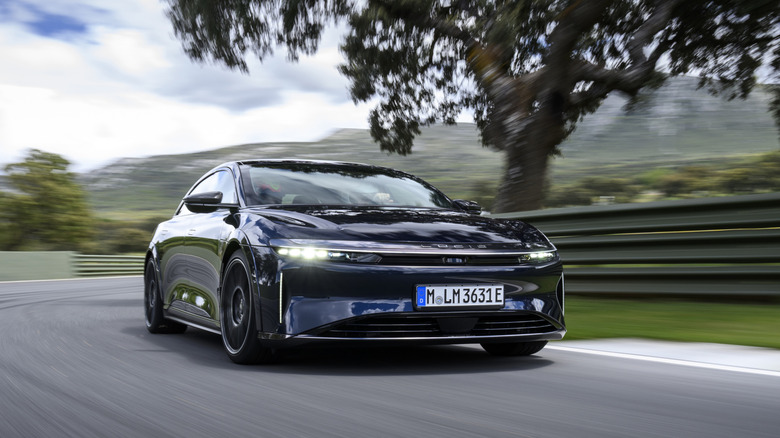
We measured an 8.95-second quarter-mile time with the Lucid Air Sapphire. Admittedly, that was on a prepped surface at the Sonoma Raceway, but also one that's slightly uphill. In Car and Driver's testing, the luxury sedan covered the quarter mile in 9.1 seconds, which is still ridiculous. The real jaw-dropper is that the Air Sapphire can do this all day long. You need to engage Dragstrip mode, which preconditions the battery and takes between 15 and 20 minutes, but other than that, it's a 'release the brake' and launch affair.
Once you do that, 60 mph will arrive in a mind-crushing 1.89 seconds, and the Air Sapphire won't stop until it reaches 205 mph. These are some ridiculous numbers for a luxury sedan that can seat four passengers in maximum comfort, achieved thanks to the mega-potent tri-motor, 1,234-hp powertrain. Did we mention the Air Sapphire can also travel up to 427 miles on one charge?
But the thing that confirms that performance EV sedans are the future is how the 5,336-pound Air Sapphire handles the twisties. Thanks to the advanced torque vectoring feature, it feels light and agile, but always in control, even at the limit. As colleague Kyle Hyatt could also attest in his track time, the Air Sapphire also has exceptional carbon-ceramic brakes, which never overheated.
Now, sure, at $249,000, the Lucid Air Sapphire isn't cheap. But good luck finding a four-door luxury sedan that will beat it in speed or engagement, no matter the surface or conditions. If you ever needed convincing that EVs are the future, this is it, folks!
2022 Bugatti Chiron Super Sport (9.1 seconds)
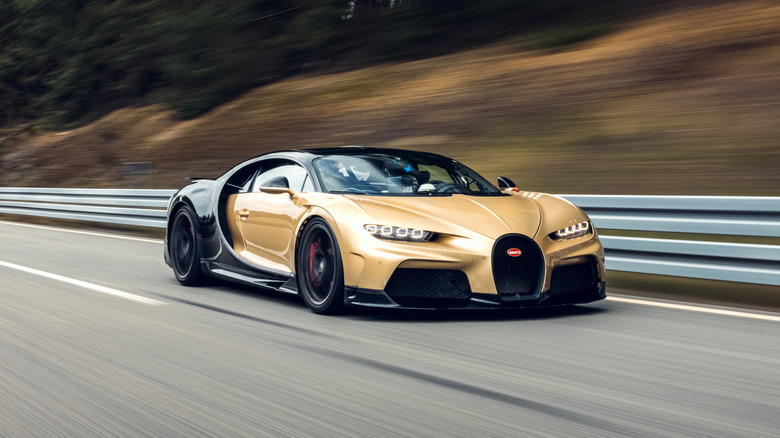
Before electric motors started to dominate the performance game, one internal combustion engine reigned supreme: Bugatti's 8.0-liter W16. Yes, that's 16 cylinders, arranged in two narrow Vs, and then quad turbocharged for good measure. In the 2005 Veyron, the W16 monster produced 1,001 hp, enough to break the 400-km/h (249-mph) barrier.
Fast forward to the 2002 Chiron Super Sport, the quad-turbo W16 was tuned to 1,578 hp and 1,180 lb-ft of torque. No electrons required — just good old dinosaur juice. As a result, the special Chiron Super Sport 300+ was the first production car to break the 300-mph (483-km/h) barrier. Yes, customer cars were limited to 273 mph (439 km/h), but still, that's slightly higher than Nevera R's 268 mph.
Of course, the Chiron Super Sport isn't as quick off the line. Bugatti equipped it with four-wheel drive and a seven-speed dual-clutch gearbox, but you simply can't beat the immediacy of electric motors. But let's not kid ourselves — the Chiron Super Sport still launches like a rocket, reaching 62 mph (100 km/h) in 2.4 seconds, and 124 mph (200 km/h) in 5.8 seconds. In Car and Driver's testing, it also covered the quarter mile in 9.1 seconds with a trap speed of 161 mph.
But how does that really feel behind the wheel of a Bugatti Chiron? Incredibly lucky colleague Rory Carroll drove the Chiron Pur Sport, designed to tackle corners more efficiently, though with a lower 1,500-hp tune of the engine. "It's a pure distillation of the sensation of speed," Rory said. We could only imagine!
2025 Porsche Taycan Turbo GT Weissach (9.2 seconds)
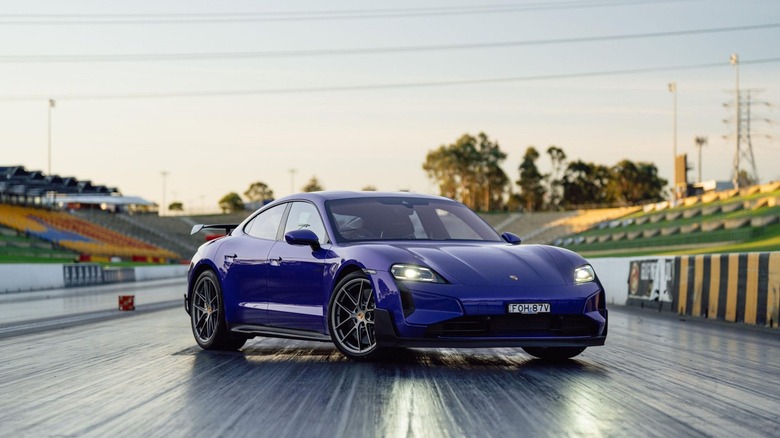
The 2025 Porsche Taycan Turbo GT Weissach is specifically designed for track day fans. There is no other explanation for the deletion of the two rear seats, fixed carbon-fiber rear wing, and underbody aero. Yes, this defeats the purpose of the rear doors, but you can have the Taycan Turbo GT in a regular, four-seater configuration. Still, the Weissach package drops the weight by 199 pounds (90 kg), so it makes the most out of the dual-motor, 1,019 hp / 914 lb-ft powertrain.
True, these figures are only available with launch control. In fact, the Taycan Turbo GT produces 777 hp and 855 lb-ft of torque, with 937 hp available when engaging the right steering paddle for some 'Fast and Furious' nitrous vibes. Did we mention that Porsche installed a two-speed transmission on the rear axle? Confusing, we know. Engage launch control, though, and you'll quickly forget about these complexities. The four-door Porsche catapults to 60 in 2.1 seconds, reaching 190 mph (305 km/h) on a long enough runway. On a prepped surface at the Sydney Dragway, Porsche also measured a quarter-mile time of 9.083 seconds. However, in its own testing, Motor Trend covered the distance in 9.2 seconds. The regular, four-seat Taycan Turbo GT: 9.3 seconds.
But the fantastic straight-line speed isn't the most impressive part about the Taycan Turbo GT. Porsche's ActiveRide electro-hydraulic system puts Porsche's EV in a class of its own, with comfort and body control that set new industry standards.
2021-2025 Tesla Model S Plaid (9.23 seconds)
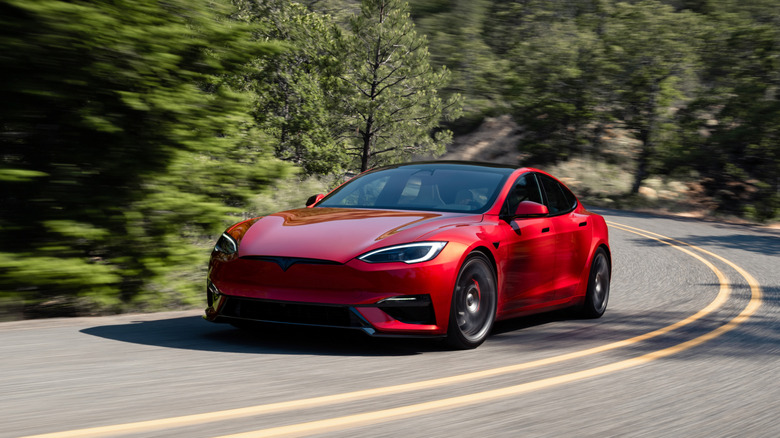
The drag strip was Plaid's traditional stomping ground when it appeared four years ago. Muscle cars. Supercars. Hypercars. It didn't really matter — Tesla's fastest four-door sedan beat them handily. The official 9.23-second quarter-mile time is still as mind-boggling today, especially considering the Model S Plaid starts at $96,630.
That's significantly cheaper than the $123,275 BMW M5, which packs a plug-in hybrid powertrain with 717 hp and 738 lb-ft of torque. The Model S Plaid? Dual-motor configuration with 1,020 hp and 1,050 lb-ft of torque. Plaid's sprint prowess is also evident in the 1.99-second 0-60 time, with the 200-mph top speed also looking impressive.
To achieve those incredible figures, though, you need to engage Drag Strip Mode on the Tesla Model S Plaid. The mode cools the motors and warms up the battery to keep them in the ideal temperature range, while also lowering the height-adjustable suspension into 'Cheetah Stance.' This introduces a slight rake (the front end sits lower) to increase traction on the front wheels. Then, it's the usual 'press brake and gas pedal, release brake pedal' catapulting into the distance.
Now, the Model S Plaid is impressive in a straight line, but also a bit scary. Namely, it's one of the few cars that accelerate faster than they stop; it reaches 60 in just 98 feet but reaches zero from 60 in 104 feet. According to Car and Driver, the brakes are also very weak for the power on offer, and, overall, the Model S Plaid feels terrifying at higher speeds. Maybe the M5 isn't a bad deal, after all!
2025 Ferrari 296 Speciale (9.5 seconds)
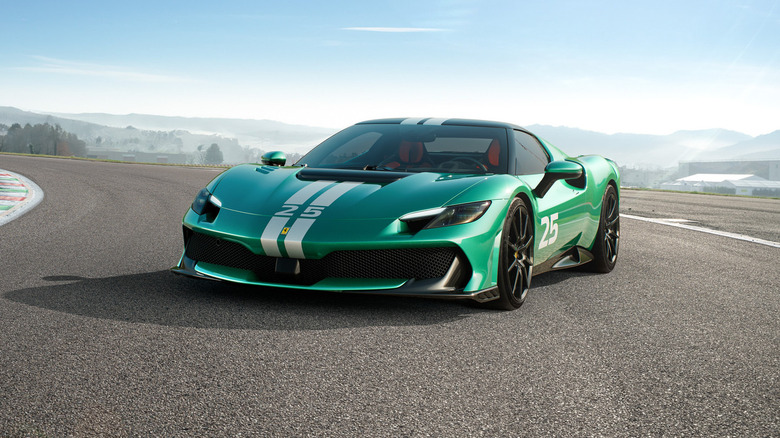
The 296 GTB might only have a V6 hybrid powertrain, but it's still one of the most accomplished modern supercars. But of course, the Prancing Horse didn't rest on its laurels and raced the 296 GTB to give us the Speciale.
Lighter, more powerful, and generally more hardcore, the 296 Speciale sets new standards in the rear-wheel-drive supercar category. Its 3.0-liter twin-turbo V6 now produces 691 hp (+37 hp) and 557 lb-ft (+11 lb-ft) of torque, thanks to a 3-psi higher boost from the turbochargers. Thanks to the more potent 178-hp (+13 hp) axial flux motor, sandwiched between the internal-combustion engine and eight-speed dual-clutch transmission, the 296 Speciale packs a staggering 869 hp.
But it's not just the power figures; thanks to the new pistons, titanium connecting rods, fasteners, and studs, the engine weighs 20 pounds (9 kg) less than before. Overall, the 296 Speciale is 132 pounds (60 kg) lighter, while also boasting active aero that provides up to 959 pounds (435 kg) of downforce at 155 mph (250 km/h).
The result? 0-60: 2.5 seconds. Quarter mile: 9.5 seconds. Top speed: 205 mph. Those are some ridiculous numbers for a rear-wheel-drive supercar and achieved on a regular — not prepped — surface. But also, fully anticipated once you factor in the $475,364 base price. If only Ferrari-level wizardry came with a price tag the rest of us mortals could touch!
2026 Chevrolet Corvette C8 ZR1 (9.6 seconds)
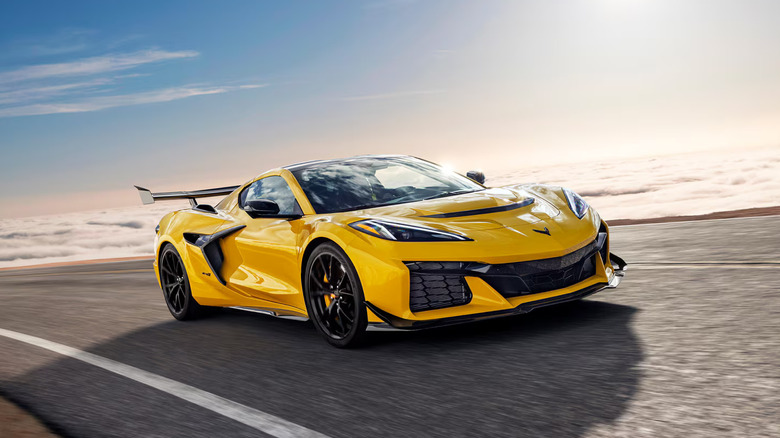
Well, look what we have here: Ferrari wizardry that us mortals could touch. Well, sort of. The Corvette C8 ZR1 is still expensive at $174,995, but it has all the hallmarks — and power — of the revered Italian supercar. Heck, it leaves the 296 Speciale in dust once both pass the quarter mile. When equipped with the stickier Michelin tires from the optional ZTK Package, the American pride posts a 9.6-second quarter-mile time (according to Chevrolet) but also reaches a significantly higher top speed of 233 mph (375 km/h).
But the 2025 Corvette ZR1 shocks the supercar system in more than one way. To begin with, it's the first-ever ZR1 with a mid-engine configuration, which immediately sets it apart from its predecessors. The 5.5-liter twin-turbo, flat-plane-crank V8, good for headline-grabbing 1,064 hp and 828 lb-ft of torque. Oh, and there is no electronic trickery here; just good old V8 American muscle. The real jaw dropper: All that power is channeled only to the rear wheels via an eight-speed dual-clutch automatic. This makes the 9.6-second quarter-mile time and 0-60 sprint of 2.3 seconds all that more impressive.
Oh, and Chevy didn't develop its mid-engine sports car only for the drag strip. A Corvette ZR1 equipped with the ZTK Performance Package (carbon fiber wheels and Michelin Cup 2R tires) also torched the field at the Nürburgring Nordschleife with a time of 6:50.763. Meanwhile, Chevy's rivals have another thing to worry about: The upcoming ZR1X hybrid packs 1,250 hp and covers the quarter mile in less than 9 seconds!
2019-2024 Ferrari SF90 Stradale (9.6 seconds)
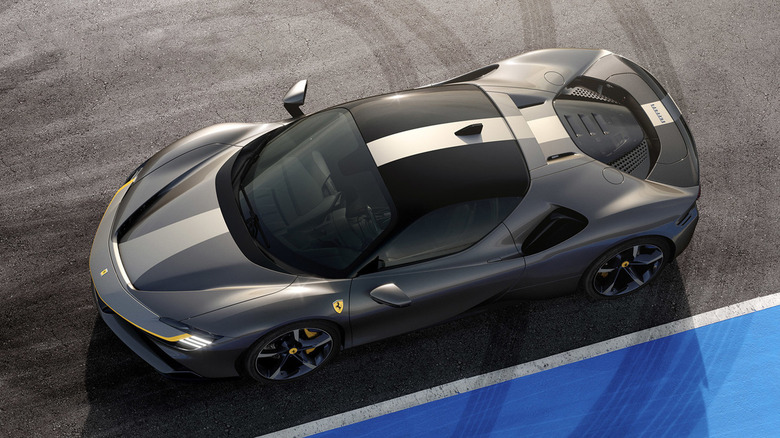
Ferrari's latest take on the twin-turbo V8 also employs electricity, but in a much more elaborate manner than in the 296 Speciale. The SF90 Stradale's plug-in hybrid powertrain consists of a 4.0-liter twin-turbo V8 that produces 769 hp and 590 lb-ft of torque on its own. Ferrari paired it with a 201-hp electric motor plus an eight-speed dual-clutch auto, plus two electric motors on the front wheels, each producing 133 hp.
Overall, the system produces 986 hp. Yes, the SF90 Stradale is also AWD, which enhances traction. As a result, the SF90 Stradale catapults to 62 mph (100 km/h) in just 2.5 seconds and has a top speed of 211 mph (340 km/h). Motor Trend also covered the quarter mile in 9.6 seconds, an impressive feat for a hybrid supercar introduced back in 2019. Oh, and thanks to the 7.9-kWh battery pack, you can drive the SF90 Stradale on electricity alone for 15 miles. Neat!
But of course, the SF90 Stradale is at its best in the corners. Although heavier than the F8 Tributo, due to the hybrid bits, most publications agree that the SF90 Stradale is a great car to drive on track. This is particularly true for cars equipped with the Assetto Fiorano package, which brings a more aggressive rear spoiler for higher downforce, titanium exhaust and carbon fiber panels for reducing weight, Multimatic shocks for better cornering, and sticky Michelin Cup 2 R tires for higher grip.
2013-2016 Ferrari LaFerrari (9.7 seconds)
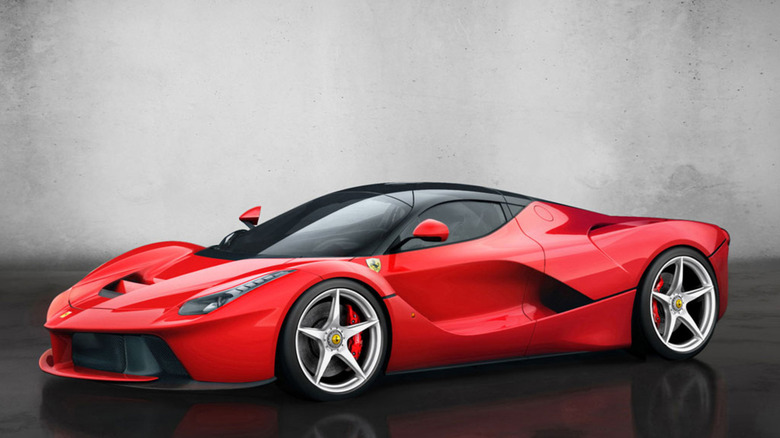
The LaFerrari is the only car that tickles your ears with a naturally aspirated V12 bonanza while being capable of a sub-10-second quarter-mile time. Admittedly, there is a HY-KERS hybrid component that helps Ferrari's 2010s flagship; the single electric motor that sits sandwiched between the engine and seven-speed dual-clutch transmission produces 161 hp and 199 lb-ft of torque, powered by a 2.2-kWh battery, bringing the total output to an astonishing 950 hp.
But what truly elevates the LaFerrari is that the electric bits don't take away from the 6.3-liter V12 jewel. The racecar-like engine has a screaming 9,250-rpm redline and produces its maximum 789-hp figure at 9,000 rpm. Torque: 516 lb-ft. Aural sensations: gazillion. Unleash the V12 musical instrument to its fullest, and the LaFerrari reaches 62 mph (100 km/h) in 2.9 seconds. 124 mph (200 km/h) arrives in less than 7 seconds. 186 mph (300 km/h): 15 seconds. Quarter mile: 9.7 seconds (according to Motor Trend). Top speed: 218+ mph. In 2013, when Ferrari first showed us its Enzo successor, these were world-beating numbers. Did we mention it's RWD-only?
You know the deal by now — the LaFerrari is even better in the corners. Yes, it's a hybrid, but it also weighs just 3,489 pounds (1,583 kg), so it feels playful and agile. The LaFerrari also has active aerodynamics to keep it glued to the ground, and advanced F1-trac and E-diff systems sourced from Ferrari's F1 program. Oh, and a very angry nemesis.
2013-2015 McLaren P1 (9.8 seconds)
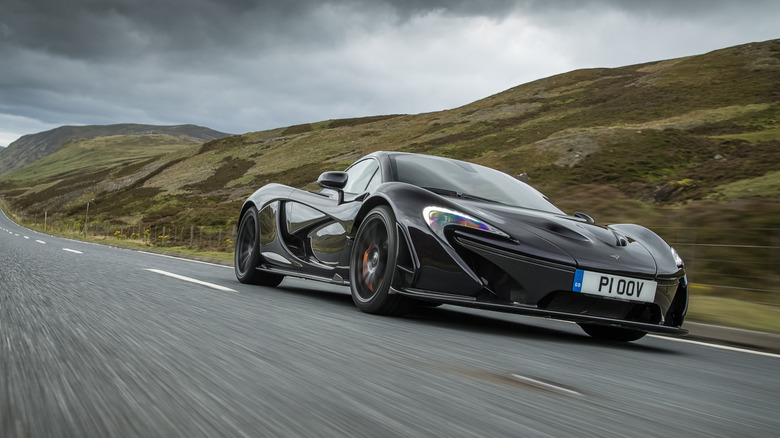
That nemesis, of course, came from McLaren. You could argue that the Porsche 918 Spider was part of a world-beating trio, but the McLaren P1 and LaFerrari were in a different performance league. The P1 was closer to the LaFerrari not just in terms of power, but also in the RWD configuration with an electric motor sandwiched between the engine and seven-speed dual-clutch transmission.
Unlike its Italian rival, though, the P1 employed a 3.8-liter twin-turbo V8, good for 727 hp and a not-too-shabby 8,300-rpm redline. Aided by a 177-hp electric motor, the overall system produces 903 hp and 664 lb-ft of torque. At 3,075 pounds (1,395 kg), the P1 weighed less, too. According to McLaren, all this translates into a 0-62 mph time of 2.8 seconds. 0-124 mph (0-200 km/h): 6.8 seconds. Top speed: 217 mph (350 km/h). Quarter mile: 9.8 seconds (according to Motor Trend). In other words, neck and neck with its closest rival.
What has set the P1 apart, though, was the unholy 1,323-pound (600-kg) downforce at 160 mph, courtesy of the massive, adjustable rear wing. The P1 could also be lowered by a full 2.0 inches for track attack purposes, turning it into a real racecar. Heck, you could even increase the roll stiffness by 3.5 times in Race mode, thanks to the hydraulic anti-roll bars.