

If You're Still Coasting Downhill In Neutral, You Need To Stop

Anytime the price of fuel rises at the pump people start looking for ways to get better fuel economy. If you frequently drive on roads with any type of steep grade, you've noticed that going uphill stresses your engine, causing it to suck down fuel at increased rates. On the other side of the hill you might hope your engine will drop to a steady idle speed since gravity is doing the work, only to be disappointed by an rpm above idle due to engine braking.
If you've thought about slipping your transmission into neutral to reduce those revs, don't do it. If you make coasting downhill in neutral a regular practice, stop it. For one, you're not really saving any fuel by coasting, especially in modern, computer-controlled cars with fuel injection. In addition, due to safety concerns that arise from coasting downhill with your transmission in neutral, the practice is actually illegal in many areas of the United States.
Why is coasting downhill in neutral a bad idea?
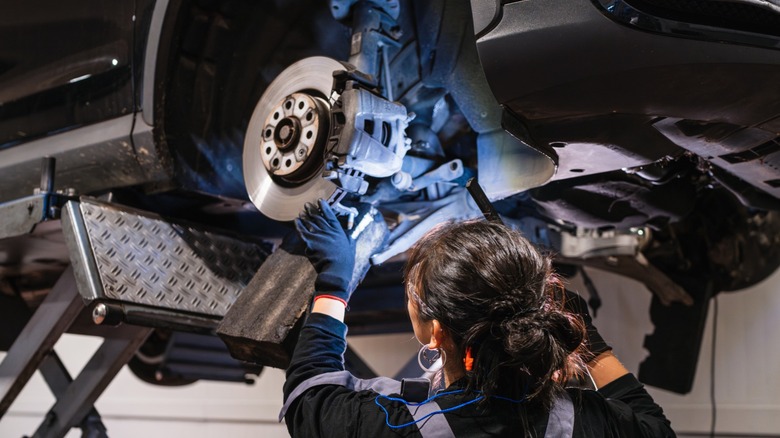
While there are several dumb car myths that are harmless, coasting down slopes with your car in neutral, or with the clutch depressed, is a bad idea on several fronts. First, people employ the technique in an attempt to save money on fuel. The kicker is, the practice actually uses more fuel than allowing engine braking to slow the car on steep grades. This happens because the car's computer must provide fuel to the engine for it to remain at idle, but completely cuts off the fuel supply during engine braking.
In addition to using more fuel, coasting, instead of engine braking, requires more frequent and vigorous use of the car's braking system to maintain a safe speed. This leads to increased wear of brake components. Plus, coasting by holding down the clutch pedal of a manual-shift car can cause premature wear of the throw-out bearing, a difficult part to change with its location at the heart of the clutch assembly, sandwiched between the engine and transmission.
Why is coasting prohibited in most states?

Many states have statutes prohibiting coasting. Virginia law, for example, says, "The driver of any motor vehicle traveling on a downgrade on any highway shall not coast with the gears of the vehicle in neutral." While it's admittedly hard to enforce such a law, your car is probably equipped with a crash data recorder, the technology for which came from the Indy 500. If you're involved in an accident, that data could reveal coasting or other driving characteristics that place the blame on you.
Safety is the main driver of prohibitions on coasting downhill. Relying exclusively on your mechanical brakes to limit speed, which can increase rapidly in the absence of engine braking, while driving downhill can cause them to overheat and become ineffective. If your brakes fail when you need to stop you'll almost certainly crash into another vehicle or run off the road. And the steering system in your car could be less responsive while coasting. This, along with the extra speed, can make it difficult to navigate curves smoothly and reduce control in emergency situations.
Shifting your transmission from neutral into gear or releasing the clutch can also pose risks, especially at increased speeds encountered due to coasting. If traffic ahead suddenly slows or you encounter an object or animal in the roadway, quickly reengaging the transmission can lead to mistakes. The need to shift an automatic transmission from neutral to drive during emergency maneuvers is a distraction, and releasing the clutch too quickly can cause you to lose control and crash.