

This Is The Rarest Chevy Engine Ever Made (And The Cars It Powered)
There are quite a few rare Chevy V8s. I could go on about '56 Corvette dual-quad 265s with Duntov cams, ZL-1s, L88s, L89 aluminum-headed 396s, and L84 fuel-injected 327s. Rarer still is the Z-11 427 W-series Mark-I that's descended from the littlest big block, the 348. The Z-11 427 is the engine Chevrolet inflicted upon unwitting victims foolish enough to challenge lightweight '63 Impala drag cars. In all, Chevy only built 57 of those engines. Or maybe 50, or upward of 70, since apparently 20 engines may have been sold directly. But rarity must reach an end point, and as Connor MacLeod said in "Highlander," there can be only one.
That rarest of the rare is likely the 1963 427 Mark-IIS, with the S standing for "stroked," as Chevy experimented with a shorter-stroke 409 displacement before upping the cubes. Most famously, it's called the "Mystery Motor" or the "Porcupine" (we'll explain both nicknames momentarily). Mark-IISs are only barely related to the later Mark-IV big block 396s that debuted in 1965, and major parts won't swap from one to the other. While there may be as many as 70 Z-11 427s, 60 is the maximum anyone will give for the Mystery Motor, and some guesses go as low as 16. Most say the real number is, at most, around 50. Perhaps nine still exist.
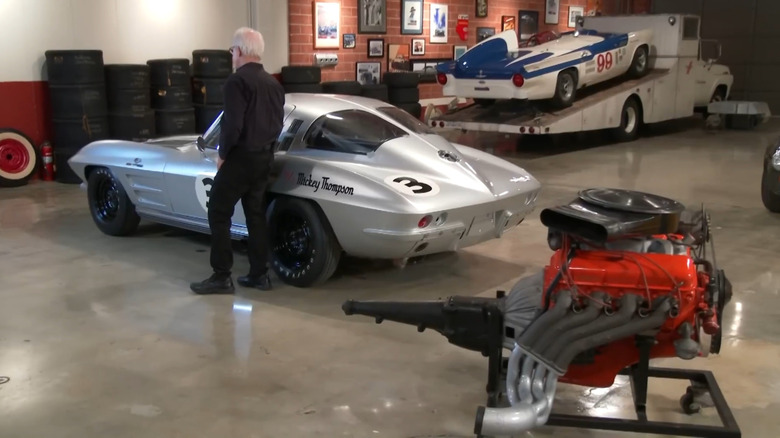
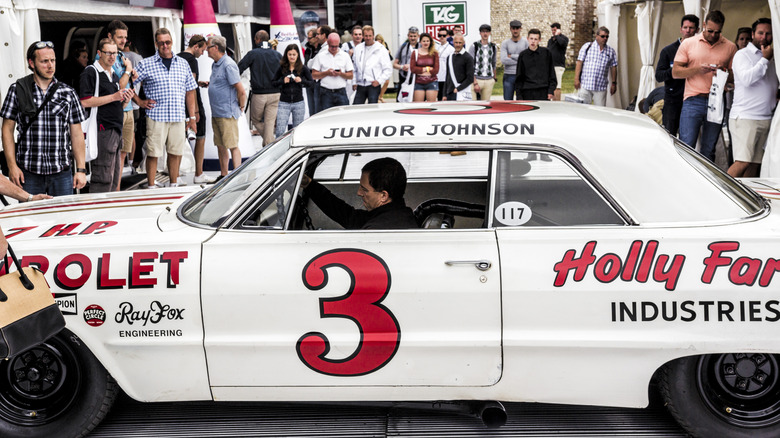
Being so rare, only a few cars got the Mark-IIS. Mickey Thompson crammed one into a C2 '63 Corvette Z06 and raced at the 1963 Daytona 250. Smokey Yunick and crew used a 427 Mystery Motor in the black-and-gold number 13 Chevrolet Impala at the 1963 Daytona 500. The most successful car powered by this engine is the 1963 Impala driven by Junior Johnson, which won seven races and achieved 13 finishes in the top five.
The missing link has porcupine heads
To understand the Mark-IIS Mystery Motor, we must first look at the Mark-I W-series that began in Model Year 1958 with the 348. W-series are weird — as the block decks have 74-degree angles, forming a wedge shape with the flat underside of the heads against the crowned piston tops. In 1961, 348s grew to 409s, inspiring the Beach Boys to come up with rhymes for that engine displacement.
To get 427 cubic inches, Chevrolet increased the crank's throw by 15 hundredths of an inch, extended the connecting rods by an eighth of an inch, and moved the wrist pins deeper into the pistons. But while the W-series' strange chambers accentuated low-end torque, they just weren't as efficient at high rpm as regular in-head combustion chambers found in wedges and hemis. So for NASCAR, where engines run at high revs for hours, the 74-degree decks and in-block chambers had to go.
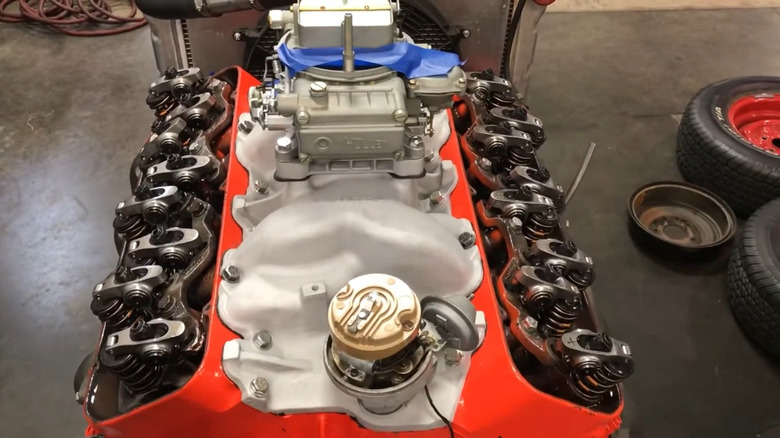
In preparation for the new closed chamber heads, Chevrolet cast a special W-series block with 90-degree decks and the Z-11 427's 4.31-inch bore and 3.65-inch stroke. Contrast this with the Mark-IV 427 and its 4.251-inch bore and 3.76-inch stroke. Thanks to the different valve stem angles, those who got to see the Mark-IIS without its valve covers said the valves resembled porcupine quills — hence the "Porcupine" nickname.
Also, Mark-IIS 427 heads were narrower than the W-series', ensuring that Mystery Motors would fit in C2 Corvettes. Mickey Thompson proved this when he slotted the Mark-IIS in his '63 Z06, paving the way for the introduction of the Mark-IV big block 396 in the 1965 Corvette. Oh, and while regular '63 Corvette Z06s with the "big-tank" option had 36.5-gallon fuel capacities, Thompson used a stupefyingly large 50-gallon tank for the Daytona 250.
Murder Mystery Motor
On February 2, 1963, the Charlotte News (via pontiacv8.com) ran a story headlined, "Pontiac, Chevy Racing Plans Jolted By GM." With the Automotive Manufacturers Association (AMA), insurance companies, and safety organizations breathing down General Motors' neck, the suits in charge decided it would be easiest to drop racing altogether.
Less than a month earlier, as recorded in Joel W. Eastman's book "Styling vs. Safety," American Motors President Roy Abernethy had stood before the AMA and criticized automakers for advertising all that horsepower, speed, and fun: "The start of a new horsepower race ... would create a public spectacle that could rob the industry of its deserved and hard-won reputation for responsibility." (Seat belts didn't become mandatory until 1968, five years after Abernethy said that. Perhaps the industry didn't have the handle on auto safety it claimed?)
So awesome early-1960s racing engines such as Pontiac's 421 Super Duty and the 427 Mystery Motor were cut off from GM like an embarrassing heir being removed from a will. Sure, racers like Smokey Yunick and Mickey Thompson were allowed to use the 427s already supplied, but no more engines or parts were forthcoming. And in May 1963, Hot Rod magazine wrote about the Mark-IIS and its quick corporate death, calling it the "Mystery V8." The name stuck. Here's Junior Johnson talking to Don Garlits about it:
So, how powerful was the Mark-IIS? In 2015, Hot Rod managed to secure the only one still in existence that actually raced — the one from Mickey Thompson's Corvette. The magazine slapped it on a dyno and found that it produced 446.7 horsepower at 5,700 rpm. That might sound rather puny compared to modern engines, but in 1963 terms, it might as well have been all the horsepower ever made.