

The Rise And Fall Of Front-Engine F1 Cars: What Really Forced The Switch
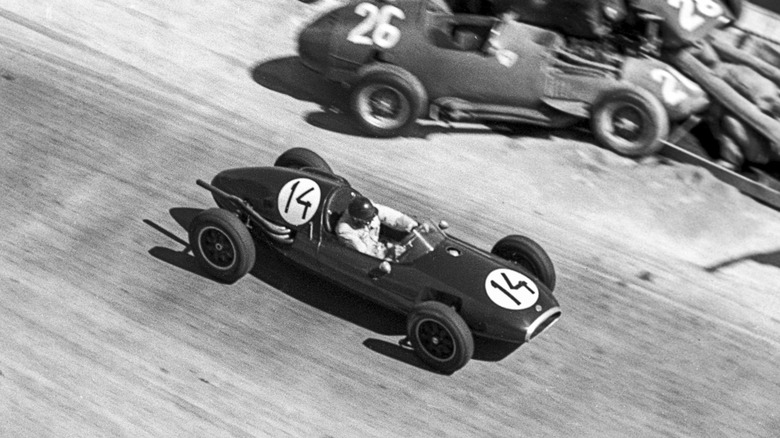
Although Formula 1 racing is known for being on the cutting edge of automotive engineering today, it didn't get started that way. When the cars lined up for the first modern Formula 1 Grand Prix in 1950 — as part of the first series to determine F1's first world champion driver — they had their engines mounted ahead of the driver. Yet a number of innovators in other motorsports competitions had already begun chasing checkered flags with rear-engined cars.
Ferdinand Porsche, for instance, had helped develop a mid-engine Auto Union racecar in the 1930s. In the United States, Harry Miller borrowed that idea for his Gulf-Miller special, which became the first mid-engine machine to qualify for the Indy 500 in 1939. However, World War II put the evolution of racecars on hold, and when competition returned in the late 1940s and early 1950s, many folks found it easier to start back with the dominant front-engine layout from the pre-war era.
But that was just delaying the inevitable, due to the inherent performance benefits of having the racecar's engine located behind the driver. Just remember that, technically, modern Formula 1 cars are mid-engined machines, since their motors are still in front of their rear axles. A true rear-engined car, like the Porsche 911 — offering the best base model money can buy for 2025 — positions its engine aft of the rear axle.
The racing benefits of having the engine in the rear
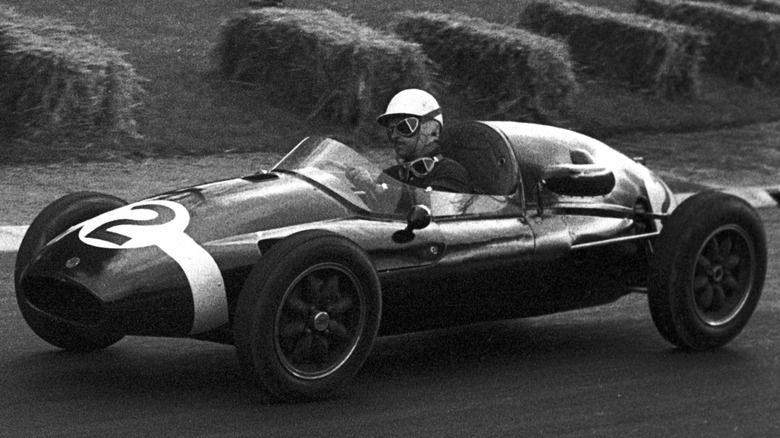
The primary benefit of having the engine behind the driver is that it greatly improves handling. In a front-engine setup, a car typically has a few hundred pounds of engine weight pushed well to the front, leading to an unbalanced weight distribution — unless you've also put another few hundred pounds in the trunk. A mid-engine car, with the engine behind the driver, concentrates most of its weight in the center and can often achieve the much-vaunted 50/50 weight distribution.
Along with the better balance comes a lower polar moment of inertia. Yes, physics once again rears its ugly head, but the key here is that it's harder to get a car to turn in the first place when weight is concentrated at the ends instead of in the center. The folks at Autoweek have compared it to pushing a grocery cart with the load back near the handle or way at the front. In the latter situation, you'll find it noticeably more difficult to turn the cart.
A rear-mid-engine configuration also helps better leverage its weight to improve acceleration, especially as compared to the front-engine/rear-wheel-drive layout of the early Formula 1 cars. Moving the engine back puts its weight over the driving wheels for better traction to get going quicker — benefits like these also drove the success of some production rear-engine cars that stood the test of time.
A quick history of modern rear-engine F1 cars
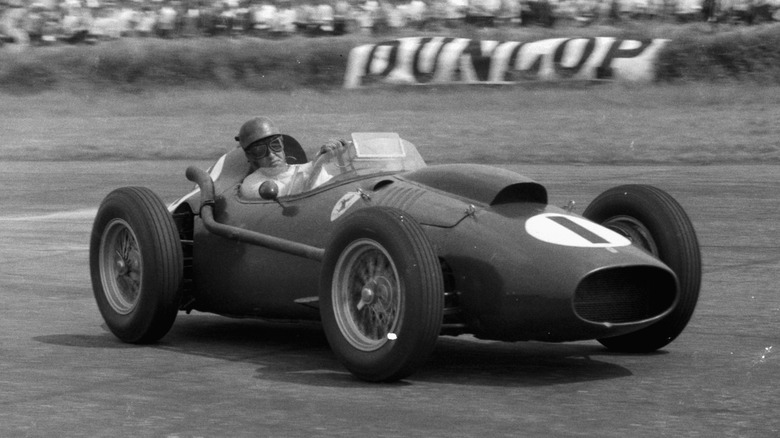
The revival of rear-engine racecars after World War II begins with the Coopers, Charles and his son John. Though better remembered today for producing the iconic Mini — John is still honored with cars like the 2025 Mini John Cooper Works 2 Door — the Coopers were heavily involved in racing in the 1950s. They participated in early Grand Prix events, with front-engine cars, but also began racing smaller cars in new motorsports classes that were getting popular with folks who couldn't afford to get into F1 racing.
These smaller Coopers had chain drives, so it made sense to put the engine in the back, close to the rear wheels, to shorten how long the chains had to be. The result was the Cooper T39, a single-seat rear-mid-engine racecar meant for Formula 2 competition. Cooper then ran a similar car but with a larger engine, the T40, in the 1955 British Grand Prix. Although not exactly a success, it was the first rear-engine car to compete in Formula 1. And the next iteration, the T43 with an even larger motor, now up to 2.0 liters of displacement, was the first to win a Grand Prix.
Lighter, quicker, and more nimble, rear-engine F1 cars soon became the class of the field. The final front-engine F1 car to win a race was a Ferrari Dino 246 driven by Phil Hill in the 1960 Italian Grand Prix at Monza. Coincidentally, the Dino 246 was also the first F1 car with a V6.