

What Are The Pros And Cons Of An Independent Rear Suspension?
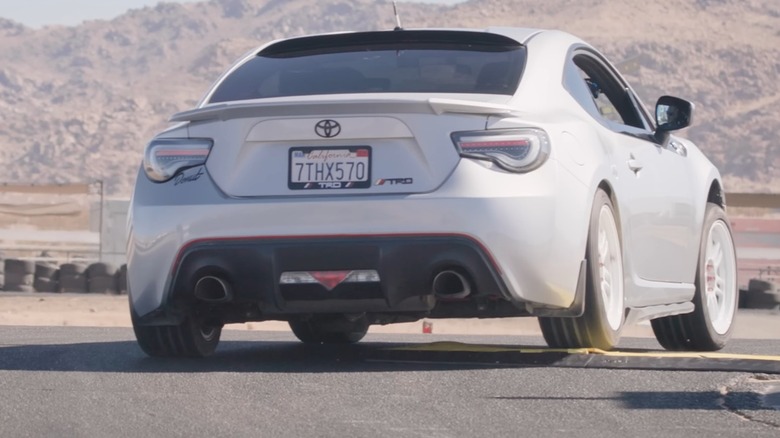
While the attention given to a car is often focused on components like the engine or its exterior design, what's used to attach the wheels to the chassis makes a bigger difference than you might think. There are a variety of configurations when it comes to rear suspension in an automobile, with options like live axle, independent, and torsion beam, which is still used by new Mazda3s. Each version offers benefits and disadvantages while dramatically affecting factors like ride quality, traction, and performance in different scenarios.
Independent rear suspension (IRS) is a system that allows the rear wheels to move separately of one another. You can find IRS in a variety of modern vehicles, including mid-sized luxury sedans like the Lexus ES, pickup trucks like the Honda Ridgeline, or the Ford Mustang GT, to name a few. This distinct suspension system first found its way into an early 1960's Jaguar, and has been a part of the industry ever since.
With an IRS configuration, you can expect a gentler ride and experience enhanced grip under certain circumstances, which may offer additional control and increased safety. However, when compared to alternatives, IRS isn't as robust, and features additional complexity that has negative rippling effects.
Pros: increased traction, improved overall control, and superior ride quality
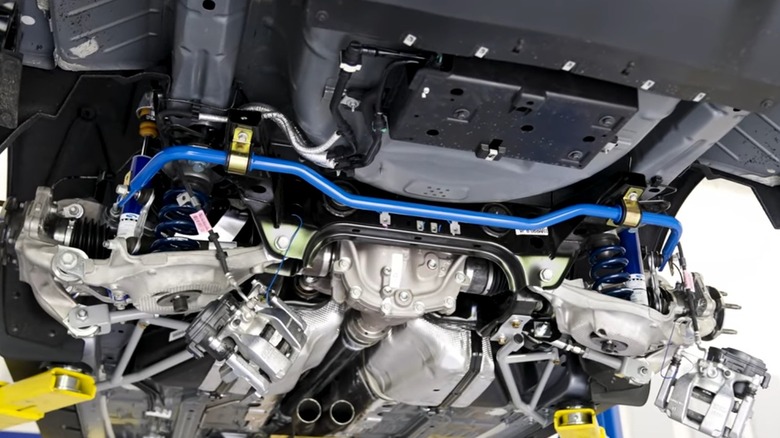
While an IRS, at its core, is a configuration which isolates the movements of each wheel, there are different designs used to achieve it, such as multi-link and double wishbone. For example, a double wishbone IRS utilizes a "V" shape, with each of the two arms including a point connected to the wheel and two others affixed to the vehicle's frame.
Since each rear wheel can move vertically without effecting the other, it enables better traction. The more the tires are touching the road (known as their contact patch), the greater a car's grip. With a live axle, when one wheel pushes up over a bump, it also tilts the other up at an equal angle, pulling much of the rubber tread off of the road's surface. If you were to encounter an uneven road while cornering, an IRS would allow at least one tire to remain fully connected to the pavement, improving control and safety.
Finally, one of the primary benefits of an IRS is that its design helps minimize jarring dips and shifts in the road surface, offering increased driver and passenger comfort. This is why it's not unusual to see this kind of setup in a luxury vehicle, as buyers would expect a refined experience via better ride quality. Although, suspension isn't the only factor determining a car's feel, as tire speed ratings also affect ride quality.
Cons: complex, expensive, and not the strongest option
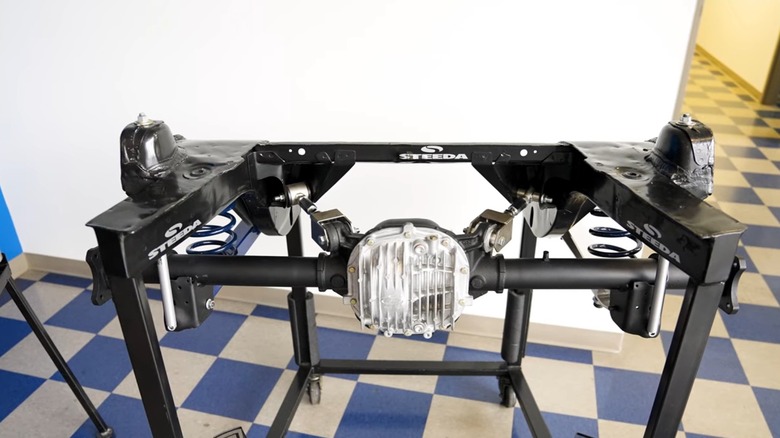
With all the benefits of an independent system, why wouldn't every vehicle utilize this configuration? For one thing, these setups are far more complicated to engineer, which results in increased costs to manufacture and maintain them. Compared to a basic live axle, which features a more straightforward installation, an IRS is more intricate and can even require specially modified parts. Although, if you've seen cars that look like they're driving sideways down the road, it's probably due to a straight or live axle that's been bent, so that's not an issue you'll likely encounter with IRS.
In addition, because of the fewer connections — and, therefore, less potential points of failure – of a live axle, its simpler design can stand up to more force. During hard acceleration, wheel hop can become present in IRS setups, putting additional strain on the axle shafts. It's for this reason that IRS may not be ideal for every car, particularly if aggressive acceleration is the goal.