

5 Concept Chevys That Never Made It To Production
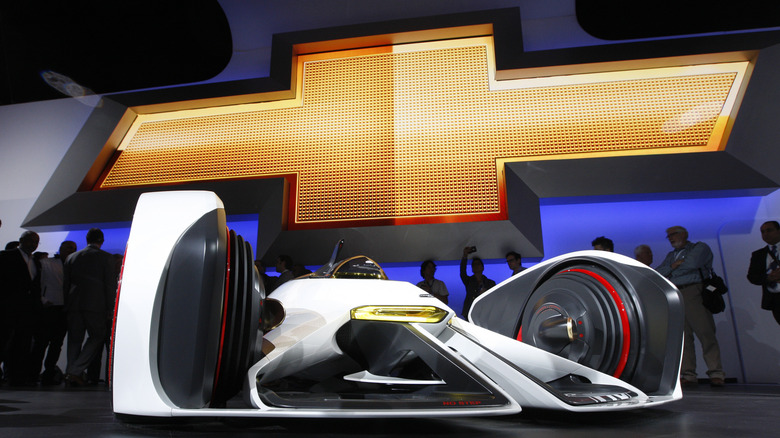
In the automotive industry, there's nothing that grabs attention better than a concept car. Not meant for public roads, these science experiments on wheels show us what the future could be for automakers. Whether that leads to ruthless optimism or divides the industry, reaction is everything when it comes to concepts.
Some concepts haven't just graduated to full production cars, but have done so with shocking resemblance to their original design. The Volkswagen I.D. Buzz concept and the Honda Prelude's surprise comeback are two fantastic examples of cars almost identical and unchanged from the auto show to the factory floor. Although the sixth-gen Supra shares plenty of design features with the FT-1 Concept, various changes had to be made for the sports car to return to the road.
In most cases, however, the concept never makes it past the auto show floor, and nobody has mastered the craft of misfit concepts quite like Chevrolet. From retrofuture throwbacks to Hollywood-caliber cruisers and a couple of Corvettes, here are five concepts from Chevrolet that were never built.
1963 Testudo
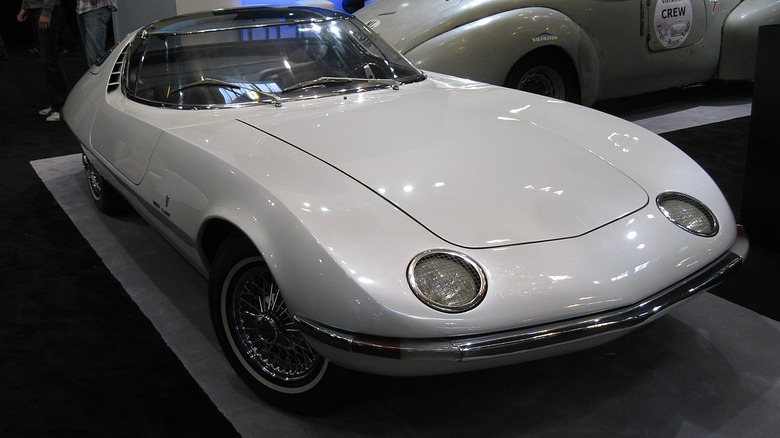
Before Ralph Nader wrote a single word in anger, and before Time Magazine put it on its list of the 50 Worst Cars of All Time, there was nothing but ruthless optimism behind the Chevrolet Corvair. A mass-produced, relatively affordable mid-engine car with a boxer crammed behind the driver, it felt like all the ingredients were there for the car to be America's answer to the Volkswagen Beetle.
However, one key piece was missing for the Chevy: European appeal. In an era when General Motors was trying to promote the brand across the Atlantic, Vice President Bill Mitchell believed that the Corvair ought to be the one leading the charge. However, Mitchell believed the car looked too American for foreign roads. Two chassis were shipped to Italian coachbuilders in the early '60s, and each was tasked with getting the car suited up for the European market.
Pinifarina sent back its Corvair Speciale, but Bertone's would come out on top with its design: the Testudo. Bertone shortened the chassis by 12 inches to transform the car from an American compact to a European coupe. Design icon Giorgetto Giugiaro converted the Corvair from box to bullet, giving it a smooth, Berlinetta-style body, with pop-out headlights and a fighter-jet-style hinged canopy in place of doors.
Nuccio Bertone drove the car to Geneva, where it made its debut at the 1963 Geneva Motor Show. It was instantly an eyecatcher, and Road & Track's Henry Manney reported that the vehicle attracted numerous photographers and journalists.
Ultimately, Ralph Nader's 1965 book "Unsafe at Any Speed" directed much of its fire at Corvair's deadly handling. By 1969, production of the Corvair ended, along with any chance of a future for the car in Europe.
1976 Aerovette
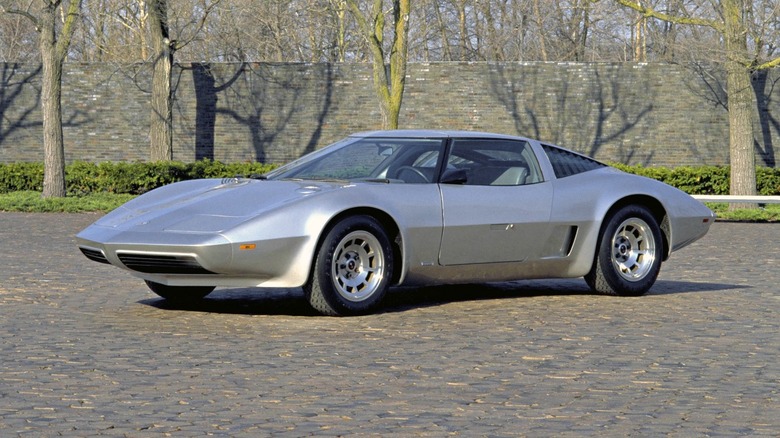
While many celebrated the Corvette's long-rumored move to a mid-engine, the decision came to the outcry of many Corvette diehards. Regardless, Chevrolet has let the car do the talking, with the 1,250-horsepower Corvette ZR1X setting a new Nürburgring lap record. However, any true Corvette fan will know that the move to mid-engine was a decision Chevrolet has been considering for nearly half a century, starting with the rotary-powered Aerovette concept.
You heard that right — the first mid-engine Corvette might have run on rotary power. With the Oil Crisis a rising threat in the late '60s, Chevrolet believed the next generation of 'Vettes should focus not on high power, but on low weight, good handling, and high efficiency. At the 1973 Paris Auto Show, Chevrolet showed two versions of what the next Corvette could be: a four-rotor concept, dubbed the XP882, and a less powerful, two-rotor variant, known as the XP-987GT.
A rotary-powered corvette sounds about as wrong as an LS-swapped RX-7, but on the surface, it would have undoubtedly fit in on Chevrolet's showroom floors. Although the concept's low and long fiberglass body and gullwing doors made it seem like a supercar straight out of Europe, Bill Mitchell's design team ensured it had the Corvette look.
While Corvette would never go the way of the Wankel, the concept would reappear in 1976, this time with a 6.6-liter V8. It was redubbed as the Aerovette, and the concept seemed destined to become the C4. However, chief engineer Dave McLellan believed the mid-engine model would struggle to sell, like the Porsche 914, and the Aerovette was cancelled.
1987 Express
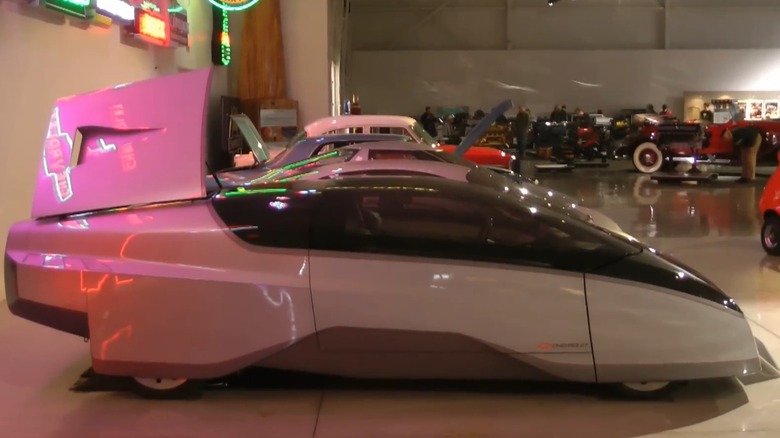
When your concept almost hits Marty McFly, you've done a pretty solid job of designing the car of the future. That's because the Express concept was Chevrolet's optimistic idea of what the automobile could be in the year 2015. While the nameplate would ultimately work its way onto full-size vans in the coming decades, Chevrolet believed the Express was destined to be a gas-turbine-powered cruiser designed for the freeways of the future.
The vision of the Express was based on the proposed high-speed highway network, an American system of autobahn-like roads where cars would self-drive at triple-digit speeds. Despite the concept's turbine engine only making about 120 horsepower and 350 pound-feet of torque, the Express' ultra-sleek body hypothetically allowed the car to carry four passengers at 150 mph while offering roughly 25 miles to the gallon.
The kerosene-powered turbine and overhead canopy in place of doors may seem a little too bizarre for today's roads, but with the Express, Chevy nailed its prediction of what other creature comforts the automotive future might hold. From throttle-by-wire to proximity key fobs and rearview cameras in place of mirrors, there truly were some aspects of the Express that would be common in cars in 2015.
The best part? The concept was fully functioning. That kerosene-turbine engine and all of those next-gen gadgets in the car weren't just for show — they could actually work. As a driving, working example of a car 30 years ahead of its time, it's no wonder Universal gave it a cameo in "Back to the Future Part II." Hopefully, Marty wouldn't be too bummed to find out that our version of the Express is a van that's been practically unchanged since 1996.
2003 Super Sport Concept
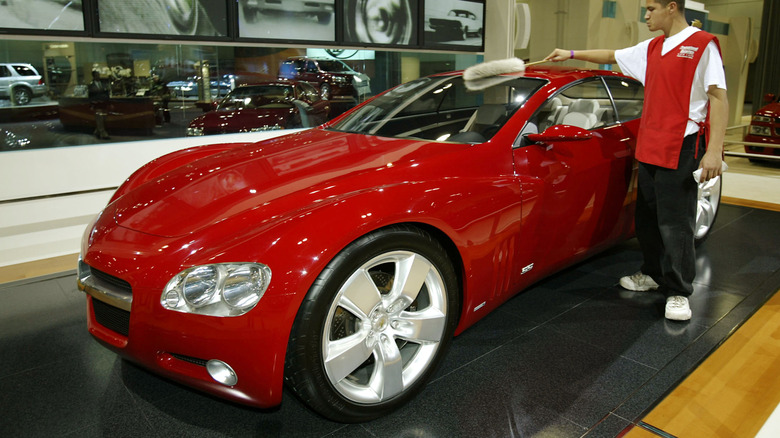
At the turn of the century, American automakers were milking nostalgia tactics dry. From the Plymouth Prowler to the Chrysler PT Cruiser and Ford's Thunderbird, everyone was trying to party like it was 1959. Eventually, Chevy wanted in, with a rival to the PT Cruiser in the form of the HHR, as well as a pickup convertible and the SSR that we can't stop disagreeing about.
But in all of these design callbacks, nothing truly captured the heritage and style that defined Chevrolet's performance in the late '60s and early '70s. What Chevy wanted was a true callback to the Impalas and Chevelles of yesteryear – an American answer to the affordable and practical performance of Europe's sports sedans.
The solution came in 2003 with the SS concept. Debuting at the North American International Auto Show in Detroit, the concept was targeted as a reliable, cheaper, and American alternative to the E39 M5. It certainly had the horsepower to challenge the BMW, with its 6-liter small block V8 cranking out 430 horsepower. That power was sent to the rear wheels using a four-speed automatic gearbox, the same transmission used in the auto-optioned Corvette. The SS copied more of the sports car's homework for handling, including many suspension pieces derived from the C5.
While the 2003 concept never made it into production, A modernized and refined SS hit the market in 2013. Using the same Zeta platform as Pontiac's G8, the SS was a manual sedan with all-American V8 power. While the car was met with next to no fanfare, a decade later, it's appreciated by many as one of the most underrated Chevrolets ever built.
2011 Miray
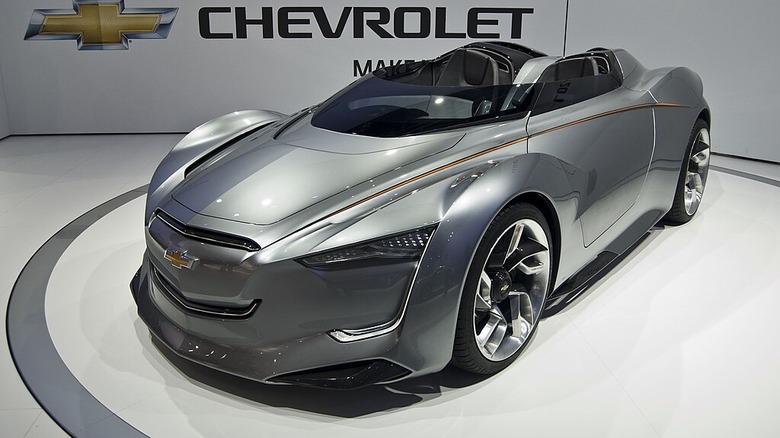
Built by GM Korea's design studio, the Miray roadster was launched at the Seoul Motor Show in 2011 in celebration of Chevrolet's 100th birthday. Meaning "future" in Korean, the concept relied on the brand's past century of experience to inspire what the future of performance could be for the bowtie. The rendition would be yet another mid-engine Corvette, only this time, it was less sports car and more spaceship.
At its core, the Miray takes design inspiration from a plethora of Chevy's racing concepts from the 1960s, but it mainly embraces the Corvair Super Spyder's Design, with its tiny windshield and sharp decklid. However, the concept was far from a throwback. With its carbon fiber body and scissor doors, the Miray was envisioned as a bold direction for a Corvette to take.
And that direction wouldn't just be visual, but mechanical. With no V8 in sight, GM Korea gave the Miray a hybrid powertrain. Behind the driver was a 1.5-liter turbocharged inline four. When the car wasn't being operated in anger, it would switch over to its twin 15-kW motors to send power to the front axle.
Over a decade later, the Miray vision would evolve and transform into the 655-horsepower 2024 Corvette E-Ray. The final result, however, was far less dramatic than the Miray and nearly identical to the standard Corvette. To the relief of many, that includes the motor, as the first Corvette hybrid still features the standard C8's small-block V8.