

The Pros And Cons Of The Mazda Miata RF's Folding Metal Roof
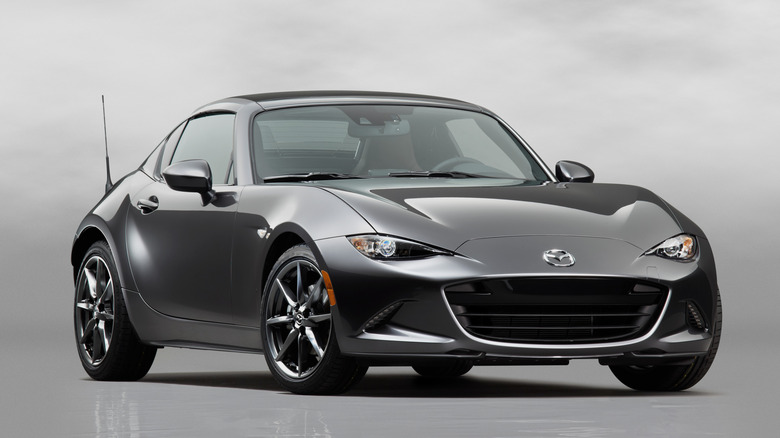
Ever since it first arrived at the very tail-end of the 1980s, the Mazda Miata has been the go-to answer for many driving enthusiasts looking for something that delivers old-school driving thrills without breaking the bank. Currently in its fourth generation, the humble roadster continues to deliver everything folks have always loved about the nameplate, with a simple rear-wheel drive setup, a punchy four-cylinder engine, and lightweight, minimalist construction.
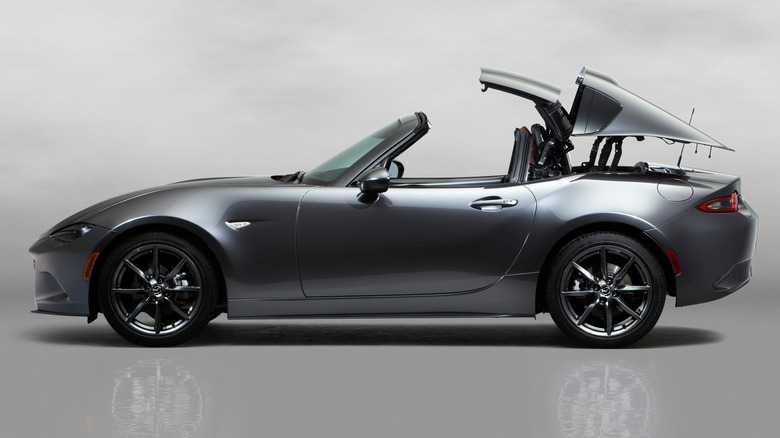
However, the market for two-seat sports cars isn't exactly huge, which limits the sales potential of the Miata. To help widen its appeal, and to help keep the model alive, an RF version was introduced during the fourth-gen's production run — with the "RF" standing for Retractable Fastback. It's a folding hard-top version of Mazda's evergreen Miata, and it's been available in the U.S. since 2017. We think that everyone should drive a Miata at least once, but whether the RF is the right model for you depends on what you want.
Understandably, there are different pros and cons to both the old-school soft-top and the RF model's folding metal roof. While some might be immediately obvious, other upsides and downsides might not jump out so quickly.
The upsides of owning a Mazda Miata RF
To start off with the benefits, the RF's metal roof offers significantly more protection from the elements than a traditional soft-top, which can be particularly attractive if you live somewhere that frequently experiences cold climates. Sure, both cars have heaters and can be equipped with heated seats, but that extra level of protection should help to make daily life a little more comfortable.
Secondly, that metal roof also means less noise creeps into the cabin — when it's up, at least. A quieter cabin might not be what you want on a twisting back road, but for the daily commute, it's a plus-point for sure. That metal roof also offers an extra layer of security, as soft-tops can be particularly attractive bait for vandalism.
Some people might prefer the sharp looks of the RF as well. This is a subjective point, but if you fall into that camp, it might be one of the most appealing points of the car. Finally, the entry-level Mazda Miata RF comes with a great selection of standard equipment, such as a Bose nine-speaker sound system, heated Recaro seats, and 17-inch gunmetal gray wheels. In comparison, the non-RF Miata only offers 16-inch wheels, cloth-trimmed seats, and a six-speaker system on its entry-level trim.
There are downsides to consider, too
Onto the cons, and the first one is a big one; the Mazda Miata RF starts from $37,850. That price is subject to taxes, title fees, license fees, and tariff-influenced destination charges. The soft-top Miata kicks off at just $29,830, not counting the same additional fees. That's a difference of $8,020, which is one considerable premium. Additionally, that clever roof comes with another cost too, although not a monetary one. The appeal of a Miata has always beat its low-weight thrills, and while the RF is hardly a portly choice, it does tip the scales at 103 pounds heavier than the entry-level Roadster.
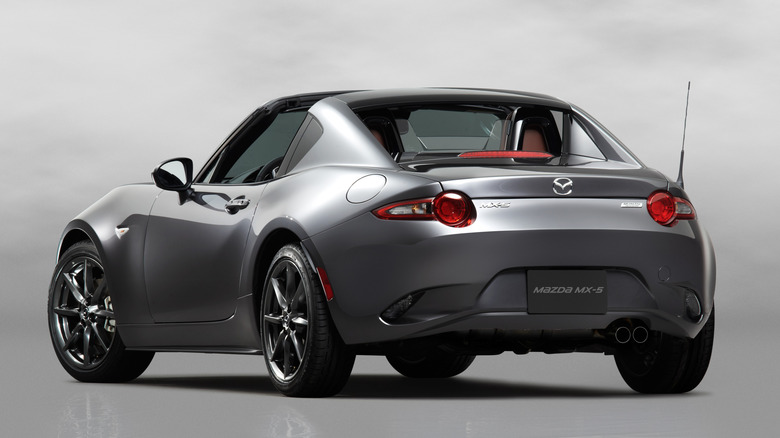
That roof adds more than just weight, too, as it also takes around 13 seconds to drop the roof. In comparison, the Roadster's soft-top can be thrown down by releasing the single catch and just flinging it rearward. That's hardly a big negative for the RF, but it's worth pointing out all the same. Some owners also note that, when the roof is in the down position, the wind noise is really quite invasive — likely due to these cool-looking buttresses on the rear. We're all for that wind-in-the-hair experience, but the noise that comes with it is not the greatest.
Ultimately, the biggest con brings us back to that price. It's not exactly a fair comparison, as the Roadster comes with a simpler base trim. The fairer comparison would be between the Club trims of both cars. In this instance, the Club Roadster checks in at $33,330, which is much closer to the RF's $37,850 asking price, although the difference of $4,820 is still a considerable gulf.