

The US Military Is Retiring The A-10 Warthog: Here's Why
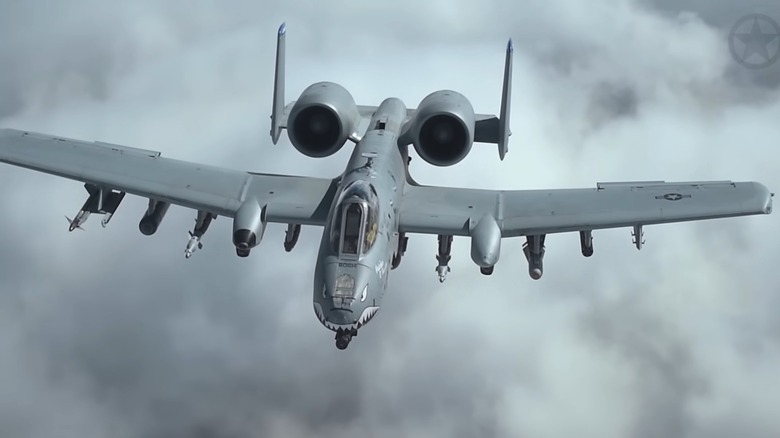
The legendary A-10 Warthog has been granted retirement in 2026 for several reasons, including the changing landscape of modern combat and military budget limitations. Due to the aircraft's effective but simplistic design, it lacks some features necessary to compete against other modern forces. For instance, the A-10 Warthog is anything but stealthy or quick, which is a problem when sending this aircraft against an adversary utilizing state-of-the-art air defenses.
In addition, considering the eye-watering cost of every variant of the F-35, for example, there aren't enough dollars left over to keep the Warthog going, with cost per flight hour sitting between $19,000 and $22,000, per National Security Journal. But there are reasons why many are reluctant to bid farewell to this iconic attack aircraft.
First flown in 1972 as a prototype, the A-10 Warthog has been a mainstay in U.S. military close air support for four decades. One of its most defining features is the massive cannon protruding out of its nose, called the GAU-8/A Avenger. This 30mm cannon measures 21 feet long, and when fully loaded, tips the scales at more than 4,000 pounds, making it the heaviest automatic cannon affixed to an aircraft. With the GAU-8/A Avenger able to hold greater than 1,000 rounds, which fire at a rate of 70 every second, the A-10 Warthog can rain down absolute destruction, turning armored vehicles into Swiss cheese.
U.S. soldiers are said to breathe a sigh of relief upon the entrance of an A-10 Warthog to an active battlefield. And one pilot, referred to only as McGraw, told Business Insider about its effect on enemy troops: "Lot of times [when] we're overhead, they'll just put their guns down and go away because they know the A-10 is overhead."
Drones as anti-tank weapons
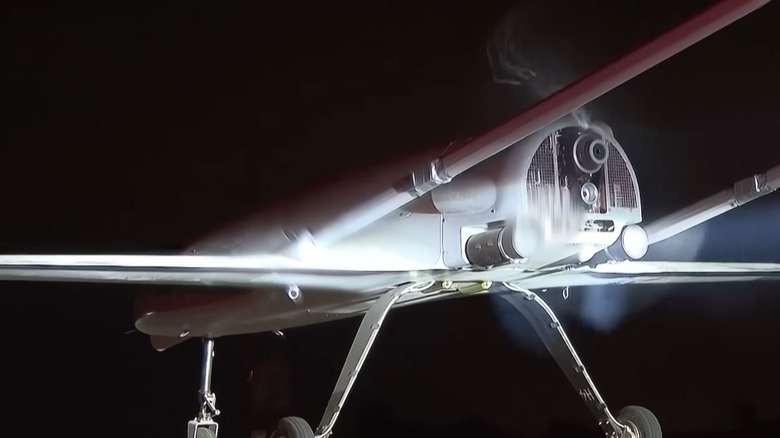
So why is the A-10 considered outdated? As drone technology has advanced, the capabilities of these unmanned aircraft has expanded. While drones once were used primarily in reconnaissance roles, they now have been weaponized and put to use for targeted attacks. And while cheap FPV drones aren't the future of airpower yet, they have proved useful for attacking armored vehicles in the conflict between Ukraine and Russia, where they deliver explosive payloads in one-way flights.
The U.S. Army, meanwhile, has been testing attack drones, which are substantially less expensive than traditional aircraft and can potentially destroy multi-million-dollar enemy tanks. The Army's is exploring inexpensive drones equipped with explosively formed penetrators — projectiles with enough mass and high speed to potentially break through an enemy tank's armor, although they haven't been used in combat yet and their actual feasibility is uncertain. Some speculate drones armed this way could replace artillery operations in the future.
The F-35 can provide close air-to-ground support
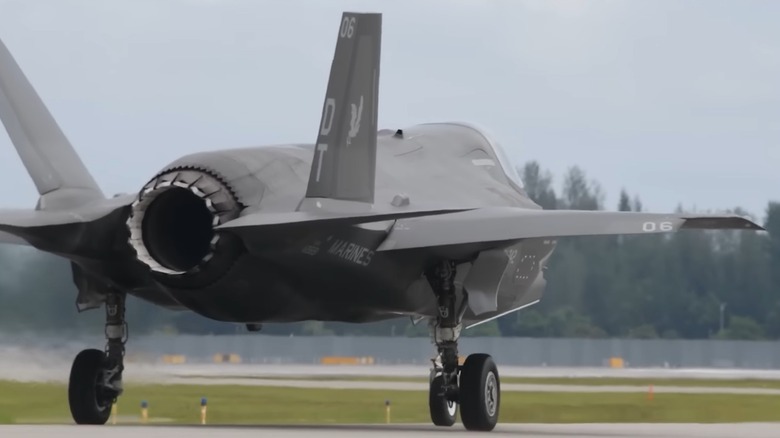
Another reason the A-10 Warthog is being phased out: it became redundant following development of the highly versatile F-35. This fifth-generation fighter aircraft offers the advantage of stealth technology, which makes it undetectable in situations where the A-10 Warthog would loudly announce its presence. This means that the F-35 could get much closer to the enemy before unleashing a host of ordnance designed to support friendly ground troops. In fact, it can transport as much as 22,000 pounds of weaponry, including an internal 25mm gun, on some variants.
While not nearly as beefy as the A-10 Warthog's cannon, this internal gun lets the F-35 perform strafing runs on enemy ground targets. The cutting-edge fighter also can take advantage of more sophisticated weapons, like the StormBreaker smart munition. The StormBreaker can zero in on the enemy even during severe weather or times of low visibility with infrared and laser-guided features. In addition, one of the advances with the latest generation of fighter aircraft is connectivity. An F-35, for instance, can communicate crucial targeting data to other friendly aircraft, better coordinating an attack.