

The Evolution Of The US Mail Truck (And Why Some Mail Carriers Use Their Personal Vehicles)
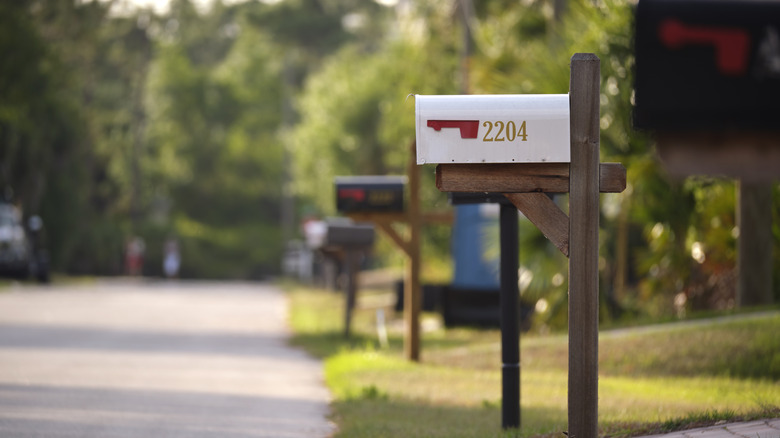
The U.S. Postal Service's delivery of envelopes and parcels had humble beginnings. But much as the automobile transformed everyday Americans' means of travel, it also greatly enhanced the Post Office's ability to efficiently deliver mail.
Just before the turn of the 20th century, an experimental horseless mail wagon made by the Winton Company of Cleveland got a test run, during snowy conditions of all things. The route was a total of 22 miles, and featured 126 mailboxes. While the typical time for a horse-powered wagon was six hours, the automobile was able to perform the same job in just 2½. And this was just the start of the agency's vehicle progression.
By 2020, the Postal Service counted around 133,000 rural carriers and delivery persons across 79,500 rural tracks alone, and it's grown since. To reduce overall costs, the Postal Service employs contractors for many of these rural routes, and they use their own vehicles. While the Postal Service must maintain and fuel its own fleet, it isn't required to do so for carriers using their personal cars. Some city carrier assistants — temporary postal employees — also use private transport to complete their duties. A mileage reimbursement is allotted for any carriers using personal vehicles.
The Postal Service's future is uncertain, and based on your opinions, these should be the next mail trucks when the Post Office gets privatized. But for now, let's look back on some of the notable vehicles responsible for mail delivery over the years.
The Columbian Mark 3 and a hodgepodge of mail vehicles
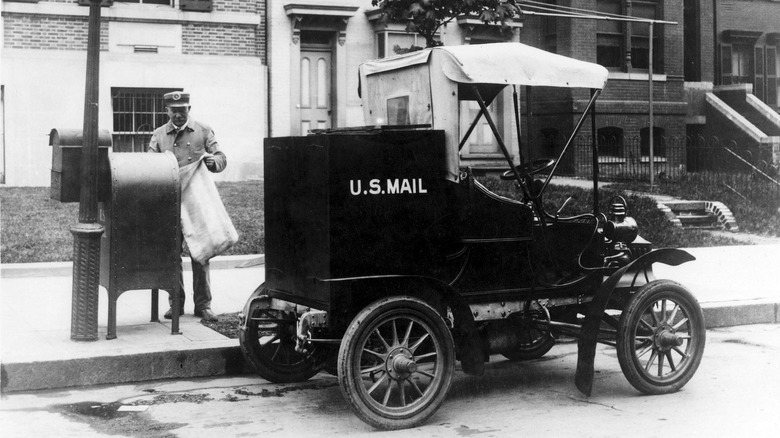
While it wasn't the first gasoline vehicle to deliver mail, the Columbian Mark was the one that really kicked things off. In 1906, two of these early cars, which could transport two mail bags and some parcels, successfully ran routes in Baltimore. These vehicles let the carrier perch on the back in a standing position, which made it easy to get to some mailboxes.
Due to the success of the Columbian Mark, just six years later automobiles were delivering mail in several other large cities across the country. However, this expansion of automobile mail delivery was far from seamless, as the Post Office became desperate for carriers who actually knew how to drive. Driving a car was a fairly new practice at that time, and early mail carriers were angering the public due to their flagrant indifference to traffic rules. In fact, New Yorkers sounded their disapproval of these delivery vehicles speeding beyond the limit of the time, which was only 15 mph.
A variety of mail vehicles were used in the years following, such as modified Model T's and experimental options like electric variants. Outside of large cities, though, the mail was still being delivered by horse-drawn carriage, as early automobiles couldn't navigate well in snow unless the roads were thoroughly plowed. A three-wheeled motorcycle was even tested in Washington, D.C., but was dropped after lackluster results.
The Willys Jeep
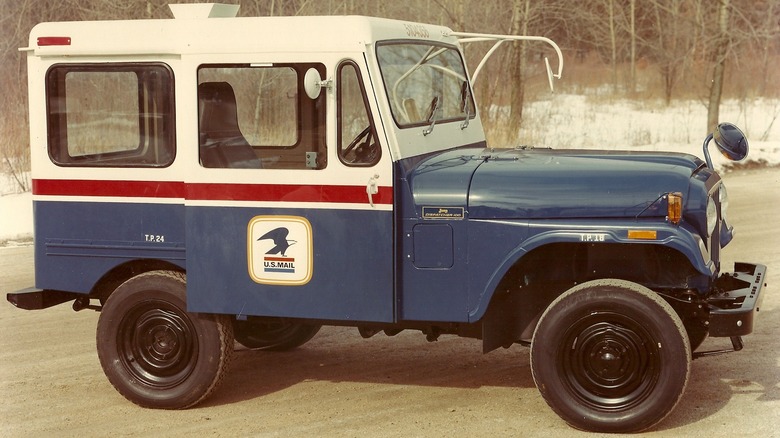
Following its success during World War II, the Willys Jeep became a major part of the Post Office's efforts to bring mail carrier service up to date. It's not hard to understand why, as today, you can find an 80-year-old Jeep that still has the goods. So, in 1953, these postal Jeeps began being churned out and offered one very useful feature specifically for mail carriers. To help facilitate easier access to mailboxes, these Jeeps were configured with the driving controls on the right-hand side of the vehicle. So instead of the repetitive and time-consuming task of getting out and walking around to the mailbox, a mail carrier could simply lean out the window.
The initial Willys Jeeps were CJ-3A Dispatchers that featured two-wheel drive, but the Post Office would later use DJ5 models. Over the subsequent decade, these postal vehicles would receive updates that included a longer wheelbase and a sliding door. By 1971, Jeep had reduced the size of the front grille with five slots instead of seven for enhanced visibility, and upped the engine to an AMC straight-6. The DJ was finally widely replaced in the mid-'80s when another postal vehicle was chosen, though rural carriers still used them through 2001.
The Studebaker 8E5-FC (Zip-Van)
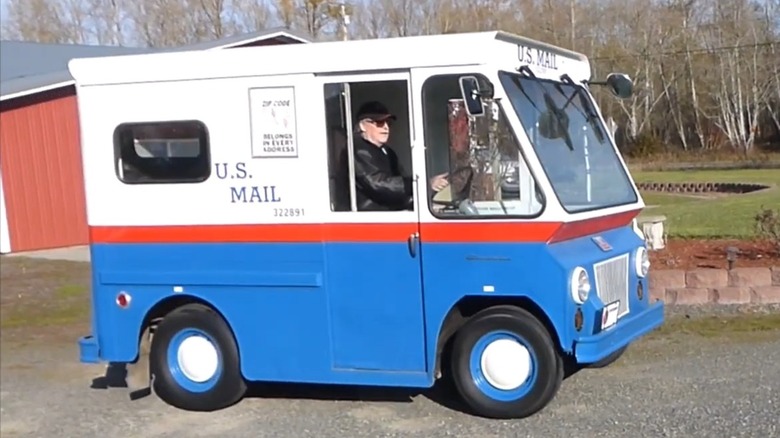
While the Willys Jeep was still going strong, a struggling Studebaker was granted a $9-million contract in 1963 for its 8E5-FC, which was called a Zip-Van as a new program called the Zone Improvement Plan (as in ZIP codes) was introduced. It featured a wheelbase of 85 inches, measured 12 feet in length, and included a 169.6-cubic-inch Skybolt Six that produced around 112 horsepower.
Looking like a literal box on wheels, the Zip-Van caught the attention of the post office because of its unique single-seat design, which let the postal carrier operate the vehicle either sitting or standing. The seat could adjust, folding up so that it offered additional room for the driver to remain on their feet if they chose.
However, these Zip-Vans were short-lived, as Studebaker failed to secure another contract the following year. In fact, just 4,238 were made before the Post Office moved on. Trouble started for the company well before its relationship with the Postal Service dissolved, with the rise and fall of Studebaker a well-documented but ultimately tragic story.
The Grumman Long Life Vehicle (LLV)
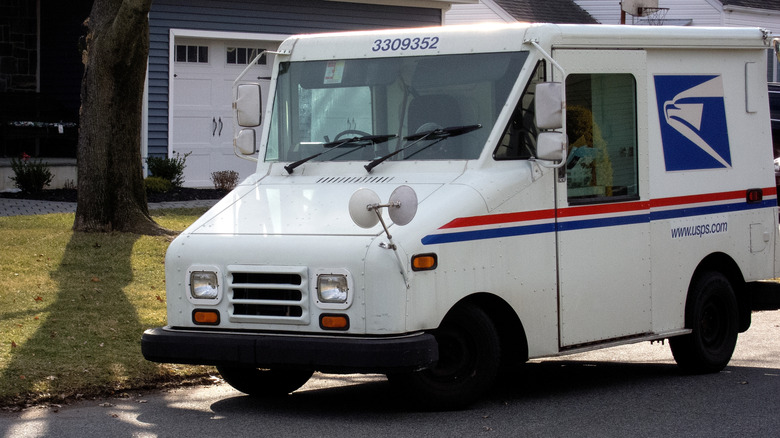
Looking to replicate the success of the Jeep, the Postal Service sought to find something that would last multiple decades. It held a contest in the mid-'80's, and the victor was the Grumman LLV, the most recognized mail carrier vehicle to date. The Postal Service didn't take this test lightly, with several specific hurdles these mail trucks had to overcome during their performance assessment. Some of the tougher tasks included traveling over 960 miles of potholes going up to 14 mph, and transporting a ton of weight for 50% of the road testing, among others.
While Grumman manufactured the body, which is made from aluminum, General Motors was responsible for the chassis. Many of the LLVs came equipped with GM's 2.5-liter 4-cylinder "Iron Duke" engine and were automatics. In the most extensive order in Postal Service history, just under 100,000 LLV's were requested, with the final unit manufactured in the mid-'90s.
These LLV mail trucks are still on the road in some areas today, but the Post Office has been looking for a replacement to correct a few of their flaws. While these aging vehicles have been slowly getting replaced with more efficient Flexible Fuel Vehicles (FFV), the Postal Service has been working on another option. These new generation postal trucks may look goofy, but mail carriers love them, as they're electric, more spacious, and quieter than the classic LLV.
The Oshkosh NGDV
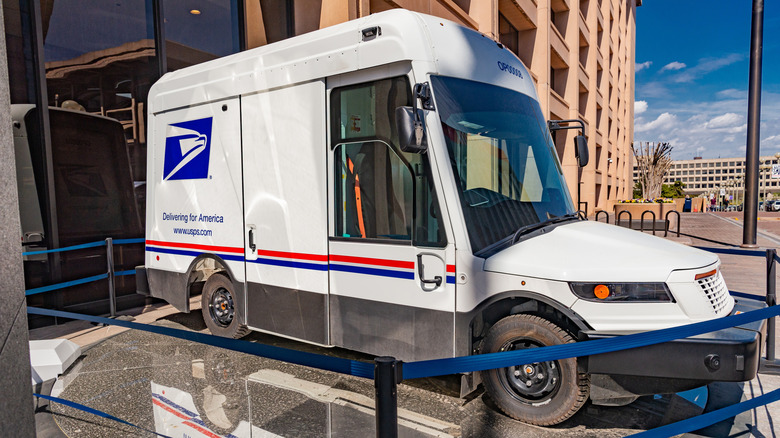
The USPS boasts nearly 32,000 mail vehicles on the road today operating with alternative fuels. These include hybrids and vechicles powered by natural gas, liquid propane, and ethanol. However, the Oshkosh Next Generation Delivery Vehicles (NGDVs) are the next step in the agency's goal of cutting 40% of its emissions by 2030, with electricp-owered mail delivery that offers several upgrades over the long-running Grumman LLV. While a bit odd-looking, these new vehicles have received a warm reception from mail carriers, specifically for their inclusion of air conditioning, sorely absent in the Grumman LLV.
In addition, the Oshkosh NGDV comes with cutting-edge enhancements that improve safety significantly. For instance, mail carriers now have access to a state-of-the-art backup and 360-degree cameras, which dramatically boost other vehicles' visibility. With the help of bumper sensors, they reduce the chances of an incident, especially in congested city areas.
In terms of range, the NGDV in cold weather with the heat blasting (the most challenging EV scenario) can achieve a range of around 70 miles. This figure may seem very underwhelming in comparison to other EVs on the market, some of which can now exceed 400 miles. But the requirements for the NGDV are far different than that of a personal vehicle. Typically, a Postal Service city route is 15 to 25 miles a day — well within the NGDV's capabilities.