

Chevy 350 Vs. Pontiac 350: How Are They Different?
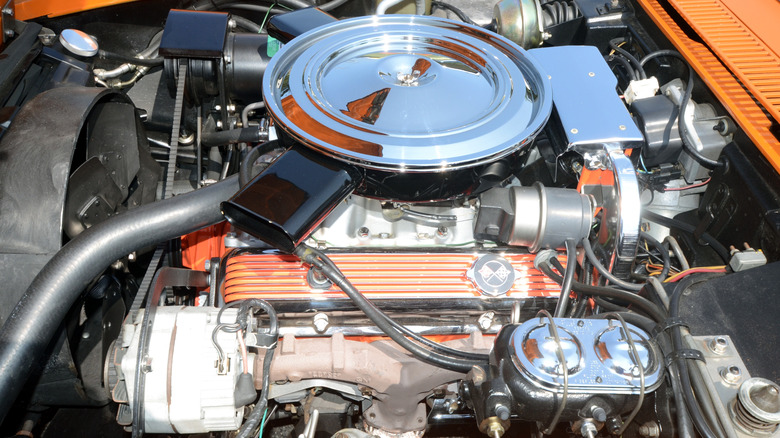
Admittedly, this would be a much shorter article if we focused on the similarities of the Chevy 350 and the Pontiac 350 — because outside of their displacement, these are, for all intents and purposes, two completely different motors. These are artifacts of GM's history — an automaker that basically assembled itself out of pre-existing automakers that already had their own powerplants.
Chevrolet, for example, was founded in 1911 but didn't become part of General Motors until 1918. Pontiac began as a company called Oakland, which launched in 1907 and was purchased by GM in 1909. GM introduced the Pontiac brand for customers who wanted a step up from Chevrolet but couldn't afford an Oakland. Pontiac proved popular enough, though, that GM dropped the Oakland name entirely in 1932.
GM kept a fairly hands-off approach with its divisions for decades, and in that context, it was logical for them to independently develop separate engines with completely different castings, etc. As a result, per the experts at Speedway Motors, the Pontiac and Chevrolet 350 V8s "share almost no interchangeable parts. These two V8s have different engine block castings, different head designs and different internal dimensions. As a result, major components cannot be swapped."
Of course, that kind of independence wasn't good for GM's bottom line. It was much more expensive for two divisions to develop two individual powerplants than it would be for them to share the costs — and then the motors. On the other hand, sharing can go too far — these lazy car rebadges prove that.
History of Pontiac's 350-cubic-inch V8
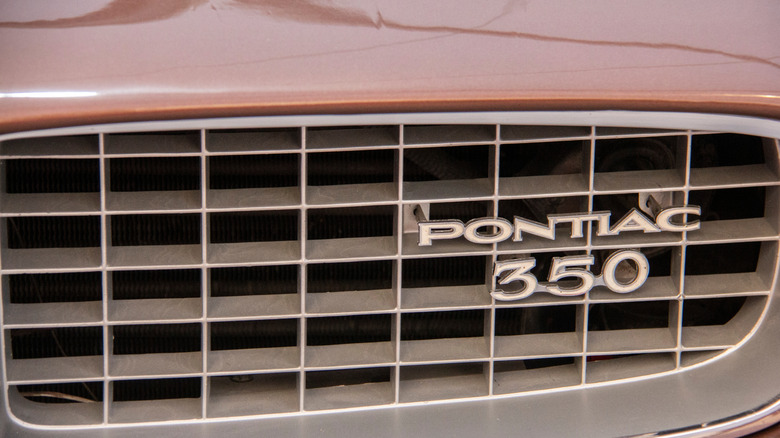
Pontiac's biggest engines were usually of the straight-8 variety up until the mid-1950s, when engineers created a 287-cubic-inch V8 with a cast-iron block, a two-barrel carburetor, and up to 180 horsepower. The same block with an increased stroke for 389 cubic inches of displacement could deliver 345 horsepower in 1959. Pontiac eventually de-stroked the engine down to 326 cubic inches for the 1961 Tempest.
By 1966, by mostly relying on bore/stroke adjustments to the original 287-cubic-inch unit, Pontiac had 11 distinct V8s in its powertrain portfolio, including the highest-HP engine ever put in a Pontiac Grand Prix. In 1968, after again bringing in the boring team, the 326 engine was upped to 350 inches for both that year's Tempest and Firebird.
This unit was the famed Pontiac 350 that could serve up 265 ponies with a two-barrel carb. However, with a four-barrel carburetor and performance cams, it was capable of 325 horsepower. Key differences between Pontiac's V8 and Chevy's — like the longer stroke and heavier crankshaft for the former — were great for low- to mid-range torque, giving Pontiacs of the time a powerful feeling of acceleration that helped polish the brand's growing reputation for excitement.
The death knell for the Pontiac 350 sounded in the early 1970s due to a combination of factors. First off, Pontiac began opting for bigger V8s with over 400 cubic inches to deliver even more muscle to muscle cars like the Pontiac GTO and Firebird. The gas crisis of that decade didn't help either.
History of the Chevrolet 350

The robust foundation of the Pontiac 350 allowed the division to use pretty much the same block for all its V8s, which was good. However, it also required a heavier block, and that was exacerbated by Pontiac's larger — and heavier — pistons and connecting rods. All that means a Pontiac 350 typically weighs around 70 pounds more than a comparable Chevrolet 350, with a notably lower redline to manage the extra weight of the engine's rotating parts.
The Chevrolet 350 was a direct descendant of the very first small-block V8 – a 265-cubic-inch Chevy mill designed for lighter weight and improved efficiency – that didn't sacrifice any power. Chevrolet upped displacement to 283 cubic inches in 1957, when it further fine-tuned the engine with fuel injection. At that point, it became one of the first American motors able to deliver a 1:1 horsepower-to-displacement ratio. The 283 V8 was eventually bored and stroked to 327 cubic inches, and the legend was born in 1967 after the same small block grew to 350 cubic inches.
Since that time, more than 113 million small-block V8s have been sold wearing the Bowtie, and it's one of the oldest engines still being produced today. You can chalk up its success to two primary reasons. Number one is the small block itself, as its lighter weight and compact size that made it a better choice for modern vehicles. Beyond that there was Chevrolet's much bigger presence in the market — and the aftermarket — which gave it a significant volume advantage.