

Here's What Makes Spark Plug Sockets Different From Standard Deep Sockets
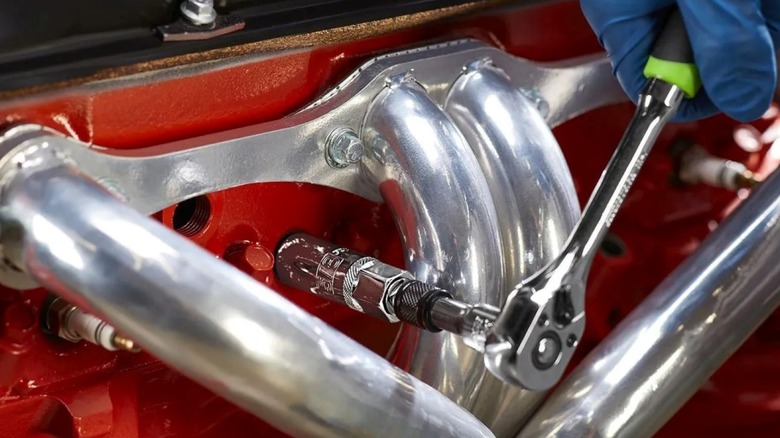
Working on cars requires numerous tools, including a plethora of sockets. However, while most sockets look very similar, there are often subtle differences between them that allow us to tackle diverse jobs. For example, basic sockets are useful for removing and installing hex-head fasteners, like lug nuts or brake caliper bolts, while spark plug sockets have a similar, albeit more specialized role. As the name implies, these devices are meant to help us remove and install spark plugs, and they allow us to do so thanks to a unique interior design feature.
Changing your spark plugs is an essential maintenance service for gas-powered cars. While the job can be tricky if your vehicle has a transverse V-style engine, replacing the spark plugs is pretty accessible for most DIYers — as long as you have the right tools, that is, which includes a decent spark plug socket in the appropriate size.
The main reason why you'll want a dedicated spark plug socket when performing this service has to do with the location of the plugs themselves. Spark plugs screw into the cylinder head, and you access them via deep tubes. These tubes are not wide enough to reach into with your hands or fingers. While you can use a traditional socket to tighten or loosen the plugs, gravity will likely prevent you from removing them with a standard socket. That's where spark plug sockets come into play. In comparison to regular sockets, these tools typically feature either a rubber insert or a magnet designed to grip the plug and secure it in the socket. That allows you to remove or install the spark plug without the risk of it falling out of the socket and becoming stuck in the tube or cross-threaded in the cylinder head.
What makes a spark plug socket better?
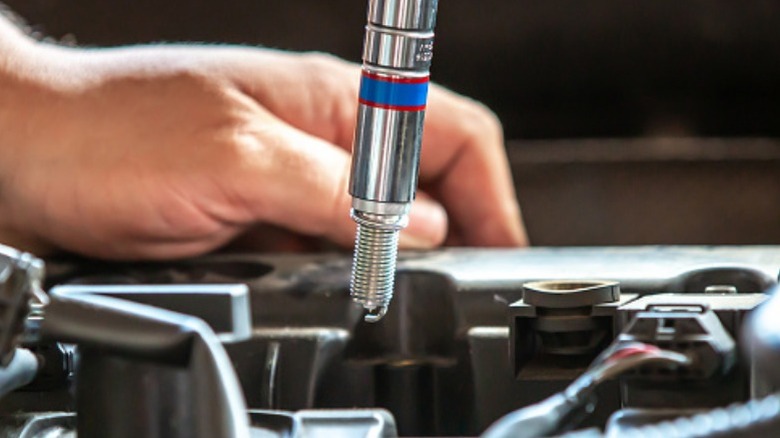
Many older spark plug sockets have an interior rubber insert designed to protect the spark plugs' fragile body and hold them tight while removing them from the engine. Newer versions frequently feature a magnet inside to maintain a better grip on any spark plug inserted, as well as thin walls to fit into spark plug tubes or a rough outer surface to prevent slippage when using the tool with oily hands.
While replacing spark plugs isn't necessarily a wrenching skill everyone should learn, it comes in handy when performing maintenance on everything from passenger cars and trucks to dirt bikes, string trimmers, and chainsaws. If you plan to perform your own maintenance on any of these vehicles or tools, having access to a quality spark plug socket can make a world of difference.
The spark plug sockets or wrenches that sometimes come included with a vehicle's maintenance tools are often stamped metal affairs with no protection or grip. In the case of these cheap wrenches, a standard deep socket could be the superior option. However, sometimes, a standard socket won't fit into the recessed area where the spark plug lives, making a thin-walled spark plug socket essential. That said, most basic socket sets usually include one or two spark plug sockets in common sizes. If you do decide to replace your own spark plugs, you'll probably realize just how handy these inconspicuous devices really are and why they're one of the tools that will help save your sanity while wrenching.