

The Evolution Of The Roundabout And How It Came To America
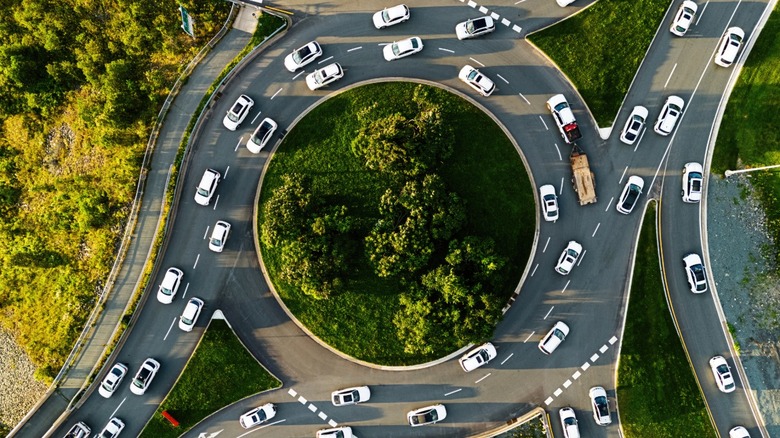
Many Americans think roundabouts are confusing, and even robotaxies get perplexed by roundabouts. In some parts of the United States, they are about as well-liked as root canals, though studies have shown that public opinion often changes once roundabouts are installed. Why? Because roundabouts are safer than other types of intersections and help keep traffic flowing.
How did roundabouts finally make their way into the U.S.? Oh, but that's the wrong question. You see, it assumes that roundabouts weren't in America to begin with. The question really should be, "How did they come back to the U.S.?"
Actually, the first roundabout for cars was built in the U.S., in New York City, to be exact. While round intersections and traffic circles of different sorts had been around since at least the 18th century, none were really designed for cars. That changed in 1905 with the installation of Columbus Circle in NYC. Soon, other American communities started adopting traffic circles, which would evolve into rotaries by the 1930s. However, they became unpopular in the U.S. by the 1950s because they were causing accidents and traffic jams.
In the 1960s, the British realized that the problem wasn't traffic circles themselves, but how they had been managed. So, they made them smaller and instituted a simple change in the right-of-way rules, and suddenly, roundabouts were reducing accidents and traffic congestion. America stubbornly refused to re-adopt round intersections until the 1990s, but it hasn't looked back since then, installing over 11,000 of them, as of this writing.
Ye olde traffic circles
Did you know that traffic circles date all the way back to the 1700s? Apparently, even before the days of cars, traffic jams were slowing people down and causing social friction.
Dupont Circle is one of the more famous neighborhoods in Washington, DC. Visitors to the city can take a break from visiting historical sites or trying to start an insurrection by enjoying this neighborhood's art galleries, bistros, or boutique bookshops. The neighborhood itself is named for the traffic circle that sits in its center. The middle of the circle features a pleasant pedestrian area arranged around an impressive fountain. Dupont Circle was designed in 1791 by the French architect Pierre Charles L'Enfant, who designed much of Washington, D.C., including multiple traffic circles.
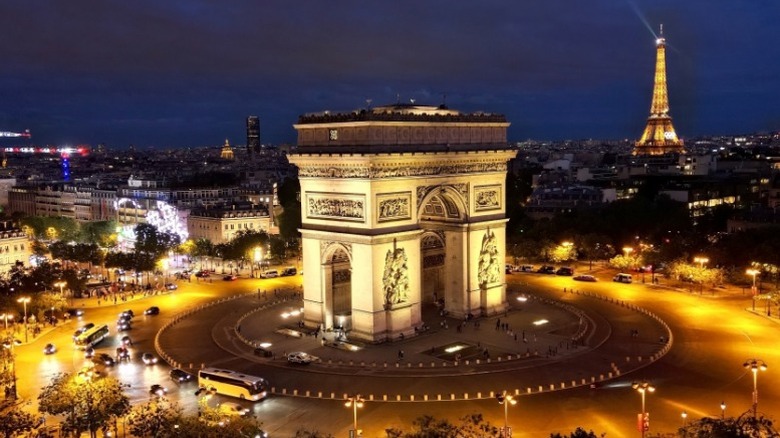
Another famous traffic circle that survived into the modern era is the one at Place Charles de Gaulle, formerly Place de l'Étoile, surrounding the Arc de Triomphe. The monument was finished in the 1830s, before cars entered the picture. But there would be mayhem once multiple motorists started trying to make their way through the intersection at the same time. The circle would eventually have to be modified to accommodate automobiles.
The first roundabout for cars wasn't built where you'd expect
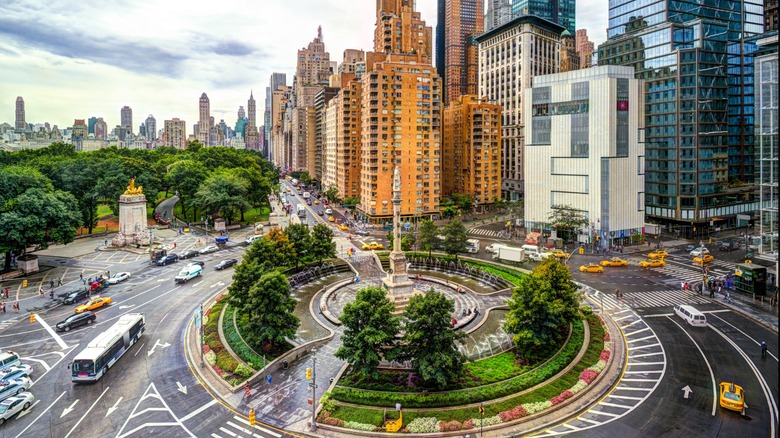
It may be surprising, considering roundabouts are about as welcome in most American neighborhoods as landfills and sewage treatment plants, but the first traffic circle for cars was built in the U.S. The year was 1905, and the world was still trying to figure out how best to manage automobile traffic. Though, to be fair, it's 120 years later, and we're still trying to figure that one out. However, around that time, a traffic nerd and New York native named William Phelps Eno had an idea about how to handle traffic at intersections and came up with designs for roundabouts. He designed the first automobile traffic circle built, Columbus Circle in New York City. He was also involved in the restructuring of that famous traffic circle around the Arc de Triomphe in Paris.
The traffic circle for motor vehicles wasn't Eno's only bright idea about traffic safety. In 1900, he wrote an article titled, "Reform in Our Street Traffic Urgently Needed," which called for the distribution of simple rules of the road and giving cops the authority to enforce them — thanks for that, William. He also wrote the first "Rules of the Road," adopted by New York City in 1909. He eventually became known as the Father of Traffic Safety. Since he never learned to drive, we're guessing that also makes him the Father of Backseat Driving.
Those early traffic circles were different from modern roundabouts. For one thing, they allowed high-speed weaving and merging. The most important difference was that traffic in the circle had to yield to cars that were entering.
We were doing it backwards the whole time
After Columbus Circle was built in New York, traffic circles started popping up all over the United States and Canada, as well as in Europe, such as the one around the Arc de Triomphe in Paris. There had been a street that circled the Arc de Triomphe for some time, but it was disorganized and dangerous. In 1907, someone decided to have all of the traffic go the same direction, so now it's only dangerous. Traffic circles evolved in the 1930s to rotaries, which incorporated connecting roads that had gradual entry points into the circles. Many of them used splitter islands, which better separated entering and exiting lanes on the side roads.
Believe it or not, these round intersections caused accidents and traffic congestion, the very things they were built to prevent. By the 1950s, the traffic circle design was no longer considered a good option by road and city planners in the U.S., and many rotaries were actually removed. These early traffic circles were mostly large, multi-laned, and allowed high speeds. They also gave the right-of-way to cars entering the circles.
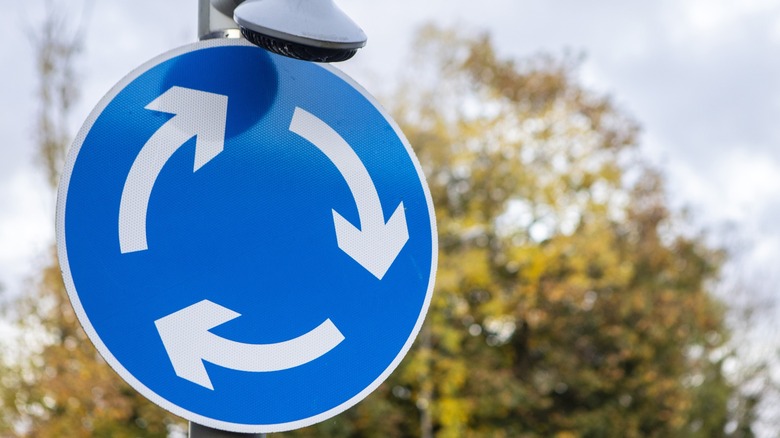
In 1966, instead of scrapping circular intersections altogether, the British realized that the world had been doing them backwards the whole time. So, they gave the right-of-way to cars already in the circle, requiring entering vehicles to yield. This relieved congestion and decreased accidents by 40%. These new and improved rotaries are considered the first modern roundabouts. They wouldn't catch on the in U.S., though, for decades.
The triumphant return of the roundabout to the U.S.
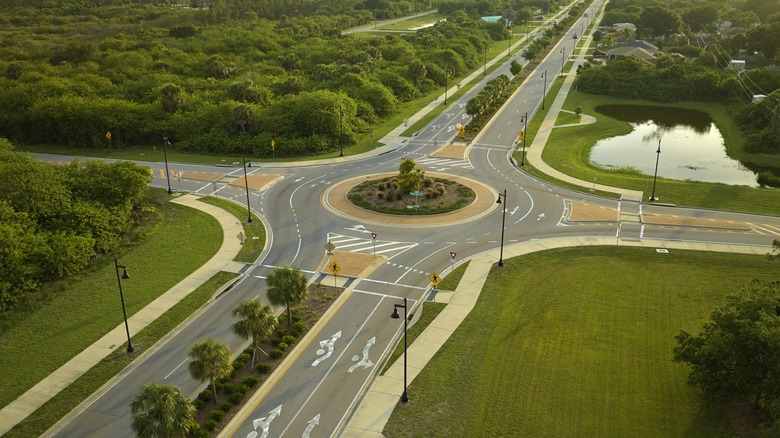
The 1960s saw a British invasion of sorts in the United States. There were The Beatles, The Rolling Stones, The Who, and Herman's Hermits, among others. But for some reason, the invasion did not include roundabouts. America just wasn't ready to get back together with circular intersections yet, despite the improvements the Brits made to them in 1966. That time wouldn't come for over two decades.
There was a false start in 1988, when the state government decided to build a roundabout in Ojai, California. However, the locals weren't having it, and officials were forced to cancel the plans. Between two and three years later, though, two roundabouts were built in the planned community of Summerlin, Nevada. Then, like a rash that shouldn't be scratched but you do it anyway, roundabouts started to spread far and wide, and 35 years later, there are at least 11,000 roundabouts in the U.S. 152 of them were built in Carmel, Indiana, which replaced all of its traffic lights with roundabouts. In true American fashion, some YouTubers decided to drive around a roundabout 24 hours straight. Some European countries have more roundabouts, like France, which has over 30,000. But hey, it's not a contest.
When it comes to numbers, Florida has the most roundabouts with over 1,600 circular intersections, according to the Roundabouts Database. As of 2023, South Dakota had the fewest roundabouts in the country at 16, while Nebraska had the most roundabouts per capita.
The benefits and future of the roundabout
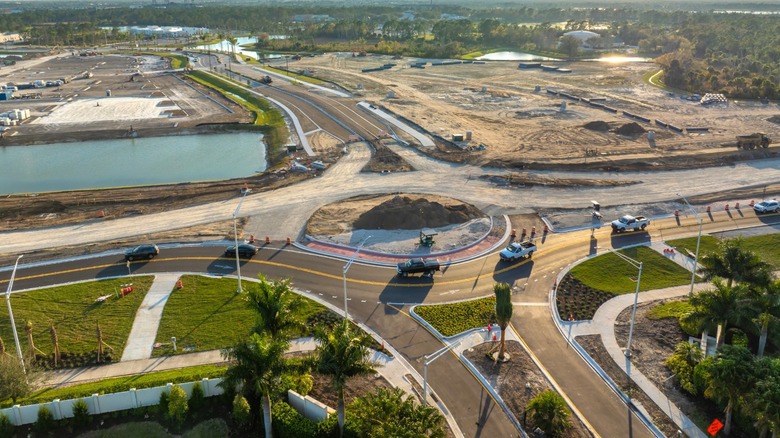
Numbers don't lie — roundabouts save lives. Data from numerous studies shows that replacing traffic lights and signs with roundabouts reduces injury-causing accidents by roughly 72% to 80% and reduces all accidents by 35% to 47%. And while critics might claim that roundabouts aren't friendly to people on foot, some European studies show that installing roundabouts can result in up to 75% fewer pedestrian collisions.
What about the flow of traffic? Together, the IIHS and the Federal Highway Administration (FHWA) also conducted studies comparing traffic flow and congestion in roundabouts to intersections with traffic lights. Those studies revealed that traffic flow improved substantially and that traffic capacity increased by 30% to 50%. And don't forget about the cost savings. These intersections don't use as much electricity or require as much maintenance as intersections with traffic lights.
Roundabouts are in the U.S. and don't seem to be going anywhere, at least not anytime soon. Will they continue to appear at the same pace, or will RCUT intersections — a simple road design meant to cut commute times — supplant roundabouts? Who knows? But we're in favor anything that makes the roads safer and cuts down on the number stop lights we get stuck at.