

How Often Should You Change Your Coolant? It's Not Always Every 30,000 Miles
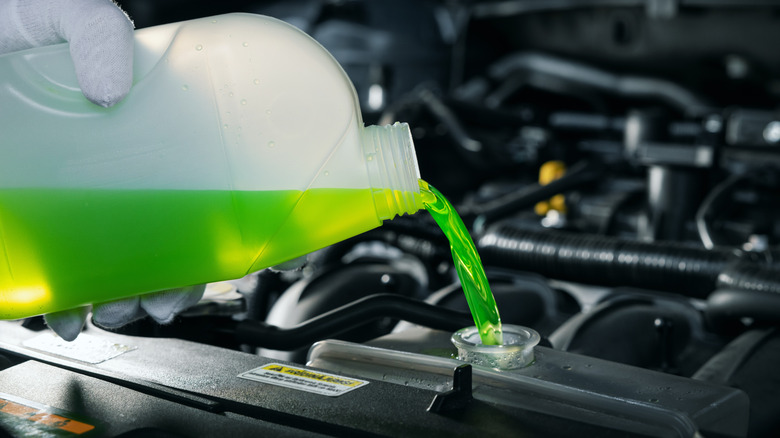
Coolant — typically a mix of glycol, water, and additives – plays a crucial role in keeping your car running properly. It dissipates heat and keeps temperatures down in the summer, prevents your engine from freezing in the winter, and protects its components from rust and corrosion. However, leaving your coolant unchanged can cause it to lose its anti-corrosion properties, resulting in rust on the water pump, radiator, and heater core. Over time, these rust particles can build up within the cooling system's narrow passages and clog them up. Cooling system blockages can cause the engine to overheat, as they prevent the coolant from circulating properly to absorb heat from the engine and disperse it through the radiator.
As such, doing a regular coolant change is key to maintaining its corrosion-preventing properties. Mechanics generally recommend changing the coolant every 30,000 miles. But the interval for changing it could be different depending on the formulation of the coolant, your car's manufacturer, and its age. Of these, the coolant type is the most vital aspect to take into account.
Coolants are made using either ethylene glycol or propylene glycol as a base, with additives that provide the existing coolant with corrosion-fighting properties. For example, older cars often use a type of coolant known as Inorganic Additive Technology (IAT), which usually consists of ethylene glycol as a base, with silicates and phosphates as corrosion inhibitors. If you use this type of coolant, the suggested interval is every two years or 30,000 miles, whichever comes first. Toyota, for one, recommends following that schedule if you use a traditional coolant with silicates. However, it's always best to check your owner's manual for specific recommended intervals. And remember, an open bottle of coolant doesn't last forever.
Coolants built for modern engines can last five years or 100,000 miles between changes

Some cars produced in the 2000s or later use advanced coolant types that can run for about 150,000 miles before needing a change. This is because these coolants are engineered to provide superior protection over traditional options like IAT. A good example is Organic Acid Technology (OAT) coolant, which is based on ethylene glycol. This coolant uses organic acids for protection against corrosion, as well as additives that are meant to better protect the engine. As a result, it performs effectively for 150,000 miles or five years. OAT is compatible with a range of engines, including those from GM (cars from 1996 and later) and Volkswagen (older models).
Hybrid Organic Acid Technology (HOAT) is another coolant type that's specifically formulated to protect your engine for much longer than IAT. It is created from a combination of both IAT and OAT formulas, and relies on silicates and organic acid for advanced protection against corrosion. Cars from manufacturers like Ford and Chrysler tend to use this coolant type. However, manufacturers like BMW prefer the coolants used in their vehicles to be free of nitrate and phosphate. For that, you have Phosphate-free HOAT, or hybrid OAT, which contains both organic and inorganic corrosion-resistant additives but is low in silicate and does not include any phosphates.
Conversely, cars from East Asian manufacturers like Toyota, Honda, Nissan, Hyundai, and Kia work well with Phosphated HOAT coolants, which use phosphates and organic acids to keep the engine in perfect working order. Another option is Silicated HOAT, which combines silicates and organic acids, but is devoid of nitrites, nitrates, phosphates, amines, borates, and imidazole. This coolant type is suitable for brands like Audi, Bentley, Mercedes-Benz, Porsche, and VW (models from 2007–2008).
How to recognize when you need a coolant flush
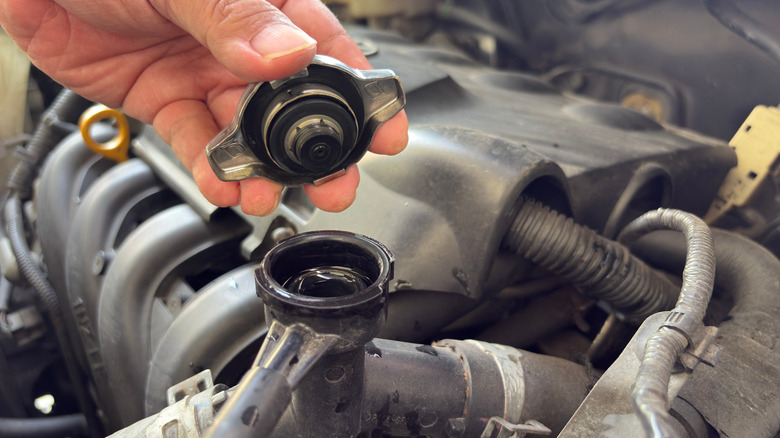
Five years or 150,000 miles is a lot, so it's easy to miss your manufacturer's recommended coolant change intervals. But you should watch out for signs that it's time to flush your radiator. For instance, when you begin to smell something sweet emanating from the engine, it is often an early indication that your coolant is in need of a change — a lingering sweet odor in a car's cabin is typically attributed to ethylene glycol overheating.
You'll also typically experience recurring overheating issues. Among other possible explanations, low coolant levels and restricted coolant flow caused by a blocked radiator are the most common sources of trouble. So you want to make sure to check the cooling system promptly. Also, it's common to hear an odd noise like water sloshing around or gurgling when starting the engine — gurgling often suggests your coolant level is running low, and occurs due to air pockets that form when there's not enough fluid in the system.