

When Did Ford Switch From The F-100 To The F-150?
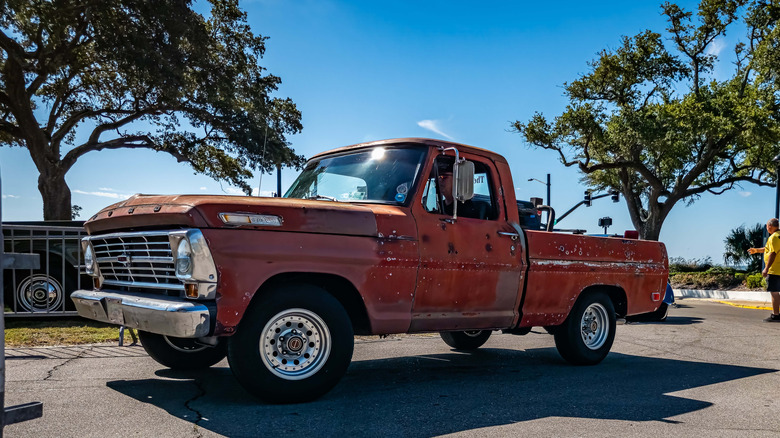
The Ford F-150 is a ridiculously popular pickup truck, having dominated sales charts in the U.S. for decades now. It's easy to see why, as the Blue Oval truck offers plenty of towing capability, space for a full family, and a range of different powertrains, all for an attainable price point. However, this wasn't always the way. Ford's popular F-Series range actually begins its story in 1948 with the F-1, which was replaced just five years later with the F-100.
The F-Series range as a whole proved to be a successful fixture in the Blue Oval line-up for many years, satisfying the needs of workers up and down the country. However, in the 1970s, changing customer demands and the introduction of stricter emissions regulations saw Ford deem it necessary to add a new model into the mix. This new model would wind up being the evergreen F-150. In terms of capability, it sat halfway between the half-ton F-100 and the heavy-duty F-250, and it ultimately replaced the F-100 entirely by 1983.
So, while the F-150 first appeared in 1975, Ford didn't replace the F-100 with it until eight years later. Blue Oval truck buyers clearly saw more sense in buying the larger, more spacious, and more capable pickup truck that performed admirably as both a work and personal truck, rather than settling for the lighter-duty F-100.
Why Ford introduced the F-150

The F-Series proved successful, particularly with farmers and workers, although the 1970s saw a shift in how pickup trucks were perceived. They were no longer sought after as just workhorses, but now also as family and lifestyle vehicles. Ford saw the opportunity to develop a truck that performed both as a workhorse and as a comfortable passenger vehicle, but in order to do so, the base had to undergo some changes as compared to the F-100.
The primary upgrade was in increasing the GVWR of the truck — that's the Gross Vehicle Weight Rating. Specifically, Ford wanted to raise the GVWR enough so that the all-new F-150 would be lifted out of the light-duty truck category, where the F-100 sat. To achieve this, Ford provided the F-150 with upgraded suspension, new engine options, various structural differences, and reconfigured cab styles. Doing so put the F-150's GVWR at 6,050 pounds; 350 pounds higher than that of the F-100, and 50 pounds higher than the max for a light-duty pickup truck.
This was important, as light-duty trucks were about to be hit with regulatory changes. These changes included the need to run on unleaded gasoline and to have catalytic converters fitted as standard — one of the car parts that thieves just love to steal. By launching the F-150, Ford effectively side-stepped having to accommodate these new regulations. The changes also allowed customers to enjoy a raft of new benefits, such as a higher payload capacity, without having to size up to the F-250. With the F-150 joining the mix, the F-100 soon fell out of favor. It became a 4x2 model in 1979, and by the early 1980s, the writing was on the wall, and Ford dropped the model completely.