

Everything We Know About Mazda's New Skyactiv-Z Engine (So Far)
Mazda has developed a wide variety of engines and propulsion systems over the years. Famously, Mazda pioneered rotary technology, but the Japanese automaker has also developed rotary hybrids, fully electric systems, plug-in hybrids, mild-hybrids, and a series of regular combustion engines, such as the Skyactiv-X and Skyactiv-G engines.
It's the latter, the Skyactiv-G, that Mazda is looking to replace with its Skyactiv-Z engine. At the moment, the Skyactiv-G engine powers much of the automaker's roster, including the boosted Mazda3 that we test-drove in 2022 and the striking Mazda CX-50. Mazda's Skyactiv engine tech is more than just branding, and as a result, the Skyactiv-G engine is extremely efficient and boasts an incredibly high compression ratio of up to 14:1. That said, details on the up-and-coming replacement are relatively thin on the ground.
We do, however, have some information, such as the emission standards that the Skyactiv-Z engine will need to meet, what tech Mazda is working hard to incorporate, and roughly when the new engines are set to arrive on American roads.
The Skyactiv-Z engine will have to meet strict emission standards
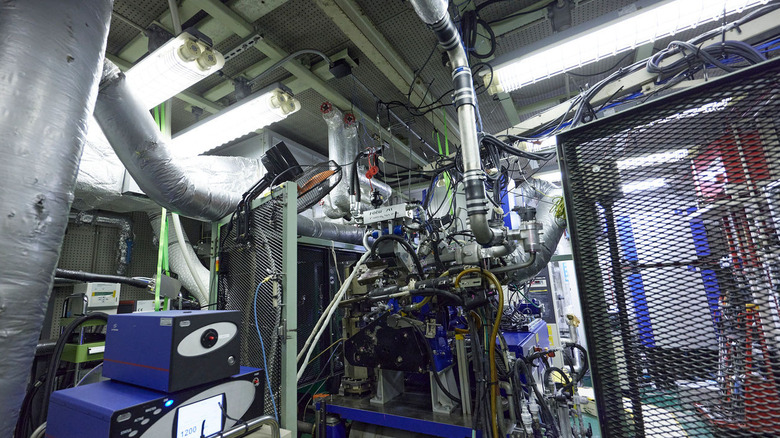
The above image shows a 2.5-liter inline four-cylinder Skyactiv-Z engine undergoing testing. As with all Mazda engines that have come before it, the Skyactiv-Z will have to deliver promising performance on the road, but it also needs to be efficient enough to compete with key competition. Potentially standing in the way of reaching these goals are the pending Euro 7 regulations in Europe and North America's LEV IV emissions standards. That's one of the issues of developing a car and engine that need to perform on a global scale — different locations will have differing requirements and restrictions, and for Mazda, meeting all of them at once could prove a tall order.
So, Mazda needs to not only ensure that the Skyactiv-Z engine delivers from a driver's viewpoint, but it also needs to put efficiency and cleanliness at the forefront of the picture — perhaps more so than ever before. Fortunately, Mazda engineers seem more than ahead of the curve here and have already hinted at how they are looking to ensure the next generation of engines will impress.
Increased thermal efficiency is a key target for Skyactiv-Z engines
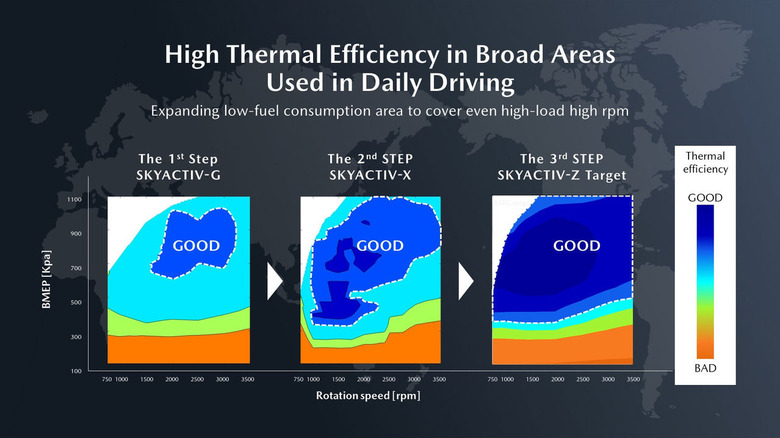
Thermal efficiency in the context of engines refers to how efficiently the engine converts the energy of fuel into useful mechanical work. If too much of that energy escapes in the form of heat, then the engine is not thermally efficient. While Mazda tackled this with its previous-gen family of engines, it's looking to take things even further with the Skyactiv-Z by incorporating compression ignition combustion technology.
Masahisa Yamakawa, a leading figure on Mazda's combustion engine development team, informs us that the company is "also planning to incorporate new heat insulation technology. This technology converts heat that would normally escape from the engine into power, further improving thermal efficiency."
Heat insulation is only one way in which Mazda hopes to increase the thermal efficiency of the looming Skyactiv-Z engine. While many details are being kept quiet for now, Yamakawa reveals that Mazda wants "to create an engine that boasts high thermal efficiency at any RPM or speed range." Mazda hopes to achieve these lofty goals without having to sacrifice engine output, which will help ensure that the engine delivers when it comes to driving performance and experience. In short, much work is being done in terms of heat management to ensure that efficiency and performance can co-exist in the new Skyactiv-Z engine.
The Skyactiv-Z engine will be hybrid compatible
It's surprising enough to see an automaker investing so much time and money into a new internal combustion engine in 2025. However, with the dominance of electrification seemingly slowing and Mazda being a driver-focused brand, perhaps it does make sense. What doesn't make sense, though, is the development of a new engine family that won't be engineered as hybrid compatible from the start, and Mazda knows this.
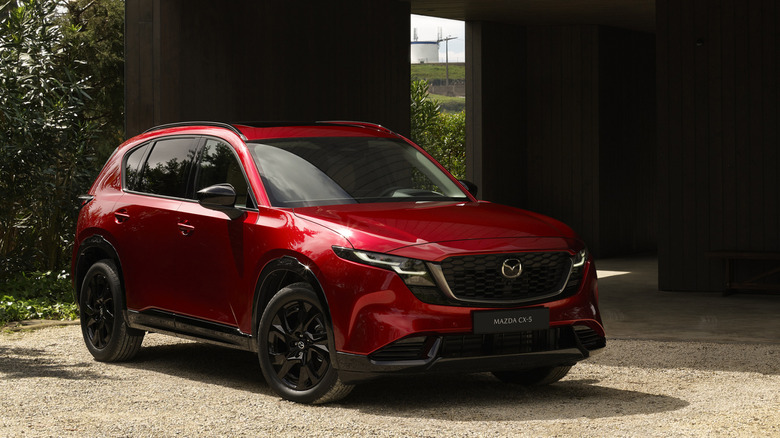
The automaker has revealed that the next-generation CX-5 will get a Skyactiv-Z powertrain by the end of 2027. Sadly, that's about all we know with regards to the next-gen Mazda CX-5 Hybrid — well, we know that the 2026 Mazda CX-5 doesn't look great, though it's probably amazing if the current model's success is anything to go by.
There is no CX-5 Hybrid on sale right now, but there is a CX-50 Hybrid, which pairs a 2.5-liter inline four-cylinder Skyactiv-G engine with three electric motors for a combined output of 219 horsepower. Assuming Mazda will look to improve on this slightly, which is usually the case, we may be able to expect an output north of 220 horses for the next-gen CX-5 Hybrid, which will be a significant upgrade over the 187 horses kicked out by the non-turbocharged CX-5 that Mazda sells currently.
Skyactiv-Z engine is set to arrive in 2027
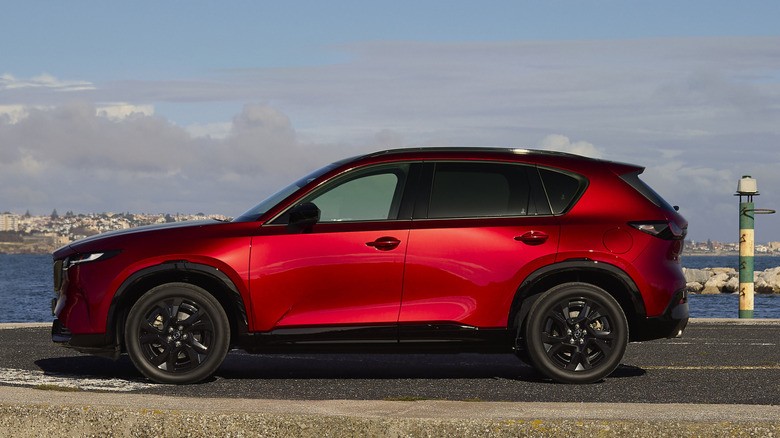
Details are thin on the ground when it comes to an exact release date for the engine and its full specifications, but we do know the CX-5 Hybrid it's set to debut in is due in 2027, which means the Skyactiv-Z engine must also arrive by then. Surely, at some point during the next 12 to 18 months, more details — such as horsepower and torque outputs — will arrive for the hotly anticipated Skyactiv-G replacement.
There are rumors of other new models arriving in the coming years, too, from electrified sedans to the ever-looming threat of a new generation of Mazda Miatas. Perhaps the stars are aligning perfectly for a Skyactiv-Z engine to arrive just in time for next-gen Miata models, with a slew of new SUV and smaller models to follow suit. The evergreen Mazda3 has been around for a while since first arriving on the scene in 2013, so perhaps that's also a likely candidate for renewal when the new engine family eventually hits the road.