

The Biggest Pros And Cons Of Driving A Dually Truck
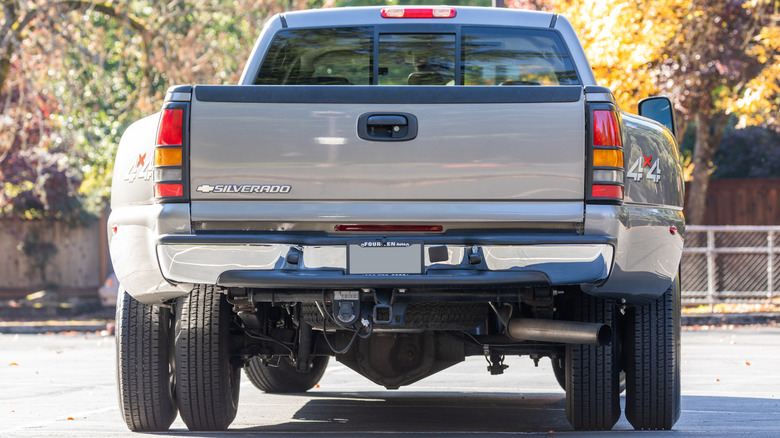
When you really need to maximize your towing and hauling potential, you need to up the ante with a dually truck — that is, one with dual rear wheels. It's pretty much what it sounds like, as duallys have two wheels on each side of the rear axle to help support heavier loads. That strength is obviously the main benefit, but, as we'll discover, it's not the only one — nor are duallys without disadvantages.
First, some background: The idea of doubling up the rear wheels on a truck isn't new, of course, but the birth of the modern dually is actually relatively recent. It wasn't until 1973 that General Motors — through Chevrolet and GMC — introduced a pickup with dual rear wheels. Before then, automakers offered what were essentially dual-rear-wheel (DRW) chassis cabs, where the part of the vehicle behind its cab featured a flatbed or was left bare, allowing owners and aftermarket companies to tailor their rides to meet their specific needs.
The holdup may have been aesthetic, too, as some sources say no one wanted to build a truck where the rear wheels extended beyond the width of a typical truck bed's fenders. To fix the issue, Chevrolet and GMC designers developed a massive fiberglass rear fender for its duallys, giving them, in theory, a similar look to that of step-side pickups with single rear wheels.
Now, U.S. customers can purchase duallys from not only Chevrolet and GMC, but also from Ford and Ram. No other brand offers them in this country — that dually Cybertruck mod was just heavy-duty cosplay.
Pro: Duallys offer enhanced pulling potential
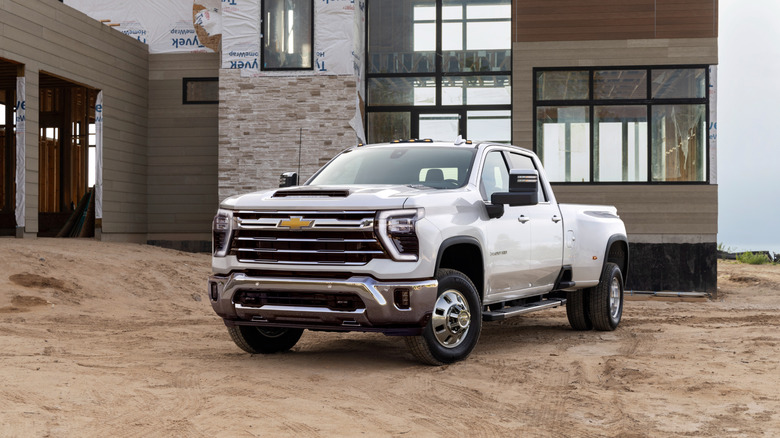
Duallys can pull more than their single-rear-wheel (SRW) counterparts for a couple of key reasons. Number one is that the additional wheels mean that there's more rubber in contact with the road, and that, in turn, means an added opportunity for extra traction to help you pull. It also makes the truck more stable and easy to control. A further benefit: Having four rear wheels spreads the load's weight over twice as many tires, so each one is under less stress.
What's the real-world difference? Let's look at one of Chevrolet's contemporary dually pickups, the Silverado 3500. Available with gas or diesel powerplants, multiple bed/cab setups, two- and four-wheel drive, and, of course, single or dual rear wheels. Multiple configurations can reach the max conventional tow rating of 20,000 pounds, including some SRW trucks. However, while the SRW diesel peaks with a Gross Combined Weight Rating of 30,000, adding dual rear wheels can raise that to 43,500 pounds (43,900 pounds with Max Trailering Pack). Be sure to check our quick GVWR guide for RV and truck owners for more information about these weights.
When it comes to gooseneck/5th wheel towing, the diesel-powered DRW is rated at 35,500 pounds (36,000 pounds with Max Trailering Pack). The comparable SRW Silverado tops out at 22,420 pounds.
Con: Duallys come with dramatic dimensions
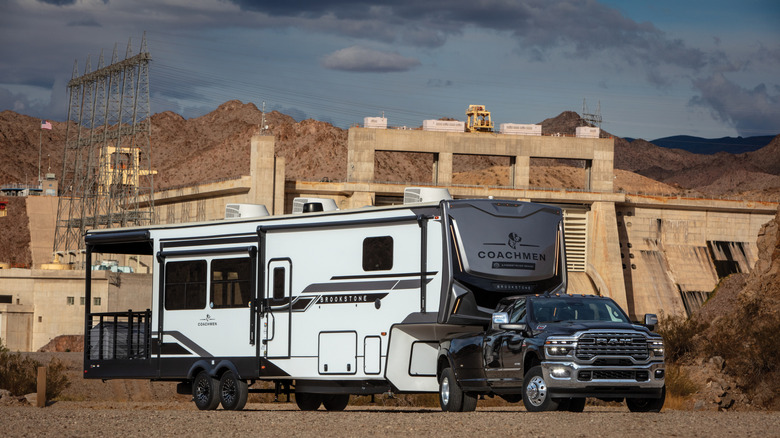
Duallys can make work easier, but they can also be harder to pilot, due to their sheer size. Consider the 2025 Ram heavy-duty truck lineup. It's true that the biggest configuration — the crew cab with an 8-foot bed — stretches the same 260.8 inches regardless of how many rear wheels it has. Yet, either way, you're talking about a truck that's almost 90 inches (roughly 7.5 feet) longer than a Jeep Compass. Then, when you do take into account the extra wheels, you learn that the DRW Ram is about 96.5 inches wide, which compares to the SRW truck at 83.5 – for comparison, the Jeep Compass is 73.8 inches wide. Even compared to the Ram 1500, the DRW 3500 can be roughly 1.5 feet longer and 1 foot wider.
The width of a typical U.S. road is between 120 and 144 inches (10 to 12 feet). Try to park, and you'll discover that U.S. parking spaces tend to be 102 to 108 inches (8.5 to 9 feet) wide and approximately 18 feet long. So, on a low-speed urban route, the DRW Ram 3500 would have only about a foot to spare on either side, and it may not fit a parking spot at all.
Pro: You have plenty of choices when it comes to duallys
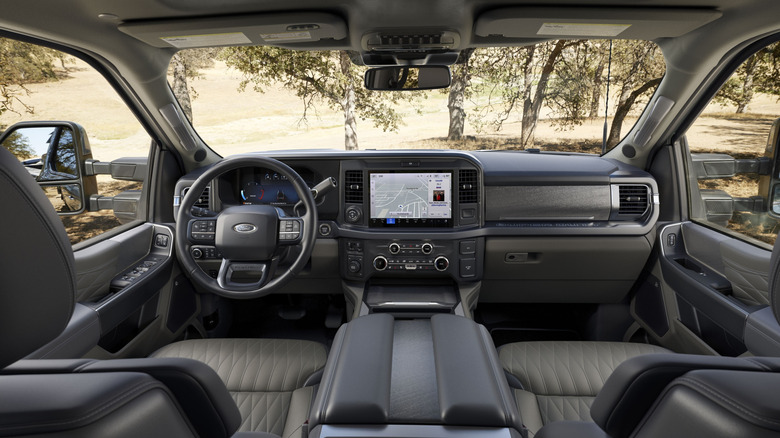
Despite designing dually trucks for a singular goal — helping folks cut bigger jobs down to size — automakers have realized that a one-size-fits-all solution won't work in today's market. Customers look to balance comfort and capability, even when it comes to commercially focused vehicles like duallys, and brands have responded with fairly large lineups of DRW trucks.
Let's move on to Ford to make the point. The Ford F-450 can tow more weight than any truck in the history of trucks. Ford achieves this incredible 40,000-pound maximum in one of its entry-level dual-rear-wheel configurations — the regular cab 4X2 XL trim with the 8-foot bed. It's a relatively basic work truck with features like vinyl seats, an 8-inch infotainment touchscreen, and a rearview camera.
Yet, that's merely one among 10 different Ford Super Duty pickups available with dual rear wheels. The F-350 and F-450 both offer XL, XLT, Lariat, King Ranch, and Platinum trims with dually setups, and you can up the ante for that last version with a Platinum Plus Pack. At that stage, you can look forward to a Smoked Truffle interior theme with heated/ventilated leather seats, a heated leather-wrapped power-adjustable steering wheel, a twin-panel moonroof, power-adjustable pedals, and a Bang & Olufsen audio system.
Con: Duallys cost more to buy and maintain
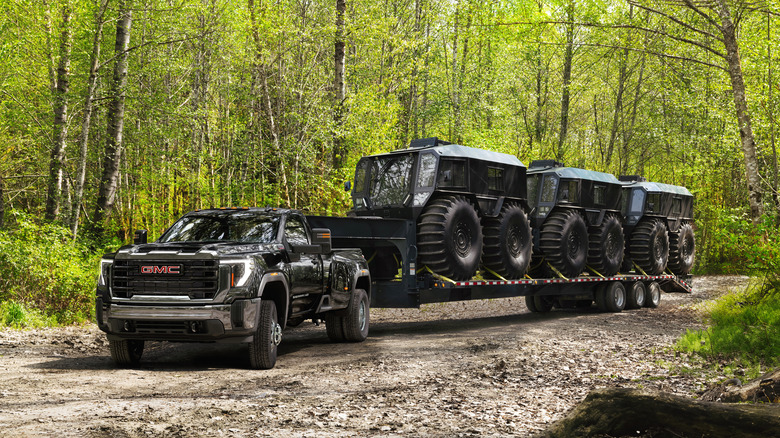
We'll put GMC in the spotlight to look at costs — since at least one version of the GMC Sierra 3500 HD starts at over $100,000 – and note that duallys are generally more expensive than SRW models. To be exact, GMC increases the price of its Pro trim, for example, by $1,400 to go from single to dual rear wheels. Adding dual wheels increases the vehicle's weight, too. This is important because weight impacts fuel economy. Per the U.S. Department of Energy, a car can see its fuel economy fall by up to 2% per 100 pounds of extra weight.
Unsurprisingly, duallys will set you back more in terms of maintenance and service than SRW trucks, for the obvious reason that there are more tires. There will be extra steps involved when rotating them and extra tires to be purchased if you get a flat. After all, some experts say you should replace all six at a time. It's critical for dually trucks to have tires of the same size, for handling and safety, and there can be a noticeable difference in the circumference of a new tire versus one that's worn down.