

H-Pipe Vs X-Pipe: Which One Usually Delivers The Bigger Performance Gain?
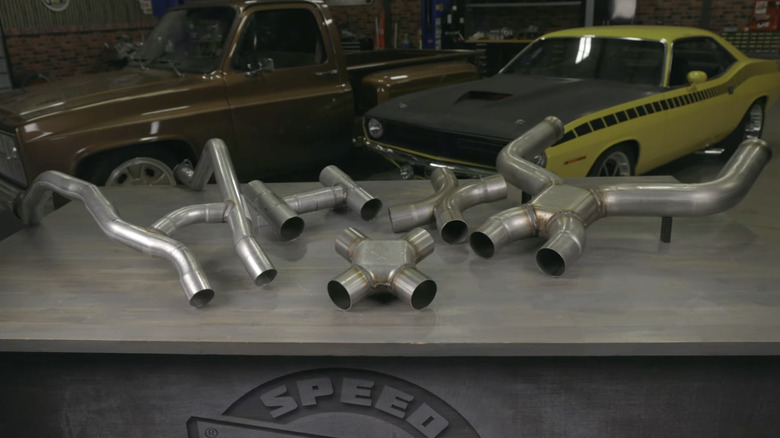
As recently as the 1950s, only a select few American automobiles were available with a dual exhaust system. Over the course of about a decade, that all changed with the emergence of the muscle car. To wit, the 1964 Oldsmobile 442, which was short for four-barrel carb, four-speed manual, and dual exhaust. Dual exhausts are most often found on V-type engines, like the V6 and V8. Each bank of cylinders, the left and right, has its own exhaust pipe that runs front-to-back.
The benefit of a dual exhaust system is that it allows spent gases to exit more freely. This means that dual exhaust systems can help reduce backpressure while increasing horsepower and or torque. However, you can improve on a dual exhaust system by adding a crossover pipe. That is, a short section of pipe to connect the left and right halves of a dual exhaust system. In that way, pressure between the two pipes is equalized.
Contrary to what you might think, exhaust gases don't form a continuous stream. Instead, they're a series of pulses determined by the engine's firing order. A crossover pipe (a.k.a. balance pipe) smooths out variation in these pulses between one side of a dual exhaust and the other, which improves throttle response and power.
Initially, such crossover pipes were known as H-pipes because they looked like the capital letter H. In the 1990s, a more efficient type of crossover pipe gained popularity – the X-pipe. Modern X-pipes tend to offer slightly greater power gains. However, both types of crossover pipes come with pros and cons. Here's how to determine which is right for you.
H-pipes are ideal for deeper exhaust tones
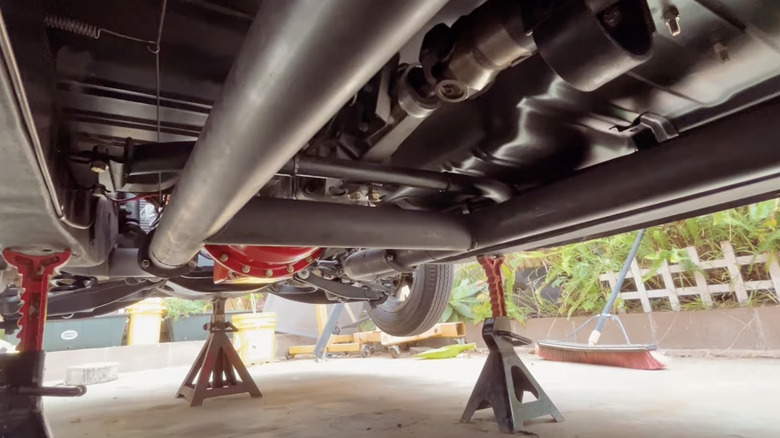
Of the two types of crossover pipes, the H-pipe is simpler. An H-pipe looks like a short length of tubing installed between the left and right halves of a dual exhaust at 90-degree angles, forming the letter H. You can build an H-pipe crossover into a new exhaust system kit that you're assembling or having installed. However, an H-pipe's small size and simple construction also make it easy to retrofit one onto an existing aftermarket dual exhaust or your favorite factory exhaust system.
To improve an existing dual exhaust system with a H-pipe, it's simply a matter of selecting a location toward the front of a vehicle where it won't interfere with other components like the transmission or driveshaft. Because the H-pipe mostly facilitates the movement of sound waves while helping to equalize pressure differences between the two sides of the exhaust system, the H-pipe's diameter can be smaller than the primary exhaust tubing itself. For example, a 2.5-inch diameter exhaust might only have a 2-inch diameter H-pipe. That makes it easier to find a good location to install the H-pipe without hitting obstructions.
Installing an H-pipe is something any capable mechanic, tuner, or muffler shop will be able to facilitate. Additionally, DIY-friendly kits are available online with prices starting at less than $100. Besides improving performance, an H-pipe can enhance the sound of your ride by eliminating the drone that plagues some dual exhaust systems and highlighting deeper bass tones.
The X-pipe makes more top-end grunt
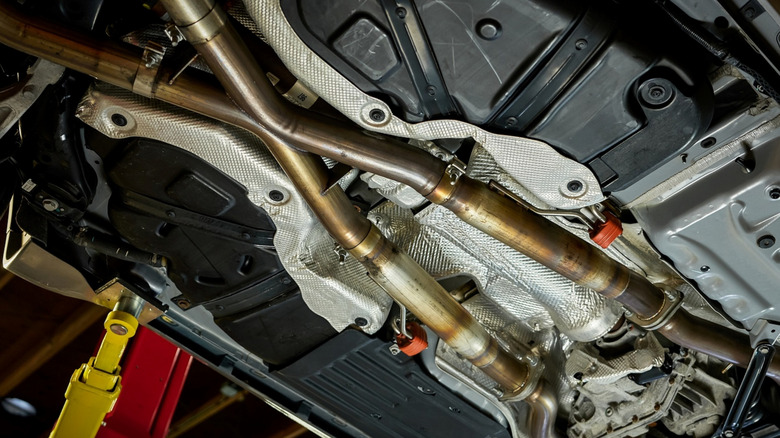
The other popular crossover pipe variation is known as an X-pipe. Spoiler alert — it looks like the letter X when you install it. Unlike an H-pipe, which acts as a simple conduit between the two halves of a dual exhaust, an X-pipe actually combines the two pipes into one for a small portion of the exhaust. X-pipes are larger than H-pipes and are fused together in a predetermined spot to form the X, making them more difficult to assemble and position around other mechanical components. That said, DIY-friendly kits are available and, while costlier than H-pipes, come at reasonable prices – around $150 from vendors like Summit Racing.
The reward for choosing an a X-pipe is more potential horsepower than with an H-pipe, particularly at higher RPM. The shape of the X-pipe leads to a venturi effect that actually draws exhaust gases from the engine more rapidly than the sharp, 90-degree bends of an H-pipe. That said, the increased backpressure that comes with an H-pipe isn't always a negative. It's actually better for making low-end torque, useful in normal street driving conditions. X-pipes also affect exhaust sound. Installing an X-pipe setup can cause the exhaust notes to stray away from that classic muscle car rumble and transform into a more high-pitched, European car sound. That could be a plus or minus depending on the driver's personal preferences.
According to Hot Rod, X-pipes are more efficient and can typically be expected to provide 2 to 4 more horses than an H-pipe. That said, installing either an X-pipe or and H-pipe will generally yield between 7 and 12 horsepower, depending on the car.