

No Wheel Chock? Here's How To Tie Down A Motorcycle To A Trailer In A Pinch
Riding a motorcycle is arguably the best mode of transportation. Even so, there are situations where swinging a leg over your two-wheeled machine isn't optimal, but you still need to transport it. And whether you're experiencing mechanical breakdowns, the weather isn't suitable for a ride, or you want to go RV camping but still have fun on two wheels when you get there, certain procedures are necessary to do so safely.
Securing your bike to a trailer or truck bed typically includes straps and wheel chocks. There is a right way and a wrong way to tie down a motorcycle, but what if you don't have wheel chocks? There's room to improvise and substitutes are plentiful, but there are things you should be mindful of if you're planning to transport your motorcycle without them.
We want to emphasize that this is a last-resort option. You should really use proper wheel chocks or think about buying some if you don't already have some.
Securing a motorcycle without wheel chocks
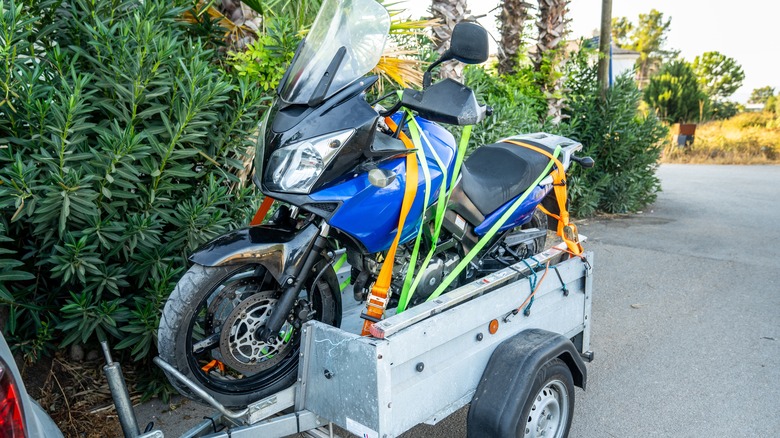
After loading your bike on the trailer or truck bed, the most important thing is to ensure it doesn't move excessively. Minimizing the movement is crucial for safe transportation. Without wheel chocks, the motorcycle will rock back and forth as you accelerate or decelerate. And make sure the engine isn't running. Certain motorcycle engines, like Harley-Davidson's V-twins, have a lot of vibrations, which may loosen the straps, and the hot exhaust could melt a strap that passes over it.
Wheel chocks are wedge-shaped blocks made of sturdy materials, designed to hold wheels in place. Technically, anything with the appropriate shape can serve as one. Just make sure it's made from a sturdy enough material to support the motorcycle's weight. Moldy planks that happen to be wedge-shaped would not suffice as they lack structural rigidity and may crumple under a vehicle's weight. (If you're wondering, there is a whole different set of procedures you need to follow when transporting your motorcycle with an RV.)
Important procedures when transporting your motorcycle
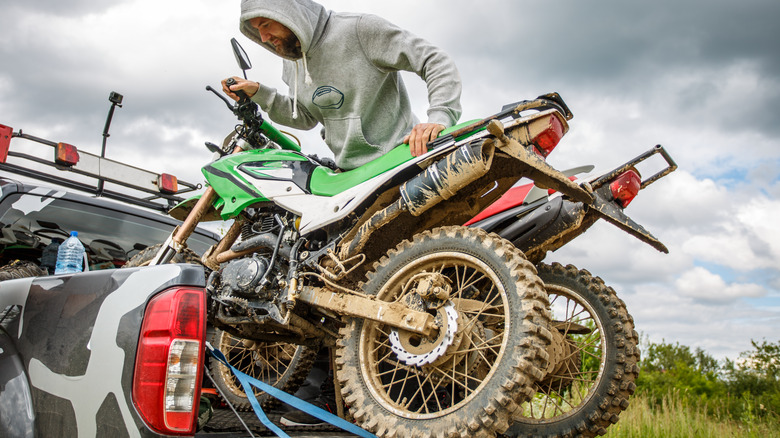
Securing your motorcycle with straps is a must, especially if you're not using proper wheel chocks. Choosing the anchor points for the straps is just as important. You want to secure them to the ends of the trailer or the fixture points on your truck bed. Use no less than four ratched straps, as this creates a stable four-point tie-down system, with the straps at a 45-degree downward angle. Avoid attaching them to anything like brake lines that might break easily. Additionally, you can wrap soft straps around both handlebars to stop the front end from moving around.
If your motorcycle is secured the right way, there shouldn't be any slack in the straps, and your ride should remain still even if you give it a gentle shake. For peace of mind, you can drive around the block and take a few turns to test if you've succeeded in strapping your motorcycle down for transportation. It may sound a fair bit more complicated than transporting a car, but follow these steps, and you should be good.
Remember, though, a motorcycle is only as secure as its wheels, so try not to forget those wheel chocks. At the end of the day, the most important thing is for your bike to survive the trip, to be ridden another day. Just make sure you know which states allow lane filtering if you are traveling away from your region.