

What Makes Older V8s Sound Better Than Modern V8s?
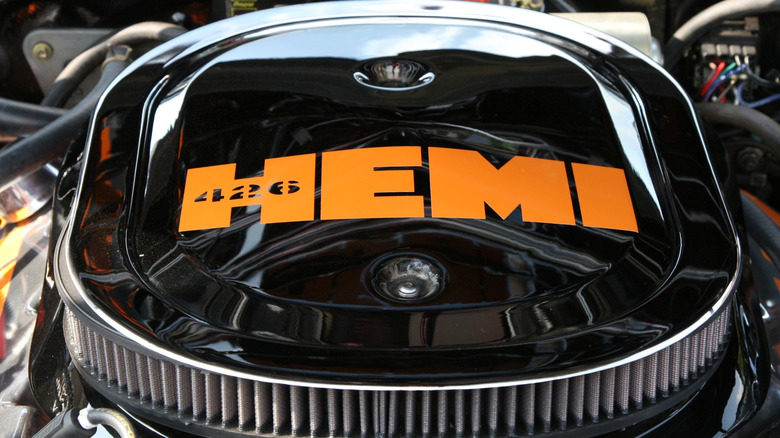
If you believe that older V8s sound better than modern versions, it could be due to a few legitimate reasons. That said, enthusiasts can also have dramatically different tastes, and what sounds "better" to one could be vomit-inducing to another.
Claiming old V8s sound better than modern V8s is largely a generalization. There are outliers, and contemporary manufacturers certainly work on tuning the sound of performance-oriented V8s to be as exciting as possible. However, as engine technology evolved over the last 50 years, so did exhaust notes. We're going to largely ignore flat-plane crank V8s, as exciting as Ferrari 458s, C8 Corvette Z06s, and Shelby GT350s sound. The goal here is an apples-to-apples comparison, and flat-plane crank V8s are relatively uncommon.
First, let's define old and modern V8s and outline what impacts their sound the most. For this discussion, we'll say our old V8 uses carburetors, solid lifters, zero smog equipment, an H-pipe dual exhaust, a single-profile lumpy camshaft, no forced induction (turbocharging or supercharging), and sits in a car with little insulation. As for our "modern" V8, we'll give it electronic fuel injection, hydraulic lifters, an emission control system, X-pipe exhaust (or even active exhaust), variable valve timing, and forced induction, and we'll install it in a car with sound-dampening insulation.
Plenty of hot, noisy air
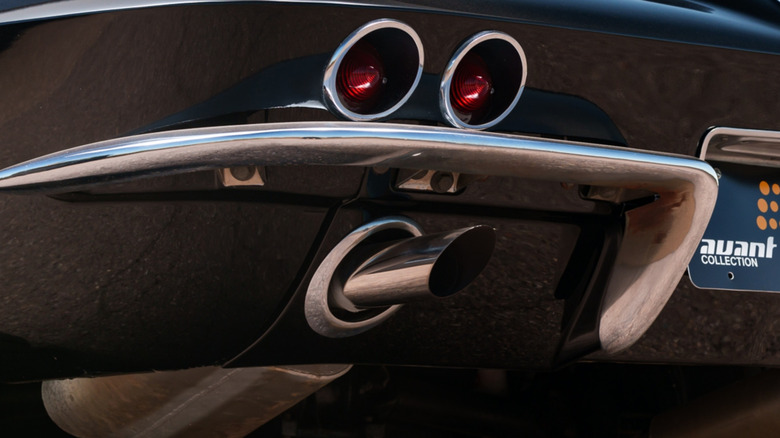
The way air travels into and out of the engine is responsible for the vast majority of a car's sound. You may get more mechanical noise from an old V8, particularly one with solid lifters, but the biggest tonal change between a vintage and modern-era V8 is what's happening after the spent gases leave the combustion chamber. In, say, a 1967 427 Corvette, the path of the exhaust is fairly simple — exhaust manifold, then pipes, then mufflers, and then exhaust tips. There wasn't even an H-pipe to cross over the gases.
Step over to a modern V8, and there's a lot more stuff between the engine and the end of the exhaust. There's a catalytic converter and possibly an Exhaust Gas Recirculation (EGR) system, which routes some exhaust gases back to the intake. Those components are followed by a set of mufflers, maybe an X-pipe for crossover (which emphasizes high frequencies over low), perhaps a set of resonators to prevent droning, and, finally, the exhaust tip(s). If the engine is turbocharged, the turbines are going to soak up some sound. However, supercharged V8s are in a whole other ballpark, because they create a thrilling whine that can usually be heard in neighboring counties.
If you hop into, say, a modern C8 Corvette with the optional active exhaust, either you or the computer can decide to open some valves in the exhaust system to improve sound and performance. However, there will still be tonal variations between these modern cars and vintage 'Vettes.
Carbs, cams, and quiet cabins, oh my!

Over time, and as manufacturers ditched carburetors, engine air cleaners moved farther away from the engine. For a modern V8, that means induction noise is usually reduced, even with less restrictive intakes. Carburetors are also finicky devices. Unless you hire a Swiss watchmaker to keep yours in tune, carbs can contribute to a rough idle that, while not optimizing emissions or performance, is like a tiger growling when some poor soul tries petting it.
Vintage camshafts were also just solid, single-profile bumpy sticks. More power generally meant a more aggressive grind and a choppy idle. With variable valve timing, it's like getting a cake that makes you lose weight yet still tastes good. You can have a smooth idle with little vibration, along with a more aggressive profile at higher rpm for more power. Combine that with the steady, perfect fuel delivery of an electronic fuel injection (EFI) system, and suddenly that uneven, popping idle is gone. Finally, engine noise is only endorphin-inducing if you can hear it. Modern cars have tons of insulation, and, unless the engineers pipe in the noise somehow, the car will run quieter.
Now, this brief examination relies on some generalizations, of course. Modern V8s can sound great if they're tuned that way. The Mercedes-AMG 6.2-liter M156s, the Lexus LC 500 2UR-GSEs, and the Mustang GTD's menacing, supercharged 5.2-liter V8 all sound incredible.
It's just that the analog technology of yesteryear tended to make V8s temperamental, and there was usually less equipment between our ears and the combustion chambers. In other words, they felt more alive, which made us feel more alive.