

These Rare Pontiac Trans-Ams Had Vinyl Roofs
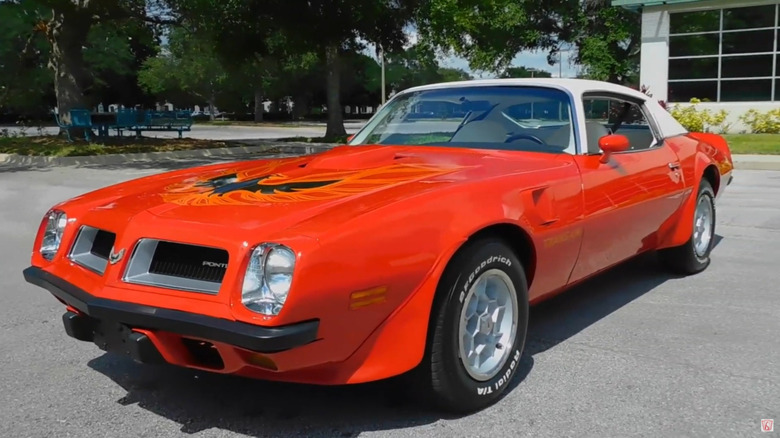
Pontiac was a bastion of performance during the last days of the muscle cars from 1972 to 1974. While other brands made do with strangled, low compression engines, Pontiac figured out how to sustain the glory days for a little longer. In 1972, Pontiac's 455 HO was making 300 SAE net horsepower, a figure tied only by Oldsmobile's W-30 455. Chrysler's 440 Magnum sat at 280 horsepower, Ford's 351 HO gave 275, and both Chevy's 454 and Buick's Stage 1 455 maxed at 270.
Pontiacs didn't just have acceleration, they had style, too, thanks to RPO code C08. Checking that code selected the vinyl "Cordova" roof on a Firebird, Esprit, or Formula model/trim. For a Firebird or Formula, the cost was $87, while the same roof on an Esprit only demanded $72. However, if you bought a Trans Am, then no Cordova roof for you. The problem was, ever since the limited production 1969 Pontiac Trans Am debuted, they had cool looking stripes down the center of the car and the Cordova vinyl roof interfered with the aesthetic.
Then, in 1973, the stripe went away, and Pontiac figured it might as well offer the Cordova roof for the 1974 model year Trans Am. Finally, you could make your Trans Am look like it had a convertible roof when it actually didn't. No, seriously, that was one of the main selling points of vinyl roofs at the time.
Order your 1974 455-SD screaming chicken with a vinyl top
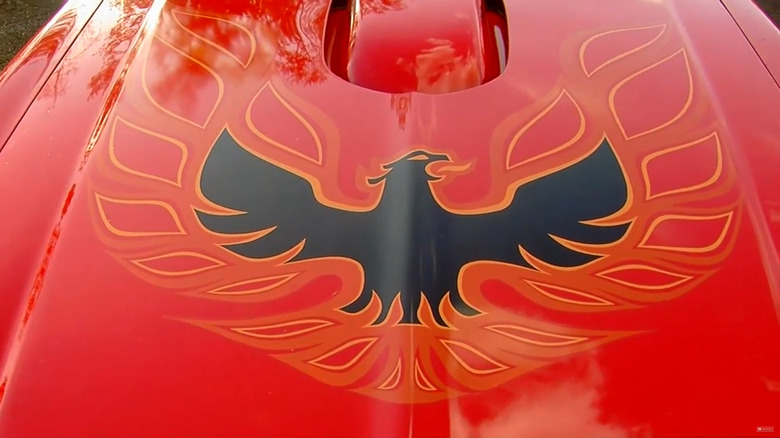
In 1974, 14,198 buyers wanted a vinyl-roofed Firebird. Some Trans Am buyers ordered the best combination of ironically and unironically awesome options available for '74 Firebirds, including a vinyl roof and RPO WW7, which selected the "Trans Am hood decal", also known as the "Rising Phoenix" or, more awesomely, the "Screaming Chicken", which Pontiac designer Bill Porter based on some ostentatious Tiffany vases.
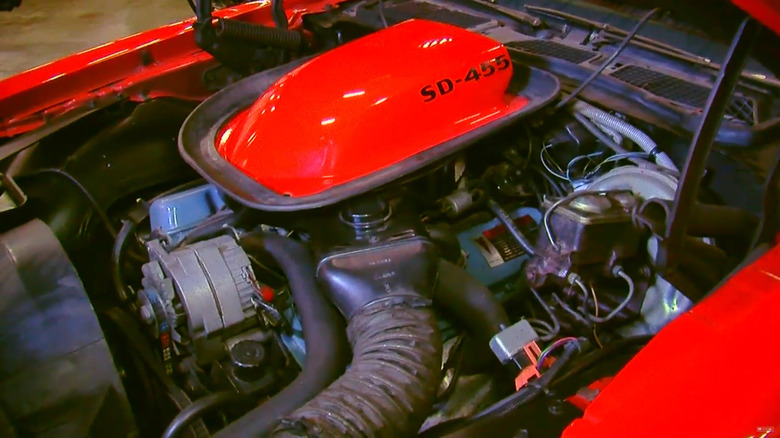
The option that made the 1974 Trans Am the muscle car of choice, in addition to the vinyl top, however, was RPO code 35X: the Super Duty 455. In 1973, when the SD-455 debuted, it made 310 net horsepower, and no other domestic muscle machine could touch it. Pontiac gave that motor everything it could, including forged pistons, forged steel connecting rods, four-bolt main caps, special treatments for the iron crankshaft, a cam with the same profile as the old Ram Air IV, and provisions for a dry-sump oiling system.
In 1974, the cam had to get less lumpy for emissions regulations, so Pontiac switched to the one used in manual transmission Ram Air III engines, dropping horsepower to 290. Even with all this extravagant hardware, the heads may be the most glorious part. Their ports were large enough for a toddler to crawl through and moved more air than the big bad wolf blowing down straw houses. This engine is a testament to Pontiac's engineers. Not only did they avoid having to subject the engine to a 50,000-mile durability certification test by basing it on an existing engine that already passed the testing, but they managed to get peak-muscle-car-era power with 8.4:1 compression.
The glory days wane for the 1975 vinyl roof Trans Am
You can argue about superior years, but almost no one would say American muscle peaked anytime between 1972 and the '80s. Most of the high-compression, tire-boiling performance engines bowed out by 1971. That was the last year for the 426 Hemi, LS6 454, and 429 Cobra Jet (a few 1972 440 Six Pack cars made it out, though). Manufacturers expanded options to try to keep cars interesting. LT-1 Corvettes got air conditioning in 1972 after GM figured out how to keep the belt from popping off. Chevrolet made Chevelle SS454 station wagons in 1973, the same year certain Oldsmobile and Chevy models got swiveling front seats to aid ingress and egress. AMC made a Gremlin with upholstery that looked like Levi's denim jeans.
For serious performance at the time, you had three options. One, go to the specialty dealers like Baldwin Chevrolet, which was still selling dragstrip-punishing Baldwin-Motion cars, or Randall AMC, which would stuff a 401 in your Gremlin. Two, modify your car yourself. Three, go to Pontiac. Then, in 1975, EPA regulations and market forces finally eliminated 454 Corvettes, 440 Dodge Chargers, 401 AMC Javelins, the entirety of Baldwin-Motion, and even the mighty Pontiac 455-SD.
But hey, Pontiac Trans Ams could still get that upscale padded vinyl roof with RPO code C09 for $99. After the Super Duty ended, Pontiac's top engine option was a 455 with 7.6:1 compression and 200 horsepower. As pitiful as that sounds, it was better than the Corvette's base 165-horsepower 350 or the Hurst Oldsmobile's 190-horsepower W30 455. To fans of old school muscle, Pontiac was still a shining beacon. Specifically, a beacon with an optional slick vinyl roof.