

Airbus A350 Vs. Boeing 787: The Main Differences And How To Tell Them Apart
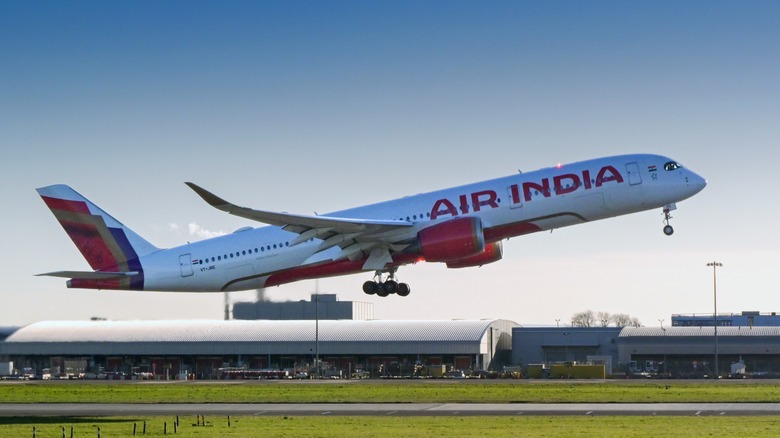
At this stage in the aviation game, there are really just two major players when it comes down to global manufacturing of commercial jets. That's Airbus, with a main office in Blagnac Cedex, France, and Boeing, which was born in Seattle but now has its main office close to Washington, D.C., in Virginia. Maybe that's why the U.S. won't ditch Boeing for Air Force One. Then again, competition is fierce on most fronts. Just consider the two companies' flagship long-haul jets, the Airbus A350, which may soon let a lone pilot fly from the toilet, and the Boeing 787 that can leave pilots disconnected from air traffic control.
Both have helped change the very nature of long trips, as they each rely on a pair of jet engines instead of the four-jet setups more popular in the past. The result has been a welcome bump in fuel efficiency, which not only saves money but also has unlocked more long-distance routes. The A350 and 787 also share plenty of modern tech and design cues — but not all of them.
Right off the bat, the A350 is a larger plane: Exact measurements depend on the variant is under discussion, but the Airbus models tend to be longer than their 787 counterparts, with a wider wingspan, more passenger capacity, and a longer range. They look different, too, especially if you know where to look. It's features like wings, windows, and engine nacelles that offer tell-tale signs of which is which.
The 787 and the A350 have different faces
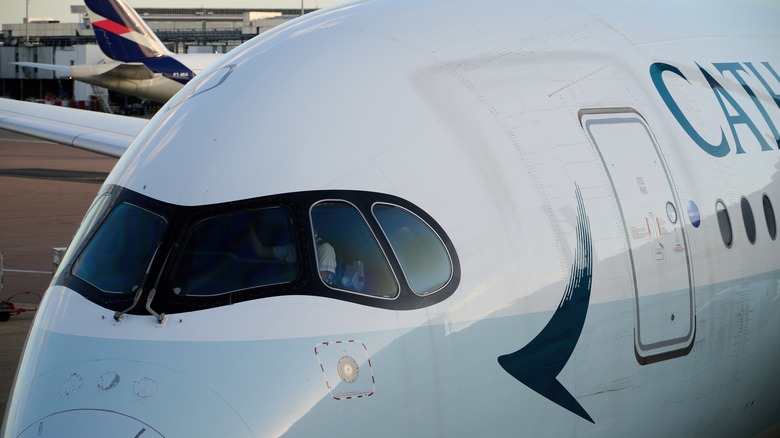
Let's do this logically by beginning at the beginning: Telling these two airplanes apart is a breeze when you're looking at their faces, thanks to the differences in their cockpit windows. The A350 has six windows shaped in a way that the plane seems to be wearing a black bandit's mask. The arrangement helps the glass fit the nose better, for enhanced aerodynamics, and the tint helps with keeping the cockpit cool and reducing maintenance costs. In terms of the nose itself, it's smoothly rounded in a way that helps it cut through the air with the least amount of drag and turbulence.
Boeing, on the other hand, leveraged the high-tech composite structure of the 787 to allow for fewer but larger cockpit windows, giving pilots a great view out of just four large panes of glass. The windows then flow into a longer, sharper nose with a noticeably steeper downward angle that creates a noticeably pointier appearance. With the way the cockpit integrates with the nose, some folks think it gives the 787 the appearance of a Japanese bullet train.
The Airbus A350 and Boeing 787 have different engines

One thing that sets the two jets apart is their actual jets. Although both the 787 and A350 went into development about the same time, the former went into service a few years before the latter — with new Rolls-Royce Trent 1000 engines built specifically for the Boeing. And to say they had teething pains would be putting it mildly. Broken turbine blades and high maintenance costs were a specialty, and Boeing began to also offer customers a second choice, GEnx-1B jets from General Electric. The bottom line is a maximum 787 range of between 7,305 and 8,785 nautical miles, depending on the plane's exact configuration.
Under its hood — er, wings — the A350 carries a pair of Rolls-Royce Trent XWB jets that basically took what Rolls learned from the Trent 1000s many problems and incorporated the fixes. Touted by the manufacturer as being the "world's most efficient large aero-engine in service," it delivers plenty of punch as well, with the XWB-97 good for 97,000 pounds of thrust in some Airbus 350 variants — and the ability to fly 9,700 nautical miles in the Ultra Long Range model.
The A350 and 787 have different wings and engine nacelles
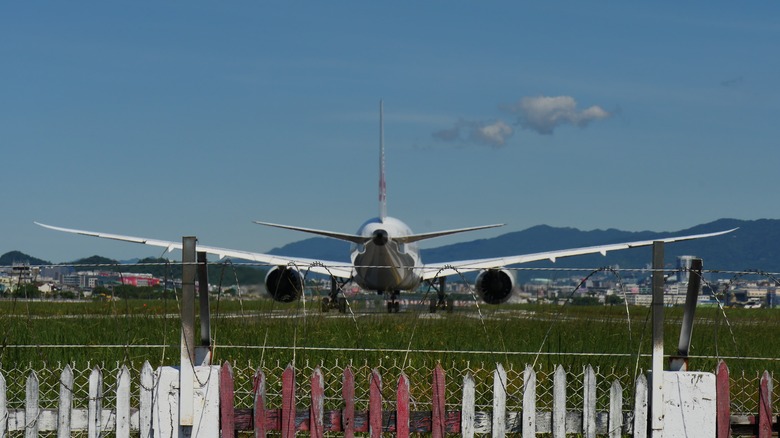
A combination of style and functionality inform differences in the two jets' wings, along with the engine nacelles hanging from their wings. As for the wings themselves, Boeing and Airbus followed different concepts to help improve aerodynamics, and that shows up in the way things look. The 787s entire wings form a noticeable upward curve as they extend outward to give the plane a unique appearance that can become even more dramatic when the wings flex — up to 25 feet — when in flight. (Although they may not be quite as dramatic as Boeing's 500-foot-wingspan plane). Anyway, the A350, in contrast, has separate winglets to help improve its efficiency through aerodynamics.
Finally, despite the difficulty of seeing the jet's engines themselves, you can distinguish between the two airplanes based on their engine nacelles. They're the smooth and aero-friendly housings for the engines, and the ones used by Boeing have a distinctive sawtooth pattern. The triangular pieces, called chevrons, help to cut down on engine noise without the need for extra insulation — which, again, is a weight-saving measure aimed at increasing efficiency.
The Boeing 787 is a 'more-electric' airplane
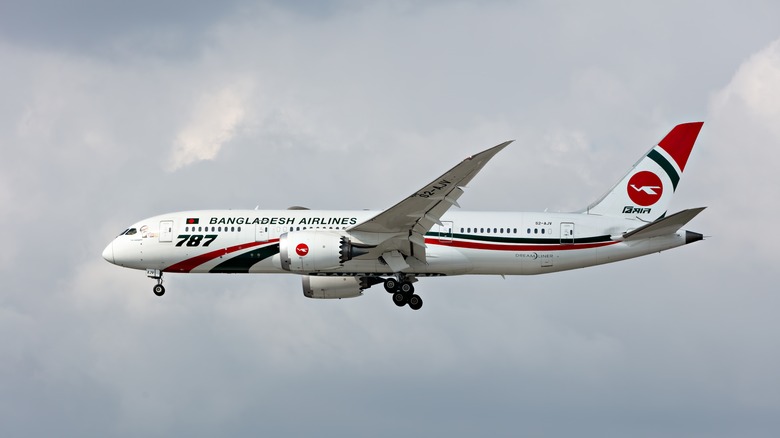
Another major mechanical difference between the two airplanes is their control systems. The 787 is a "more electric airplane" — that's a real term — which seeks to replace heavy pneumatic and hydraulic systems with lighter-weight electric controls wherever possible for more efficiency. It's a technology Airbus has yet to adopt.
A great example of this strategy can be seen in the 787's bleedless air system. The typical modern jet bleeds air from its engines — basically rerouting it from the engine air compressors and uses it for things such as running the HVAC system, de-icing, powering other hydraulic/pneumatic systems, and keeping the cabin pressurized — which is obviously crucial because here's what happens when a plane suddenly depressurizes.
This setup can be effective, but it also requires an expensive, heavy, and complicated system of ducting that requires extensive maintenance. So Boeing replaces all that by using engine-mounted generators to power electric air compressors that don't have all that baggage. (Note that despite its name, Boeing's bleedless system does use bleed air for helping keep engine cowls free of ice and making sure the hydraulic reservoir remains pressurized).
A quick cockpit comparison
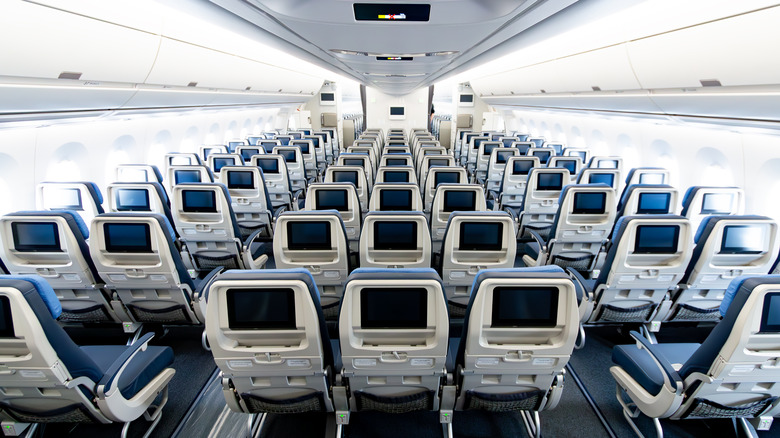
Big windows are a big deal in the 787, and not just for the cockpit. In the cabin, passengers will be able to take in the view through windows that are approximately 65% larger than those in typical aircraft. They also have an electronic dimmer function, although some airlines have gone back and installed more typical window shades to meet customer preferences.
Airbus, for its part, gives passengers more space to stretch out. Well, "stretch out" may pushing things, but the A350 seats do have roughly 1/2-inch more width than those in the 787, and — anecdotally — that does improve comfort, especially on long-haul flights. Most A350s don't have dedicated first-class seating, however.
In addition, the Airbus A350 is exceedingly quiet, with lower levels of ambient noise than the fairly hushed 787. You can chalk that up to Airbus' Automatic Noise Abatement Departure Procedure (NADP) that adjusts the aircraft's thrust levels and flight path to keep things quiet. The noise level at the A350's usual cruising altitude is a bare 57 decibels, which is below the level of a normal conversation (according to Yale).