

Should You Cross Your Trailer Safety Chains? The Pros And Cons
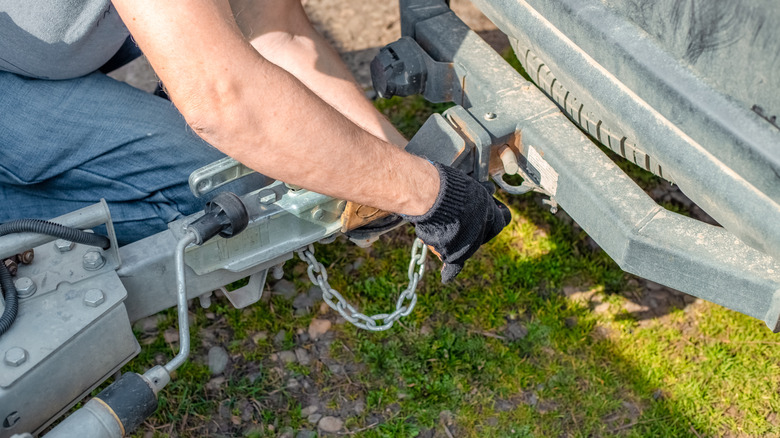
Sigh. Yes, of course you should cross your trailer's safety chains under its tongue, if possible. That's the way they're intended to be used, and in fact, it's the law in many areas. If we left the answer at that, however, this would be the shortest Jalopnik article ever, so let's take a deeper peek at the how and why behind trailer chain best practices.
Safety chains can be found on towables of all types, such as camping trailers, boat trailers, or U-Haul's new supersized car hauler. Their obvious function is to keep the trailer attached to its tow vehicle in the event that the primary coupling method fails. For example, if there's a breakage or accidental uncoupling between your vehicle's hitch ball and the trailer's coupler, the trailer will stay linked to the tow vehicle while you move to a safe area, like the road's shoulder.
Seems simple enough, right? Trailers typically have a safety chain located on each side of the coupler, with a corresponding hole or loop on the vehicle's hitch. It might be tempting to just hook each safety chain to the loop directly in front of it — that would, after all, keep the trailer attached to the vehicle if the hitch ball/coupler connection fails. But it doesn't take into account that the coupler could fall between the chains and contact the pavement, creating a dangerous, out-of-control hazard. Put simply, crossing your safety chains in an "X" pattern provides a cradle to catch the coupler.
The cons are almost nonexistent
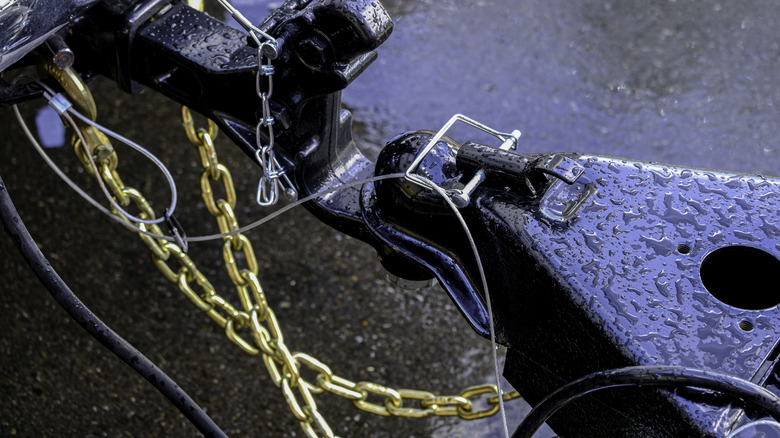
For commercial vehicles, the Federal Motor Carrier Safety Administration (FMCSA) Section 393.70(d) dictates, "The safety device must be connected to the towed and towing vehicles and to the tow-bar in a manner which prevents the tow-bar from dropping to the ground in the event it fails or becomes disconnected." However, that's good advice for all who engage in towing anything.
If there's any drawback to crossing your trailer's safety chains, it's that they may be too short. Although they may technically reach their holes on your trailer hitch, you'll want enough slack to prevent binding when making sharp turns (such as when backing a trailer in tight quarters, especially if you've never done it before). If the chains are indeed too short, they can either be replaced with longer ones or lengthened with additional chain and/or threaded link(s) with an appropriate strength rating.
Finally, what if you can't cross your safety chains? On some trailers, the two chains originate from the same point of the coupler, forming a "V" shape when connected to the tow vehicle. In this writer's opinion, that's not a great design and one that will require considerable modification to remedy. With any luck, that type of arrangement will have shorter chains to prevent the trailer tongue from gouging the pavement if it becomes detached. In summary, do cross safety chains if you're able, and for an extra modicum of insurance, consider a hook with a clip, clasp, or other mechanism to prevent the end of the chain from bouncing out of the trailer hitch's hole.