

How Many Airbus A380s Are Still In Service, And Which Airlines Fly It?
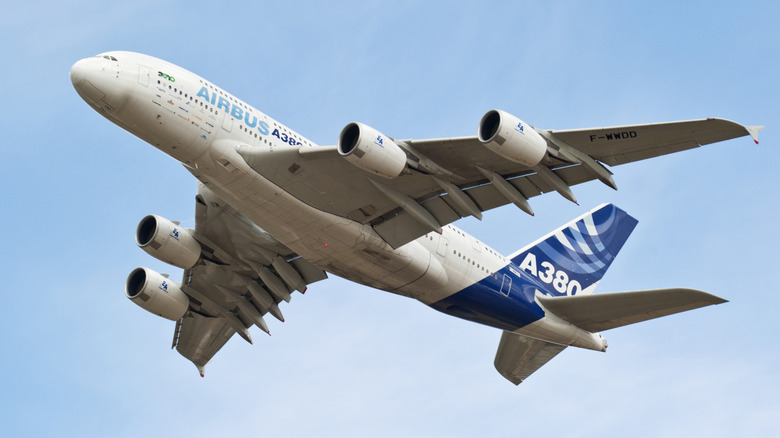
In August 2025, Jalopnik published an article about why the Airbus A340 widebody jet has four small engines instead of two larger ones. In the comments section, one reader astutely pointed out, "[It's] kind of amusing that Boeing and Airbus each built only two models of 4-engine jet airplanes, but Boeings were both bases-loaded home runs, and Airbus' were both commercial flops." The referenced Boeing aircraft are, of course, its groundbreaking 707 and double-decker 747, both of which were runaway successes (some airlines still fly the latter to this day).
Over at Airbus, the C-suite execs failed to recognize that the ever-increasing extended-range twin-engine operational performance standards (ETOPS) would render its four-engine A340 outdated almost at the time of launch. Much of that last sentence is also applicable to the brand's A380, with the added burden of being freakin' humongous and expensive to operate. The A380 made its inaugural commercial flight in 2007. In total, 251 aircraft were built, with the last unit completed in 2021.
Nowadays, approximately 189 of those 251 aircraft are still in operation. Interestingly, no United States-based airlines opted to purchase this jumbo-est of jumbo jets. In hindsight, that was a wise decision, but it means that experiencing the novelty of flying on the largest commercial passenger jet requires travel to or from the countries with carriers that operate them. Currently, there are 10 airlines to select from.
These airlines still fly the A380
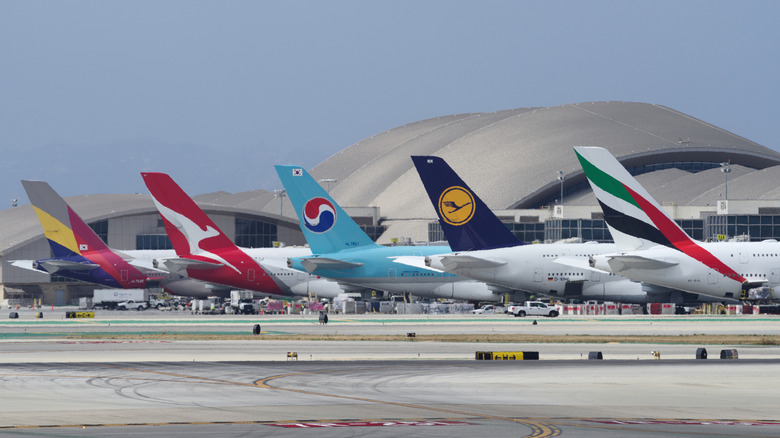
Without further ado, here's the list of current A380 operators as of August 2025. We've also included where each airline is based, plus the number of A380s either owned or leased by that airline. This information was obtained from the aviation database planespotters.net and is believed to be accurate at the time of writing. That said, airline fleets are perpetually in a state of flux, so don't shoot the messenger if we're off by a jumbo jet or two. Finally, note that not all flights operated by these airlines will feature the A380 — it's only on select routes.
- Emirates, Dubai: 116
- British Airways, United Kingdom: 12
- Qatar Airways, Qatar: 10
- Singapore Airlines, Singapore: 10
- Qantas, Australia: 10
- Lufthansa, Germany: 8
- Korean Air, South Korea: 7
- Etihad, United Arab Emirates: 7
- Asiana Airlines, South Korea: 6
- All Nippon Airways/ANA, Japan: 3
When added together, the above list totals 189 of the A380 jets that are still in service. Recall that Airbus originally manufactured 251 of this model, and between 20 and 30 units are known to have been scrapped. That leaves a few dozen of the giant jets unaccounted for, at least some of which are in long-term storage. On a positive note, a few of these parked jets have been restored to service after sitting for 1,000 days.
It's luxurious, but expensive to operate
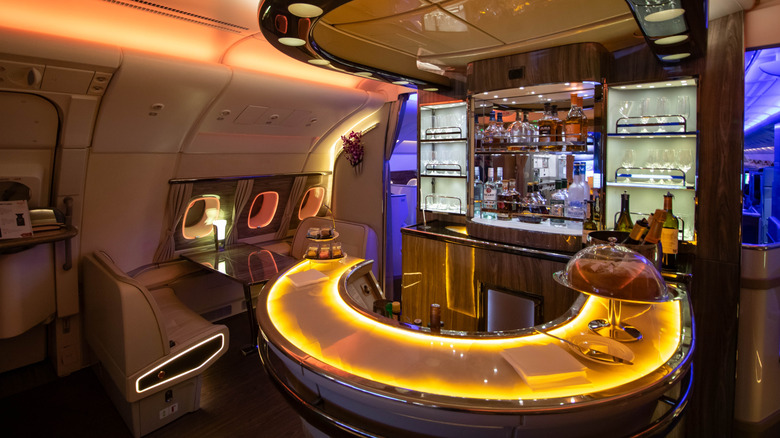
To be fair, passengers love the A380. Like Boeing's 747, the A380 has accommodations spread out across two passenger decks, but unlike the 747, the A380's upper deck extends the full length of the aircraft and isn't just a hump over the cockpit. For travelers in premium cabins like business class and first class, that extra space translates into onboard cocktail lounges and, in some cases, a multi-room "residence" in lieu of a seat, plus a shower suite to freshen up at 30,000 feet. Not just spacious, the A380 also has an excellent safety record with zero crashes or hull-loss incidents.
In spite of those positive attributes, the A380 is extremely expensive to operate. Like Airbus' ill-fated A340, it has four engines that guzzle costly Jet A fuel. Depending on how each jet is configured, the A380 holds about 500 passengers in mixed cabin classes or more than 850 flyers in all-economy. That huge number of passengers also requires a huge number of crew members — frequently more than 20.
Finally, not every airport can accommodate the A380's million-pound takeoff weight nor deplane its 500-plus passengers, which requires multiple jet bridges — one leading to the upper deck — to be done expeditiously. The list price of the A380 is about $450 million but is so unpopular with airlines that it frequently sells for more like $30 million nowadays, or even less if sold for a lengthy recycling process.